
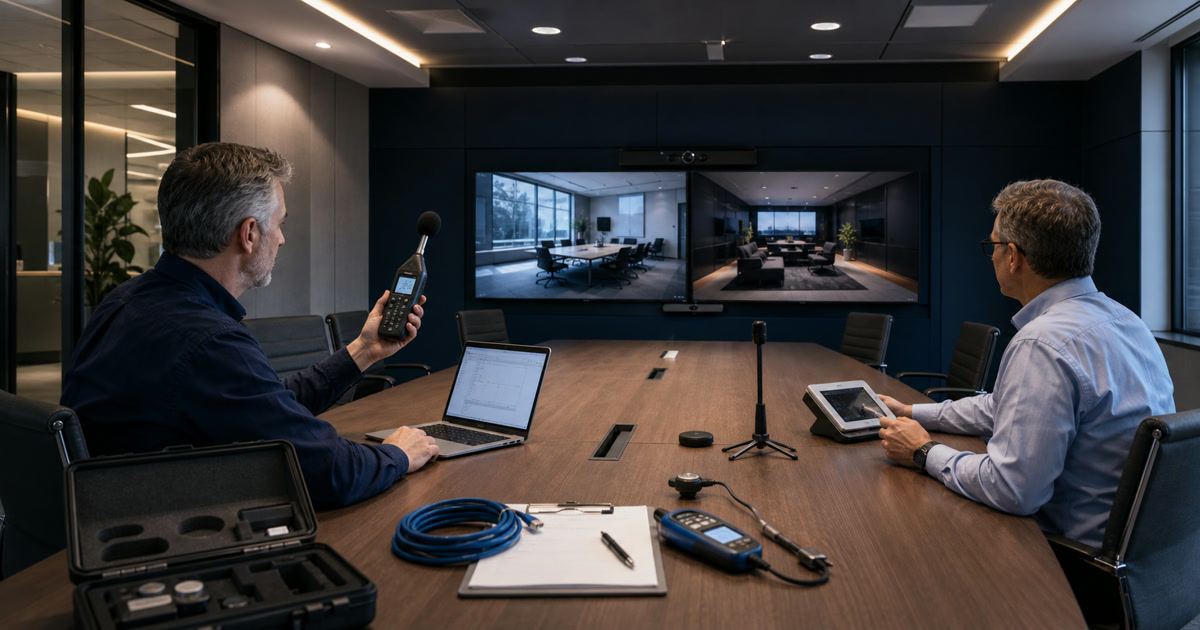
Picture the end of a room handover: a demonstration. The display wakes. The camera finds a face. A test call connects, someone signs a form, and the project closes.
That sequence proves the equipment is present. It does not prove the room can carry the work the organization put it there to do.
The gap shows up later. A meeting joins but the second display stops following content. An exam room transcribes well until the air handler runs. A classroom looks bright from the front and unreadable from the back row. A chamber streams cleanly and archives a file that omits public comment.
Acceptance testing closes that gap. The method below is deliberately not specific to one platform, one manufacturer, or one kind of room.
What an acceptance test has to settle:
| Decision | Where it lands |
|---|---|
| Which verification items apply | Selection is the work; very few projects use all 160, and the standard provides the process for choosing |
| What each item measures | A metric, a procedure and a reporting rule — or it is not testable |
| Who sets the limit and who checks it | Two different roles, named before installation |
| When verification happens | Distributed across four reporting phases; a report may be issued at any one of them or at all of them |
| What the report says | Written before the work begins, so criteria cannot describe whatever was installed |
Key Takeaways
Acceptance testing has a published framework. ANSI/AVIXA D402.02:2013 (R2024), Audiovisual Systems Performance Verification, defines how to select verification items, when to verify, how to set criteria, and how to report (AVIXA, retrieved 2026-08-20).
The standard lists 160 reference verification items across 13 categories, and states that “Very few projects will use all 160 reference verification items. The Standard provides the process for deciding which items to include.” (Audiovisual Systems Performance Verification Guide, InfoComm International, 2014). Selection is the work.
A usable verification item needs three parts: a statement of what is being verified, a metric where measurement applies, and a rule for what gets reported.
Verification is distributed across four reporting phases. A report may be issued at any one of them or at all of them.
The same method applies to a meeting room, an exam room, a classroom, a council chamber, and a dispatch floor. The items change; the structure does not.
On this page
- What an Acceptance Test Actually Is
- Selection Is the Work, Not the Testing
- Every Item Needs a Metric, a Procedure, and a Reporting Rule
- Name Who Sets the Limit and Who Checks It
- Verify Across the Four Reporting Phases
- The Meeting Room: Verify the Journey, Not the Join
- The Exam Room: Verify What the Microphone Can Hear
- The Classroom: Verify From the Farthest Seat
- The Council Chamber: Verify the Record, Not the Livestream
- Rooms That Cannot Be Taken Out of Service
- Write the Report Before the Work Begins
- Turn One Verification Into a Reusable Standard
- The Rooms This Method Is Applied To
- Take the Item Template Into the Project
- What to Do With This Method
What an Acceptance Test Actually Is
An acceptance test is a documented claim about a room that someone can check.
The framework already exists in published form. The current standard is ANSI/AVIXA D402.02:2013 (R2024), formerly numbered ANSI/InfoComm 10:2013. The full published standard controls conformance; nothing in this article substitutes for it.
It “provides a framework and processes for determining elements of an audiovisual system; the timing of verification; a process for determining verification criteria/metrics; and reporting procedures” (AVIXA, retrieved 2026-08-20).
The standard is a paid document for basic members, and free to premium and elite members. AVIXA also publishes a free companion guide describing the same structure in detail. That guide is the source for the item examples below.
The unit of work is the verification item. Categories follow how a system functions. Each item carries a unique three-digit number “that cannot be altered, to establish a common numbering language for the entire industry” (Audiovisual Systems Performance Verification Guide, InfoComm International, 2014).
The 13 categories cover more than picture and sound:
- Audio System Performance
- Video System Performance
- Audio/Video System Performance
- Cable Management, Termination, and Labeling
- Control System Performance
- System and Record Documentation
- Electrical
- Information Technology
- Operations and Support
- Physical Environment
- Physical Installation
- Serviceability
- Wireless
Four of those categories describe things the demonstration at the top of this article did not touch. Documentation, serviceability, operations, and physical environment decide whether the room stays working after the integrator leaves.
Selection Is the Work, Not the Testing
The guide is blunt about scope: “Very few projects will use all 160 reference verification items. The Standard provides the process for deciding which items to include.”
That sentence contains the practical lesson. Writing an acceptance test is mostly an exercise in choosing what matters for one specific room.
A short selection method:
- Name the tasks the room must support, in the words of the people who use it.
- List the ways each task could fail without anyone noticing at handover.
- Choose verification items that would catch those failures.
- Add items for anything that must survive a power cycle, a nightly reboot, or a staff change.
- Add items for anything the organization would need during a dispute or an audit.
The list is also not a ceiling. The guide states that the reference items are “not meant to be all inclusive” and that in-house items “can be easily incorporated into the processes defined by the Standard.”
Rooms with obligations attached are where the additions matter. A room that produces a legal record, supports a clinical conversation, or serves an emergency function carries requirements the reference list does not attempt to cover.
A worked example makes the method concrete. Take a mid-sized training room used for instructor-led sessions and occasional recorded content. The room below is illustrative, not a project VIcom has delivered.
The tasks are teaching, showing detailed material, and capturing a usable recording. The silent failure modes are a recording that omits participant questions, a screen unreadable from the back, and a room that loses its configuration overnight.
That analysis points to a small set of items rather than a long list:
- Ambient noise, because it decides whether recorded questions are intelligible
- Image size against the smallest content the instructor actually projects
- Microphone coverage at participant seating, not only at the lectern
- Recovery of routing and audio settings after a scheduled reboot
- Delivery of configuration files and a named support owner at handover
Five verified items beat forty unverified ones. The list is defensible because each entry traces to a way the room could fail without anyone noticing on opening day.
Every Item Needs a Metric, a Procedure, and a Reporting Rule
A verification item that cannot fail is not a test.
Consider AP-112, Acoustical Ambient Noise. The item reads:
“Verify that the background acoustic noise levels within audiovisual spaces are within the required limits as detailed in the project documentation.”
It then states plainly that the item “shall require a metric to be verified.”
Three things make that item usable:
- A statement. What is being verified, in one sentence, tied to project documentation rather than opinion.
- A metric. A number and a limit. Without it, “the room is quiet enough” is a matter of taste.
- A procedure. AP-112 specifies that testing “should be performed under full normal working conditions for the building and during normal working hours.”
That condition is easy to lose. A room commissioned on a weekend, in an empty building, with the HVAC in a setback mode, has not been measured under the conditions its occupants will meet.
Written out, a completed item is short. The following shape is illustrative only. The limit, the method, and the acceptance threshold belong to the project documentation and to the acoustician or designer who sets them, not to this article and not to the standard’s reference list.
| Field | Entry |
|---|---|
| Item | AP-112, Acoustical Ambient Noise |
| Requirement set by | Project documentation, via the acoustician or designer |
| Metric | The limit named in that documentation |
| Procedure | Measured under full normal working conditions for the building, during normal working hours |
| Reporting rule | Result, conditions, date, and the name of the person who measured |
| Phase selected for this project | The reader’s entry; the standard does not assign one |
The point is not the particular fields. It is that every row can be checked by somebody who was not in the room on the day.
The reporting rule matters as much. OP-100, a Software item, asks for verification that control code, DSP configuration files, and associated software were delivered. Its reporting note is procedural rather than technical: “Submit a list of all software with the signed documentation from the customer showing the software was received.”
An acceptance test that produces no artifact is a conversation. An acceptance test that produces a signed list is an asset.
Name Who Sets the Limit and Who Checks It
Verification items assume a division of labor, and a project that has not written it down does not have one.
AP-112 spells it out. “An acoustician, AV consultant, or designer specifies the maximum acoustical ambient noise limits to the architect, other consultants on the project, and the owner.”
A separate role then reports. “An AV professional prepares a report that informs the other parties of certain decisions about construction techniques, devices, and implementation of various aspects of the building services.”
The separation matters. The party that sets a limit and the party that certifies the limit was met should be identifiable, even when the same firm supplies both.
Three questions remove the ambiguity:
- Who owns the number, and in which document does it appear
- Who performs the measurement, and under what conditions
- Who accepts the result on behalf of the organization
Where regulatory or clinical review applies, that review belongs in the schedule rather than in the week after occupancy.
Verify Across the Four Reporting Phases
Verification is distributed across the project, not concentrated at the end. The standard defines four reporting phases. A report may be issued more than once, at any one of them or at all of them.
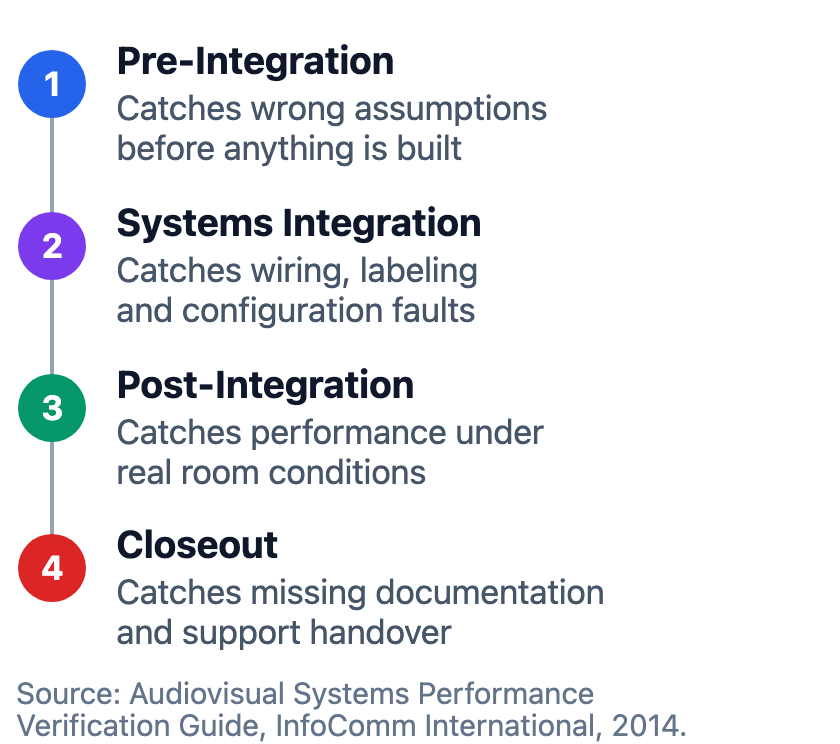
Phase choice changes what a failure costs. A wrong assumption caught at Pre-Integration can cost a revised drawing. The same assumption caught at Closeout can cost a change order and a delayed opening.
The four sections that follow apply the same three-part item structure to different rooms. The item changes; the structure does not.
The Meeting Room: Verify the Journey, Not the Join
Joining a call is not the same task as finishing a meeting, and the space between them is where a room’s failures become visible to everyone in it.
Microsoft’s own lifecycle process illustrates acceptance testing at industrial scale. New Windows feature updates are not offered to Teams Rooms devices immediately.
There is “an intentional delay of up to six months or more after the general availability date.” Microsoft uses that time “to validate Windows release compatibility for the Microsoft Teams Rooms app, device hardware, and certified audio video peripherals” (Microsoft Learn, retrieved 2026-08-20).
The block lifts after compatibility issues are found and resolved. Microsoft states that during validation, devices “should not be updated to the next release of Windows by any means.” Overriding the policies “may leave devices unusable.”
A vendor spends months verifying one release against certified hardware. A single room deserves more than a demonstration.
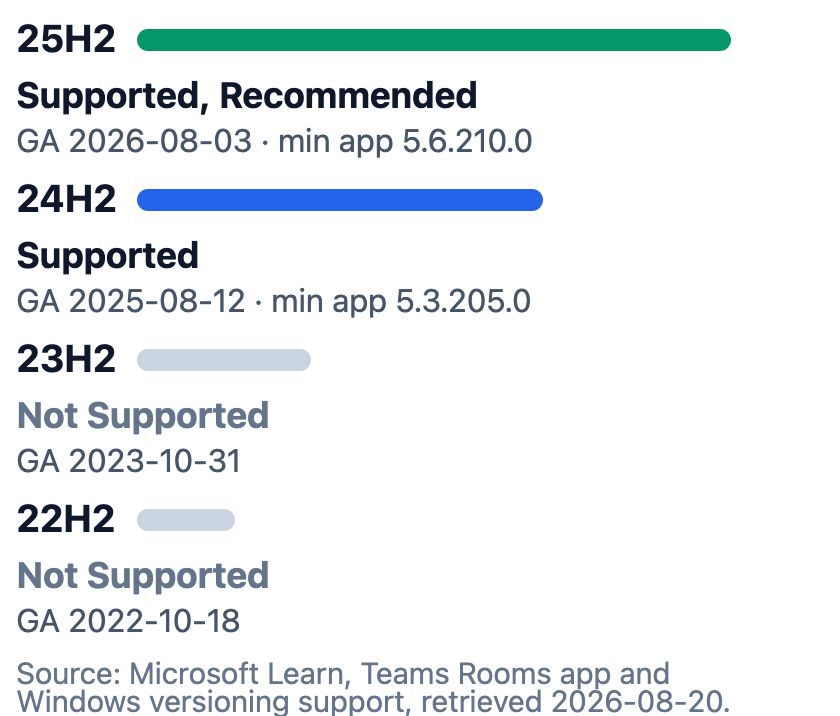
Source: Microsoft Learn, retrieved 2026-08-20.
A room-level acceptance test should mirror that discipline. Verify content ingest on every input, the second display, camera and microphone selection, recovery after the nightly reboot, and the help path when a meeting fails.
Architecture affects how much of this is testable at all. Existing guidance on choosing a room standard and on standardizing rooms without repeating a flaw covers that selection question.
The Exam Room: Verify What the Microphone Can Hear
Clinical spaces change the stakes of the same items.
AP-112 is the clearest example. Ambient noise in an exam room is not a comfort question once a documentation tool depends on intelligible speech.
The guide notes that “[e]xcessive ambient noise levels result in less effective communication due to listener fatigue,” and that noise arrives from HVAC, adjacent rooms, foot traffic, and the equipment itself.
The guide is specific about test conditions, and clinical spaces make that specificity matter. A room measured on a quiet weekend is not the room a patient visits on a Tuesday morning.
Reverberation deserves its own item. A carpeted consultation room and a hard-surfaced exam room produce very different results from identical hardware.
Clinical acceptance tests should also verify state visibility:
- Whether capture is active is obvious to the patient and the clinician
- Stopping capture is immediate and unambiguous
- The room still supports care when the software is unavailable
- Cleaning procedures do not damage or reposition the device
- A replacement device can be installed without a project
Room technology cannot make an organization compliant with any regulation, and nothing above substitutes for clinical, privacy, and legal review.
The Classroom: Verify From the Farthest Seat
Education verification has a published measure of its own.
The relevant standard is Display Image Size for 2D Content in Audiovisual Systems, listed in the AVIXA catalog as ANSI/AVIXA V202.01:2026. The standard’s own topic page still shows a 2016 designation, so the current number belongs in any specification.
It determines required image size and viewing positions for two defined viewing needs: Basic Decision Making and Analytical Decision Making (AVIXA, retrieved 2026-08-20). A free calculator supports both.
The distinction is the useful part. Full-screen video is one visual task. A dense page of small text is another. A room sized for the first can fail the second.
An acceptance test written around that measure looks nothing like a product demonstration. It uses the content a teacher will actually project. It is viewed from the actual farthest seat, with the lights at their normal level.
Resolution does not substitute for size. More pixels can render fine detail without making that detail any larger for the learner in the back row.
Audio carries the same logic, and existing guidance on classroom intelligibility covers why raising the volume does not fix it.
The Council Chamber: Verify the Record, Not the Livestream
Public meeting rooms produce an artifact that outlives the meeting.
Virginia’s Code is explicit. Section 2.2-3707 states:
“Minutes, including draft minutes, and all other records of open meetings, including audio or audio/visual records, shall be deemed public records” (Code of Virginia, retrieved 2026-08-20).
The quoted language is not introduced by the 2026 amendment.
Whether and how that language applies to a particular body or record is a question for counsel. The technical consequence is easier to state: the file has to be intelligible, complete, and retrievable.
Chamber acceptance items therefore extend past the room:
- Every microphone position is captured, including the public comment lectern
- Remote participants are present in the archived file, not only in the live stream
- The recording starts and ends completely, with a usable time reference
- File naming and storage allow retrieval months later
- An operator can tell mid-meeting that capture has stopped
Existing guidance on captions, archives, and searchable civic meetings and on hybrid chamber design covers the surrounding workflow.
Rooms That Cannot Be Taken Out of Service
Some rooms cannot be closed for testing. A dispatch floor, an incident command room, and an operating council chamber all have to be verified around live work.
That constraint changes the sequence rather than the standard. The four reporting phases still apply, but the weight shifts forward: anything verifiable before the equipment reaches the room should be verified there.
Four adjustments make that possible:
- Stage off-site. Build, label, program, and bench-test the rack in a workshop. A verification item closed on a bench is one that never risks a live shift.
- Measure without interrupting. Observation, source and destination inventory, dependency mapping, and non-disruptive measurement can be performed around live work.
- Rehearse the cutover. Verify the transition itself, including the fallback path and the decision deadline for using it.
- Verify after the change, not only during it. Watch the first live sessions with support present, log every issue, and hold the fallback open until the room has run unaided.
The acceptance record matters more in these rooms, not less. When a room cannot be taken down for a retest, the written evidence of what was verified, under what conditions, becomes the only reliable account of the room’s state.
Serviceability items deserve particular attention. Redundant processors that share one power circuit, or an inaccessible rack that cannot be opened during operations, are failures the room will not reveal until the worst moment.
Write the Report Before the Work Begins
Acceptance criteria written after installation describe whatever was installed.
The standard defines a specific report format, on pages 20 and 21 of the document. Planning the reporting early is a separate discipline, and it has a useful side effect: it forces the requirement to be stated in measurable terms while there is still time to design for it.
A workable acceptance record contains:
- The item, its number, and the document that sets its requirement
- The metric and limit, where one applies
- The conditions under which the test was run
- The result, the date, and the person who performed it
- Exceptions, with an owner and a resolution date
- The signature that transfers the room to its operational owner
Exceptions deserve particular attention. A room accepted with three open exceptions and named owners is in better shape than a room accepted with none because nobody wrote them down.
Turn One Verification Into a Reusable Standard
The return on acceptance testing arrives on the second room.
Once a room type has a verified item list, that list becomes a profile. New rooms of the same class inherit it. Changes are proposed against it rather than invented per project.
A durable profile records the room class, the selected items, the metrics, the test conditions, the acceptance record template, the exception process, and the trigger conditions for re-verification. Platform updates, peripheral changes, renovations, and room renumbering are all re-verification triggers.
Network conditions sit underneath all of it, and existing guidance on AV over IP network readiness covers the layer this method assumes is already sound.
The Rooms This Method Is Applied To
This article is the method. The rooms below apply it, each with the verification items and constraints that room type brings.
| Room type | Applied in |
|---|---|
| Meeting room | The Windows 11 25H2 update path a verified room has to survive · The governance questions that precede an AI agent in the room · Scheduling panels decided by room class |
| Exam room and patient room | Ambient clinical AI room readiness · Virtual nursing patient-room standard |
| Classroom and lab | Classroom display sizing to AVIXA V202.01 · CTE lab student workflow · What E-Rate will and will not fund |
| Council chamber | From livestream to public record · Chamber renovation continuity |
| Rooms that cannot go out of service | NG911 PSAP control-room readiness · Hospital communications downtime exercise · School E911 dispatchable location |
Take the Item Template Into the Project
The item template — statement, metric, procedure, reporting rule, the two roles and the phase — is on a one-page sheet, with the four reporting phases and the room-type journeys on the reverse of the argument.
Download the verification item template — PDF, one page, no registration.
What to Do With This Method
Acceptance testing is not a document produced at the end of a project. It is a decision, made early, about what evidence will justify signing.
VIcom can help define room classes and select the verification items that fit them. That work extends to setting measurable criteria, staging and testing systems before they reach a live space, documenting the acceptance record, and supporting the room through its service life.
The standards, statutes, and vendor requirements referenced here change. Organizations should verify current versions with the publishing bodies, and treat legal, clinical, funding, and public-record questions as matters for their own counsel and program owners.
Connect with VIcom by filling out the form below.