
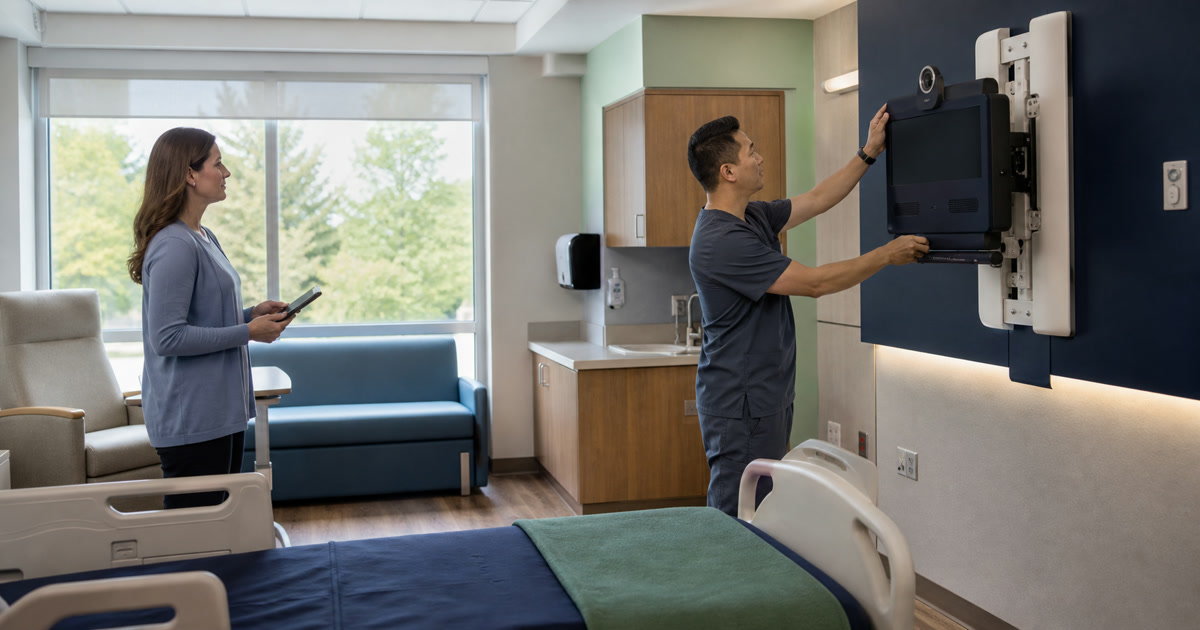
A pilot answers whether the technology can work. A rollout answers whether it works without the people who built it.
A pilot that runs in a handful of rooms, with a vendor engineer reachable and a champion who knows the workarounds, is running on conditions scale removes.
The gap is not a bigger purchase order. It is a room standard that can be reproduced, supported, cleaned, and repaired by people who were never in the pilot.
What to settle before a pilot becomes a rollout:
| Decision | Where it lands |
|---|---|
| Which room types the standard covers | A taxonomy, not one room repeated; record which types the pilot exercised and which it did not |
| What the pilot did not test | Named explicitly, before the business case is written |
| Who owns each recurring task | Cleaning, spares, firmware, access reviews — by role, not by goodwill |
| What evidence is being captured now | Decided while the pilot runs, not reconstructed after it ends |
| What the room profile says, and its version | A document that can be reproduced by people who were never in the pilot |
Key Takeaways
- Write a versioned room profile with a named owner and an exception process. Without one, every unit renegotiates the design.
- The pilot unit is the easy case. Isolation rooms, semiprivate rooms, bariatric rooms and older wings carry the variance that breaks a standard.
- Cleaning compatibility and tamper resistance are selection criteria, not afterthoughts. A device that fails a terminal clean has failed.
- Name the owner of every recurring task across nursing, environmental services, IT, clinical engineering, facilities and the vendor. Unowned tasks stop happening once the pilot’s attention moves on.
- Decide what the pilot must evidence before capital review, not after the business case is written.
On this page
- Virtual Nursing Is a Workflow, Not a Camera
- What the Pilot Did Not Test
- Build a Patient-Room Taxonomy
- Patient-Room AV Should Protect Dignity and Clarity
- Cleaning, Mounting, and Tamper Resistance
- Spares and the Day a Device Fails
- Name an Owner for Every Recurring Task
- Command Spaces Need Clinical Focus
- Evidence to Gather Before Capital Review
- Write the Room Profile, and Version It
Virtual Nursing Is a Workflow, Not a Camera
The label covers a wide range of models, and the room has to serve whichever one an organization has chosen.
Admission and discharge support, education, rounding, observation, medication reconciliation, coordination, interpreter workflows, documentation support, mentoring, and escalation all appear under the same heading. Exact models and clinical policies vary by organization, and this article does not recommend one.
What follows is the technology and operations layer underneath whichever model applies. A patient room is not a conference room, and a command space is not a generic office.
What the Pilot Did Not Test
The pilot’s success conditions are the reason it succeeded.
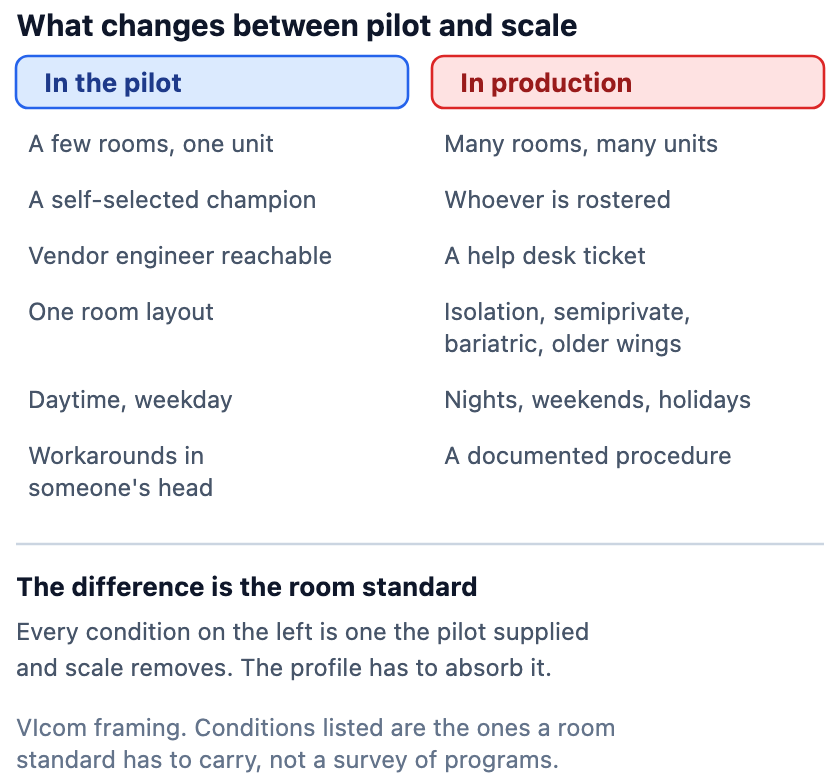
A pilot that runs on a unit that volunteered, with staff who wanted it, has not met the units that did not. Production reaches those units on a Sunday night, with agency staff oriented briefly.
That is not a criticism of pilots. It is the reason a pilot cannot, by itself, answer the scale question.
Build a Patient-Room Taxonomy
One room type is the assumption that fails first.
| Room type | What it changes |
|---|---|
| Standard medical-surgical | The baseline the pilot probably used |
| Isolation and negative-pressure | Cleaning protocol, device access, what may enter and leave |
| Semiprivate or shared | Two patients in microphone and camera range at once |
| Bariatric | Bed position, sightlines, mounting clearances |
| Behavioral health | Ligature, tamper and breakability constraints |
| Older wings and renovations | Structure, pathway, power and wireless coverage |
| Rooms with existing headwall equipment | Physical contention for the same wall |
| Overflow and converted spaces | No assumption holds |
Count how many of each exist before designing anything. The mix decides whether one profile is enough.
Form factor is a separate axis from room type. Decide which units need a fixed endpoint and which are served by a mobile cart.
The two carry different cleaning, storage, charging, network and accountability consequences. A cart that lives in a corridor is a different support problem from a device mounted on a headwall.
The semiprivate case deserves specific attention. A conversation intended for one patient is audible to another, and a camera framed for one bed may include the other. That is a design constraint before it is a policy question, and the policy question belongs with the organization’s own privacy and clinical leadership.
Patient-Room AV Should Protect Dignity and Clarity
This is the part of the original design that scale must not erode.
Camera placement should support meaningful conversation without feeling intrusive. Microphones should capture the patient and bedside team clearly while reducing hallway noise. Speakers should be intelligible without broadcasting sensitive information into a corridor. Displays should help the patient understand who is present and why.
Privacy indicators are essential. Patients and staff should be able to tell when video or audio is active, how consent is handled, and how the interaction ends. An indicator obvious to a trained nurse and invisible to a patient has not done its job.
Patients and families also need a plain explanation of what the camera does, when it is off, and how to ask for help. A plain explanation introduces the technology as part of care rather than as equipment that appeared overnight.
Cleaning, Mounting, and Tamper Resistance
These decide whether the endpoint is still usable long after the pilot team has moved on, and they are easy to settle too late.
- Cleaning compatibility with the disinfectants the organization actually uses, confirmed against the manufacturer’s published guidance rather than assumed
- Survivability of a terminal clean, including whether ports and seams tolerate it
- Mounting that clears the bed in every position it reaches, and survives a bed strike
- Cable management leaving nothing reachable, pullable, or usable as a ligature where that applies
- Tamper resistance appropriate to the population
- Service access that does not require entering an isolation room unnecessarily
- Power and pathway that do not contend with the headwall equipment already there
Infection prevention and facilities should approve the physical design before procurement.
Spares and the Day a Device Fails
A failure during a discharge conversation can undermine adoption.
Decide in advance: how many spares are held and where; who may swap one; how a swapped device is configured, named and re-registered; what the room does meanwhile; and how the failure is recorded so a pattern becomes visible.
A spare in a locked office that one person can reach is not a spare on a Sunday night.
Name an Owner for Every Recurring Task
Unowned tasks do not fail immediately. They fail quietly, once the attention that carried the pilot has moved on.
| Recurring task | Candidate owner |
|---|---|
| Cleaning the endpoint between patients | Nursing or environmental services |
| Confirming the device is powered and reachable | IT operations |
| Firmware and application updates | IT or the vendor, by agreement |
| Physical mount, damage, and replacement | Facilities or clinical engineering |
| Device inventory and lifecycle | Clinical engineering |
| Account, identity, and access | IT |
| Escalation when a room is unusable | Named, and reachable at night |
| Orientation and refresher training, including agency staff | Nursing education, with IT for the device steps |
| The room profile itself | One named owner, not a committee |
The point of writing it down is to discover the tasks nobody claims.
Command Spaces Need Clinical Focus
The command space deserves equal design attention, and it is the easier half to under-design.
Virtual nurses need sustained-focus environments: workstations, dashboards, video walls where they are justified, collaboration tools, headsets, escalation paths, and secure access to clinical systems.
Camera and headset selection matters because virtual nurses appear on camera and listen for long stretches. Acoustic separation matters when several sensitive conversations happen at once. Ergonomics matter because these are sustained clinical workstations rather than occasional video-call desks.
More screens do not automatically produce better awareness. Visual hierarchy is a clinical support requirement, not a preference. Dashboard design matters because alerts become noise, and a nurse who has learned to dismiss alerts reflexively has been trained by the design.
Virtual teams need reliable tools and visibility of room status. Bedside teams need to know when a virtual nurse can help, what tasks remain local, and how escalation works. Both decay without training.
Test it during a simulated busy shift: run a mock admission, a discharge education session and an escalation, document each interaction, involve an interpreter or family member if that is part of the model, and recover from a failed endpoint.
Existing guidance on the clinical telehealth room reliability audit covers testing a care workflow rather than a connection.
Evidence to Gather Before Capital Review
Decide what the pilot must demonstrate while it is still running.
- Endpoint uptime, measured rather than recalled, with the method stated
- Support tickets by category, and how many required entering the room
- Time to restore a failed room, and who restored it
- Which room types were actually exercised, and which were not
- Cleaning and infection-prevention sign-off on the physical design
- Adoption by use case, not in aggregate
- Bedside and virtual staff feedback gathered separately
- Patient and family feedback on comprehension and comfort
- Training delivered, to whom, and how long orientation actually took
- The exceptions granted during the pilot, and why
A business case assembled after the pilot ends can only report what someone happened to record.
Write the Room Profile, and Version It
The deliverable that makes scale repeatable is a document, not a device.
A room profile states the device, mount, position and orientation; the network, power and identity requirements; the privacy indicator behavior; the cleaning procedure and approved agents; the acceptance test; and the named owner of each recurring task. It carries a version number and a date.
The command space needs the same treatment. Its acoustics, workstation layout, dashboard set and escalation paths belong under a versioned standard too, for the same reason.
Then it needs an exception process. Units will meet rooms the profile does not fit, and the choice is between a recorded exception with an owner and an undocumented local variation nobody can support later.
Existing guidance on standardizing spaces without repeating a flaw covers the same discipline applied to a meeting-room estate, where the failure mode is identical.
Virtual nursing is a care model supported by technology. Reliability at scale is an operations problem long before it is a product problem.
Take the Room Standard Into the Capital Review
The room-type taxonomy, the pilot gaps, the ownership assignments, the evidence list and the room-profile fields are on a one-page worksheet for a nursing informatics lead and a facilities or biomedical partner to complete together.
Download the patient-room standard worksheet — PDF, one page, no registration.
Related Reading
- The clinical telehealth room reliability audit — testing the workflow, not the connection.
- How to upgrade healthcare AV without compromising infection control — doing physical work in a live clinical area.
- Standardizing spaces without repeating a flaw — the room-standard discipline this depends on.
Where VIcom Fits
VIcom can inventory room types across the units in scope, document a room profile with its acceptance test, confirm network readiness and the UC platform path, confirm cleaning and mounting decisions with infection prevention and facilities before procurement, stage and configure endpoints, define the spare procedure, and map every recurring task to a named owner.
VIcom does not set clinical policy, does not define the virtual nursing model, and does not make privacy or consent determinations. Those belong to the organization’s clinical, privacy and compliance leadership.
Connect with VIcom by filling out the form below.