
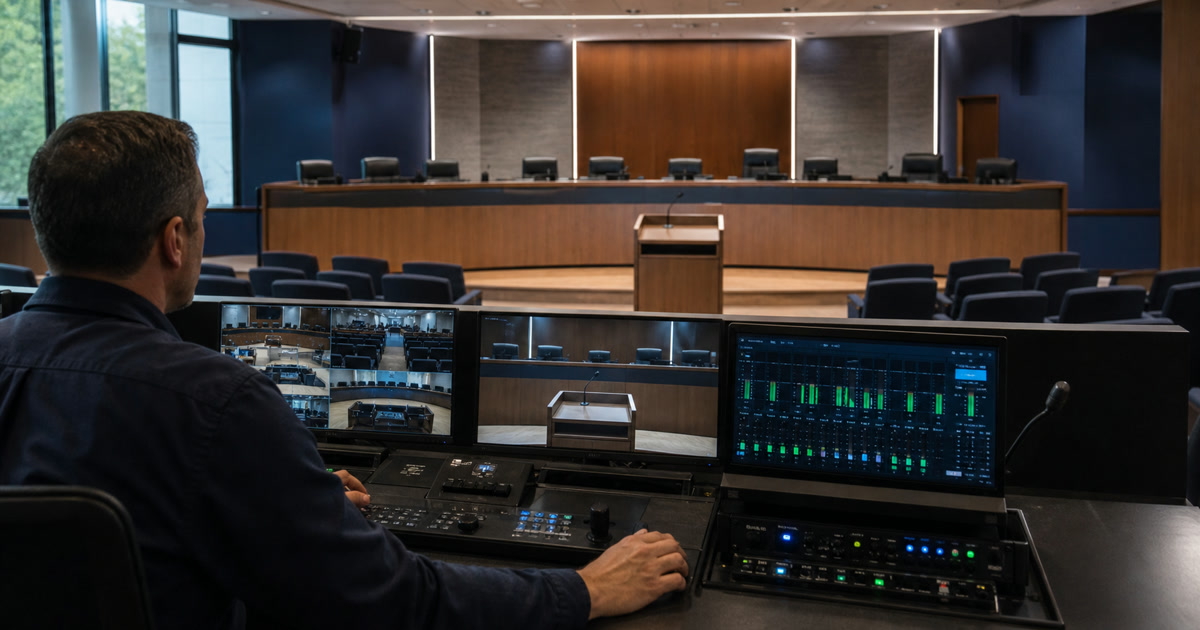
Virginia’s Code deems audio and audiovisual records of open meetings public records. A recording that cannot be heard, found or retrieved does not serve the public the way a record should.
Streaming the meeting is the easy half. The question that decides whether the record works is whether the meeting is still understandable months later, to someone who was not there and cannot ask anyone what was said.
The chain in brief, and who owns each link. The full seven stages are below; these five are the ownership boundaries.
| Stage | Owner | How it fails |
|---|---|---|
| Microphone and acoustics | AV system | Off-axis speech, unintelligible public comment |
| Production mix and encoder | AV system | Remote participants absent; stream fine, archive truncated |
| Recording | AV system | Stops silently, nobody watching |
| Naming, retention, retrieval | Records governance | File exists but cannot be found or produced |
| Published archive | Records governance | Posted without captions or transcript |
Key Takeaways
- Virginia’s Code states that “minutes, including draft minutes, and all other records of open meetings, including audio or audio/visual records, shall be deemed public records” (Code of Virginia § 2.2-3707, retrieved 2026-08-20).
- A recording that exists but cannot be heard, found, or retrieved does not serve the public the way a record should.
- Audio quality decides captioning and transcription quality, which decides whether the archive is searchable at all.
- Retention, naming, integrity and retrieval are records governance questions, and they are not answered by the AV system.
- A recording does not replace written minutes where minutes are required, and technical quality does not decide what must be disclosed or redacted.
On this page
- The Public Record Outlives the Livestream
- What the Code Says About Format
- Audio Quality Is the Foundation of Search
- Design the Whole Meeting Workflow
- Accessibility Includes Live and Later Access
- Assess the Archive With Three Citizen Tasks
- Records Governance the AV System Does Not Handle
- Meeting-Room Details That Improve Archives
- Two Checklists for the Clerk and the Operator
- Acceptance Criteria a Clerk Can Put in a Bid
- Make the Clerk Workflow Sustainable
- Take the Checklists Into the Chamber
The Public Record Outlives the Livestream
The stream serves the people watching at that moment. The record serves everyone after them.
Can a resident find the comment they care about? Do captions help someone follow the discussion? Is the audio clear enough for transcription? Are agenda items connected to the right part of the record? Those get answered months later, by people who were not in the room.
What the Code Says About Format
Virginia’s open-meeting records provision is explicit about format.
Section 2.2-3707 states that “minutes, including draft minutes, and all other records of open meetings, including audio or audio/visual records, shall be deemed public records” (Code of Virginia, retrieved 2026-08-20).
That language is not new. It is worth restating because the operational consequence is easy to miss.
One practical implication follows, and it is not a legal conclusion.
A recording is not a byproduct of the stream. It is an artifact with an audience, and it should be engineered as one.
Whether and how that language applies to a particular body, recording or request is a question for counsel and the Virginia Freedom of Information Advisory Council. This article does not answer it.
One distinction is worth keeping clear throughout. Minutes, livestream access, and audio or audiovisual records are three different things. A recording does not replace written minutes where minutes are required.
Audio Quality Is the Foundation of Search
Everything downstream inherits the microphone. Captions come from audio, transcripts come from audio, and search runs against transcripts. A member speaking off-axis can produce a caption error, a caption error becomes a transcript gap, and that is why a later search returns nothing.
The positions easiest to miss:
- Members speaking while turned toward each other rather than toward a microphone
- A quiet member of the public at the lectern
- A remote participant arriving through a platform mix at a different level
- An interpreter speaking on a separate channel, and whether that channel reaches the record at all
- Two people speaking at once during a motion
- Anyone speaking from the floor rather than from a designated position
Coverage has a limit worth stating alongside the goal. The system should capture what the body says on the record, not private exchanges at the dais between agenda items. Where a microphone stays open through a recess, that is a coverage decision rather than an accident.
Intelligibility is the requirement, not loudness. Turning the system up does not fix it.
Design the Whole Meeting Workflow
The record is produced by a chain, and the chain is only as good as its least considered link.
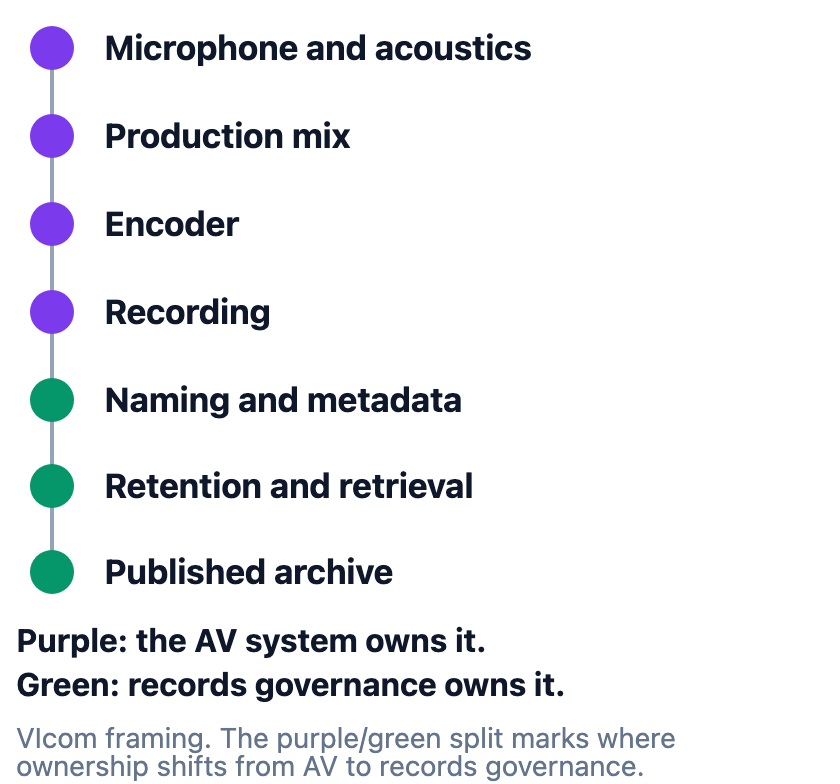
Confirm every stage has a named owner. That is the point of the diagram.
A hypothetical shows why the middle of the chain is where records are lost. A council streams a meeting successfully: remote participants are audible, the stream runs to adjournment, and nobody reports a problem.
Months later a resident asks for the public comment period. The archived file carries the platform mix cleanly and the room’s lectern microphone barely at all, because the recorder was fed the conference audio rather than the program mix. Nothing failed visibly on the night.
| Stage | Who owns it | How it fails |
|---|---|---|
| Microphone and acoustics | AV system | Off-axis speech, unintelligible public comment |
| Production mix | AV system | Remote participants at the wrong level, or absent |
| Encoder | AV system | Stream fine, archive missing or truncated |
| Recording | AV system | Stops silently; nobody is watching. Local and cloud capture fail differently, and only one is the master |
| Naming and metadata | Records governance | File exists, cannot be found |
| Retention and retrieval | Records governance | Cannot be produced on a deadline |
| Published archive | Records governance | Posted without captions or transcript |
Several concrete decisions sit inside the production stage:
- Camera presets for the dais, the staff table, the lectern and the public comment position, so framing does not depend on an operator improvising under pressure.
- A dedicated public-comment preset that moves the camera, opens the correct microphone and routes audio to captioning in one action, at the moment citizens are participating.
- Clean program audio routed to the recorder, rather than a room mix captured as an afterthought.
- Assisted listening treated as an output that needs routing, not as a device that happens to be in the room.
Accessibility Includes Live and Later Access
Accessibility is easy to treat as a live-stream feature. The archive is where it is easiest to lose.
- Captions present during the stream but absent from the archived file
- No transcript, or a transcript with no speaker labels
- A player that cannot be operated by keyboard
- Contrast or control sizing that fails on the archive page but passed on the live page
- No route to request a correction
The applicable success criteria for captions, keyboard operation and contrast live in WCAG 2.2. Accessibility here is a property of the record rather than a feature of the broadcast, which keeps it from being deferred to a separate workstream.
Assess the Archive With Three Citizen Tasks
Test the archive the way it will be used.
- Find one thing. Pick a specific vote from three months ago and locate the moment it happened, starting from the public website and nothing else.
- Understand one thing. Play back a public comment on a phone, at normal volume, in a room with other noise. Determine what was said and who said it.
- Prove one thing. Produce the file, its date, and its unedited state in a form that would satisfy someone who doubts it.
If task 1 or task 3 takes longer than a few minutes, the finding is about naming, indexing and retrieval. If task 2 fails, the finding is about the capture chain, and it belongs to the AV system.
Records Governance the AV System Does Not Handle
The equipment cannot supply this layer.
- Retention. How long each artifact is kept, under which schedule, and who applies it.
- Original versus derivative. The master capture, the streamed version, the published archive and the transcript are different objects. Which is the record?
- Naming. A convention that identifies body, date and meeting type without opening the file.
- Integrity. Whether the published file can be shown to be unmodified, and by what means.
- Access. Who can reach the master capture, and whether that is logged.
- Request retrieval. How a specific meeting is located and produced on a deadline.
- Redaction. How a version is produced when a portion must be withheld, and what happens to the original.
- Ownership. Which named role holds each of the above.
Produce an archive packet with every meeting: agenda identifier, meeting title, recording file name, caption status, who posted it, and any known audio issue. That single artifact carries the routine facts about a meeting file without anyone reopening it.
Retention schedules are set outside the AV system. The Library of Virginia’s retention schedules are the starting point for which applies to a given body.
Technical quality cannot decide what must be retained, disclosed or redacted. Those are legal and records-governance questions, and listing them routes them to the people who own them.
Meeting-Room Details That Improve Archives
Small physical decisions produce large archival differences.
- A dedicated public comment position with its own microphone and a known level
- Member identification that survives into the transcript, whether by microphone assignment or by the chair naming speakers
- A confidence monitor that shows the operator what is actually being captured
- An independent backup capture for meetings where the stakes justify it
- A visible indicator that recording is running, and someone whose job it is to notice if it stops
- Consistent room configuration meeting to meeting, so the archive is consistent too
Existing guidance on council chamber AV for hybrid public meetings covers the room design these sit inside.
Two Checklists for the Clerk and the Operator
Adapt both. The value is in them being written down and owned.
Thirty minutes before the meeting
- Confirm the recorder is running and writing to the expected destination
- Confirm free storage exceeds the expected meeting length by a wide margin
- Check every microphone position, including the public comment lectern
- Verify the remote-participant path both ways
- Confirm captioning is active and reaching the stream
- Note the start time against the agenda
- Confirm someone is watching the confidence monitor
After the meeting
- Verify the file exists, opens, and runs to the true end
- Confirm the start and end are complete rather than clipped
- Apply the naming convention
- Publish to the archive and open the published copy as a member of the public would
- Confirm captions or transcript accompany the published file
- Record any exception, with an owner and a date
- Log the retention date
Acceptance Criteria a Clerk Can Put in a Bid
The difference between a system that was installed and one that was accepted is a written list of what it has to demonstrate.
- Coverage. Every designated speaking position is intelligible in the recording, including the public comment lectern.
- Signal to noise. Speech is clearly above room noise at every position, under occupied conditions rather than in an empty chamber.
- No clipping. The loudest expected talker does not distort.
- Synchronization. Audio and video stay aligned across the full length of a meeting, not only at the start.
- Complete start and end. The recording begins before the gavel and runs past adjournment.
- Embedded time reference. The file carries a time reference that can be matched to the agenda.
- File format and export. The delivered format opens without proprietary software, and an export path is demonstrated.
- Backup capture. Where a backup is specified, it is shown to produce a usable file independently.
- Searchability. A transcript or caption file accompanies the recording and can be searched.
- Operator handoff. A person who did not install the system runs a full meeting using the written procedure.
Each of these is demonstrated once at acceptance and then re-checked on a schedule. A criterion nobody re-tests describes the day of installation.
Make the Clerk Workflow Sustainable
A process that depends on one person’s memory fails the day that person is unavailable.
Write it down, keep it to one page, and make the steps observable. Where a step is easy to skip under pressure, it belongs in the checklist rather than in a training session.
Systems, standards and statutory language change. Confirm current requirements with counsel and the Virginia Freedom of Information Advisory Council before relying on anything above.
Take the Checklists Into the Chamber
The pre-meeting and post-meeting checklists, the stage-ownership table, the three citizen tasks and the records-governance questions are on a one-page sheet for the clerk and the operator.
Download the public meeting record checklist — PDF, one page, no registration.
Related Reading
- Council chamber AV in 2026: hybrid public meetings, transparency, and accessibility — the room design that produces the record.
- Accessible public meeting technology: streaming, archives, digital signage, and Title II — accessibility across the whole public-meeting estate.
- Every networked AV endpoint needs an owner — the ownership record that governance depends on.
Where VIcom Fits
VIcom can assess intelligibility across every speaking position, stage and test chamber designs, integrate redundant capture where it is justified, document acceptance criteria for a new or upgraded system, train operators, and support the system over its life.
Connect with VIcom by filling out the form below.