

Under the current FY2026 Eligible Services List, conventional classroom AV endpoints — displays, cameras, microphones, speakers and room control systems — are not listed as eligible internal connections. Confirm the position against the final FY2027 list before filing.
The longer answer is more useful. A classroom modernization contains two different projects wearing one budget line, and only one of them is a candidate for E-Rate. Separating them cleanly is what protects both.
What to settle before the bid goes out:
| Decision | Where it lands |
|---|---|
| Which lane each line item is in | Network and cabling may be eligible; displays, cameras, mics, speakers and room control are not among the product types the ESL names |
| How mixed items are split | Tangible, reasonable criteria — and the split reaches installation and maintenance |
| Which year’s rules apply | The final Eligible Services List for the funding year, not last year’s |
| Who determines eligibility | The district remains responsible for its request, with advice from its coordinator or consultant. The FCC’s final ESL governs, and USAC reviews the funding request — not a vendor |
| What the Form 470 says | Scope and equivalency language, with bidding open at least 28 days after certification |
Key Takeaways
- Category One is “Data Transmission Services and/or Internet Access.” Category Two covers internal broadband distribution. USAC’s overview cites access points, routers, switches, hubs and wiring as examples; the FY2026 FCC list expressly includes routers, switches, access points and cabling.
- “As of Funding Year 2019, voice services were no longer eligible.”
- Where a product contains ineligible components, “a cost allocation is required to remove the ineligible components so that only the eligible portion is funded.”
- Allocation methods “must be based on tangible criteria that reach a reasonable result,” and allocation extends to installation and maintenance.
- The Eligible Services List is issued per funding year. At publication time, the final FY2027 list had not been released; the final FY2027 list will control FY2027, and eligibility can change between years.
On this page
- The Two Categories
- Why Networked Does Not Mean Eligible
- What Changed for FY2027
- Cost Allocation Is the Mechanism
- A Worked Split
- Three Things Not to Do
- Plan the Room First, Then the Funding
- Why the Foundation Still Matters to the AV
- Take the Lane Split Into the Bid
The Two Categories
E-Rate divides support into two categories. Conventional endpoint AV equipment sits outside both, although eligible network and cabling components within the same classroom project may qualify.
Category One is “Data Transmission Services and/or Internet Access,” described as “broadband connectivity and basic conduit access to the internet.”
Category Two covers internal broadband distribution. USAC groups it into three service types. Internal Connections and Managed Internal Broadband Services “include eligible products, such as access points, routers, switches, hubs, and wiring”, while Basic Maintenance of Internal Connections “covers the repair and upkeep of eligible internal connections” (USAC, retrieved 2026-08-24).
Voice is settled and worth stating plainly: “As of Funding Year 2019, voice services were no longer eligible.”
Why Networked Does Not Mean Eligible
This is the misconception worth addressing first.
A display connected to Ethernet is still a display. A camera with an IP address is still a camera. Eligibility attaches to what the product is and what it does, not to whether it happens to have a network port.
The eligible list is about moving data around a building. The classroom AV estate is about what happens at the end of that connection, and the program’s eligible internal connections, as currently listed, do not extend there.
What Changed for FY2027
The competitive bidding window is open. USAC states that “the FY2027 FCC Form 470, which must be submitted and completed to start the competitive bidding process, became available July 1, 2026, in EPC” (USAC announcements, posted July 23, 2026, retrieved 2026-08-24).
The form change is not the same as a new FY2027 eligibility change. The FCC rescinded eligibility for school bus Wi-Fi and off-premises Wi-Fi hotspots beginning with FY2025. Because those options remained on the already-released FY2026 Form 470, USAC removed them when it released the FY2027 form (USAC, retrieved 2026-08-31).
The practical lesson still holds: forms and eligibility lists are updated on different schedules, and eligibility must be checked for the applicable funding year.
USAC describes the process directly: “Each year, before the FCC Form 471 application filing window opens, the FCC releases an Eligible Services List (ESL) for the upcoming funding year,” containing “eligibility conditions for each category of service for each specified funding year.”
As of August 31, 2026, USAC’s official Eligible Services List page lists FY2026 as the current list; a final FY2027 list has not yet been posted there. The final FY2027 list will govern FY2027. Nothing in this article, and no vendor’s assurance, substitutes for it.
One process fact matters more than the calendar date. USAC states that “applicants must wait at least 28 days from the date the FCC Form 470 is certified before closing the competitive bidding process” (USAC, retrieved 2026-08-25).
USAC adds that the bid deadline “must be at least 28 days after certifying their FCC Form 470 or longer depending on your state or local procurement rules or regulations.”
The clock therefore starts at certification, not at the moment someone decides to start a project. That shapes how early the room design has to be settled.
A district that has not decided what the room must do cannot describe the network it needs, and a late scope is the one that ends up describing a product instead of a requirement.
Cost Allocation Is the Mechanism
A classroom project that mixes eligible and ineligible components has a defined answer available.
USAC states the principle: “E-Rate funds may only be used for services and products used by eligible entities for an eligible purpose (i.e., a primarily educational purpose).”
It follows that “when a product or service contains ineligible components, a cost allocation is required to remove the ineligible components so that only the eligible portion is funded” (USAC, retrieved 2026-08-24).
Where a package is mixed, “applicants and service providers must follow the cost allocation procedures.”
Two constraints govern how:
- Method: allocations “must be based on tangible criteria that reach a reasonable result.”
- Reach: “If cost allocation is required for a component, then cost allocation is also required for the installation and maintenance of that component.”
That second sentence is easily missed at bid time. Labor follows the component it serves.
A Worked Split
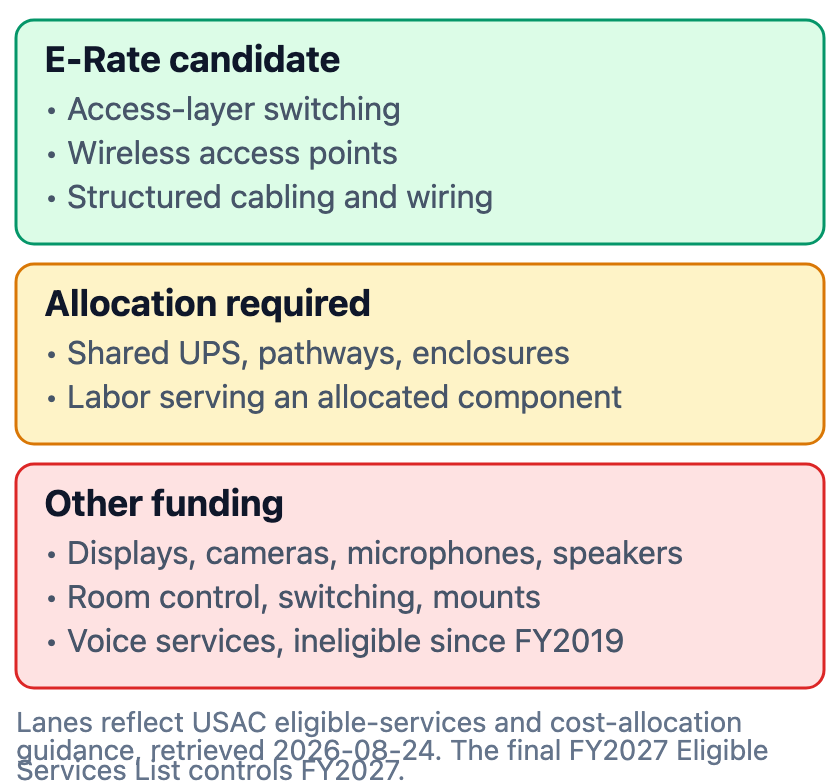
An illustrative classroom refresh, showing where the line falls. Amounts are deliberately omitted; the point is the categorization, not a price.
| Line item | Lane | Note |
|---|---|---|
| Access-layer switching | E-Rate candidate | Named product type on the ESL |
| Wireless access points | E-Rate candidate | Named product type |
| Structured cabling to the classroom | E-Rate candidate | Wiring for internal distribution |
| Display and mount | Other funding | Not among the internal-connection product types the ESL names |
| Camera, microphones, speakers | Other funding | Not among the product types the ESL names |
| Room control and AV matrix/video switching | Other funding | Not among the product types the ESL names |
| Voice handsets and service | Other funding | Ineligible since FY2019 |
| UPS serving both the IDF and AV rack | Mixed | Allocation required |
| Installation labor across both | Follows its component | Allocation required where the component is allocated |
The last two rows are where a bid either becomes defensible or becomes a problem. A single labor number covering both lanes needs a documented, reasonable allocation method — such as itemized tasks, resource estimates or work logs. Breaking it out before it reaches a funding request is cleaner.
Three Things Not to Do
- Do not bundle AV inside a network line to make it eligible. That is not an allocation method; it is the absence of one, and it puts the eligible portion at risk alongside the ineligible.
- Do not assume the Form 470’s options establish eligibility. School bus Wi-Fi and off-premises hotspots became ineligible beginning with FY2025; those obsolete options were removed from the FY2027 form. Check the final ESL for the funding year.
- Do not write a Form 470 around one manufacturer without the equivalency language the program requires. USAC’s own FY2027 Form 470 and competitive bidding resources address this directly.
Plan the Room First, Then the Funding
A clean bid depends on the order of these steps.
- Define what has to happen in the room, for which subjects and which class sizes
- Survey the existing network: switch capacity, PoE budget, uplinks, wireless coverage, pathways
- Count devices and ports the room will actually need
- Produce an itemized design where every line has a category
- Have the district review the eligible-services position with its E-Rate coordinator or consultant; the final ESL governs, and USAC reviews the funding request
- Split the scopes and identify a funding source for each
- Run competitive bidding on the eligible scope with the required documentation
- Establish evaluation criteria and weights before evaluating bids; give the price of eligible products and services more weight than any other single factor, disclose the criteria when state or local rules require it, and retain the evaluation records
- Award against the final publicly posted scope; if the scope changes materially, post the updated bidding document and observe the recalculated 28-day waiting period before selection or contracting
- Retain program records for 10 years after the later of the last day of the applicable funding year or the service-delivery deadline
Doing this in the other order — choosing the display first and asking about funding afterwards — is what produces bundled quotes that are difficult to defend.
Why the Foundation Still Matters to the AV
The half E-Rate may support is the half the AV depends on.
A classroom system fails quietly when the switch has no PoE headroom, when the wireless design cannot carry a room full of devices, or when there is no pathway to the display position.
Two more are easy to leave out of a network scope entirely: a quality-of-service policy, so voice and video do not share a queue with everything else, and segmentation and management for the devices once they are on. None of that is an AV problem, and all of it strands AV.
Funding the foundation properly is therefore not a consolation prize. It is the precondition for the part that has to be funded another way.
Existing guidance on classroom audio as accessibility infrastructure covers what the ineligible half has to deliver once it is installed, and running a classroom experience drill before faculty return covers proving it works.
Take the Lane Split Into the Bid
The two lanes, the allocated middle, the three things not to do, the order of operations and a pre-certification checklist are on a one-page worksheet for a district technology director and an E-Rate coordinator to fill in together.
Download the classroom lane-split worksheet — PDF, one page, no registration.
Related Reading
- Classroom audio is accessibility infrastructure — what the AV half must achieve.
- Before faculty return: run the classroom experience drill — verifying the finished room.
- Virginia’s school security grant window — scoping communication technology against a different funding cycle.
Where VIcom Fits
VIcom can design the classroom and the network together while keeping the scope legible: separate line items for network, cabling, AV, UC, installation and lifecycle support, in a form a district’s E-Rate coordinator and procurement team can work with.
VIcom does not determine eligibility and does not promise funding. The FCC’s final Eligible Services List for the funding year governs; USAC administers the program and reviews funding requests, while qualified E-Rate advisors can help applicants interpret and apply the rules. Program rules, forms, deadlines and eligibility all change; confirm current requirements with USAC before filing anything.
Connect with VIcom by filling out the form below.