
Build a Strong Virginia School Security Equipment Grant Application
An equipment list gives reviewers little reason to fund a project. A clear safety need, supported by site data and a practical response plan, gives them much more.
The Virginia Department of Education’s 2026–2027 School Security Equipment Grant application period runs from July 1 through August 1, 2026, at 5 p.m.
VDOE states that:
- School divisions may receive up to $250,000 through the competitive grant process.
- A 25 percent local match applies unless VDOE authorizes a reduction.
- The application must list all equipment.
- VDOE must approve the equipment.
- Divisions must use the equipment in eligible public school buildings.
- Extended warranties and service agreements do not qualify under the published requirements.
These rules make a clear scope essential. Each proposed device should address a known weakness in the school’s prevention, response, reunification, or recovery process.
Start with Emergency Procedures
Include safety, administration, IT, facilities, transportation, special education, communications, and first responders in the planning process.
Review several events that could occur at the school:
- A medical emergency in the gym
- Severe weather during the school day
- A threat reported at an outside entrance
- A power outage
- A reunification event away from the main office
For each event, answer:
- Who receives the first report?
- Who confirms the situation?
- Who begins the response?
- Which locations must receive the message?
- Who may have trouble hearing or understanding a standard announcement?
- What happens if the network, internet, power, or front office fails?
- How do staff confirm receipt?
- How do first responders receive accurate information?
The answers create clear requirements.
“Improve emergency communication” provides little direction. A stronger requirement might call for clear messages in classrooms, cafeterias, outdoor areas, and portable buildings. It could also require two approved control locations, backup power, and a written fallback process.
Check Grant Eligibility Before Finalizing the Scope
VDOE publishes the application, scoring criteria, and allowable-equipment attachment on its grant page. Compare every device and installation cost with the current documents.
A product’s general security value does not guarantee grant eligibility.
Separate the project into four cost groups:
- Eligible equipment and installation included in the grant request
- Local work such as electrical, network, licensing, or construction changes
- Ongoing costs that the division will pay after the grant
- Related improvements outside the current application
This separation helps the division plan a complete system. It also reduces the risk of funding devices without the power, network, staff, or support needed to use them.
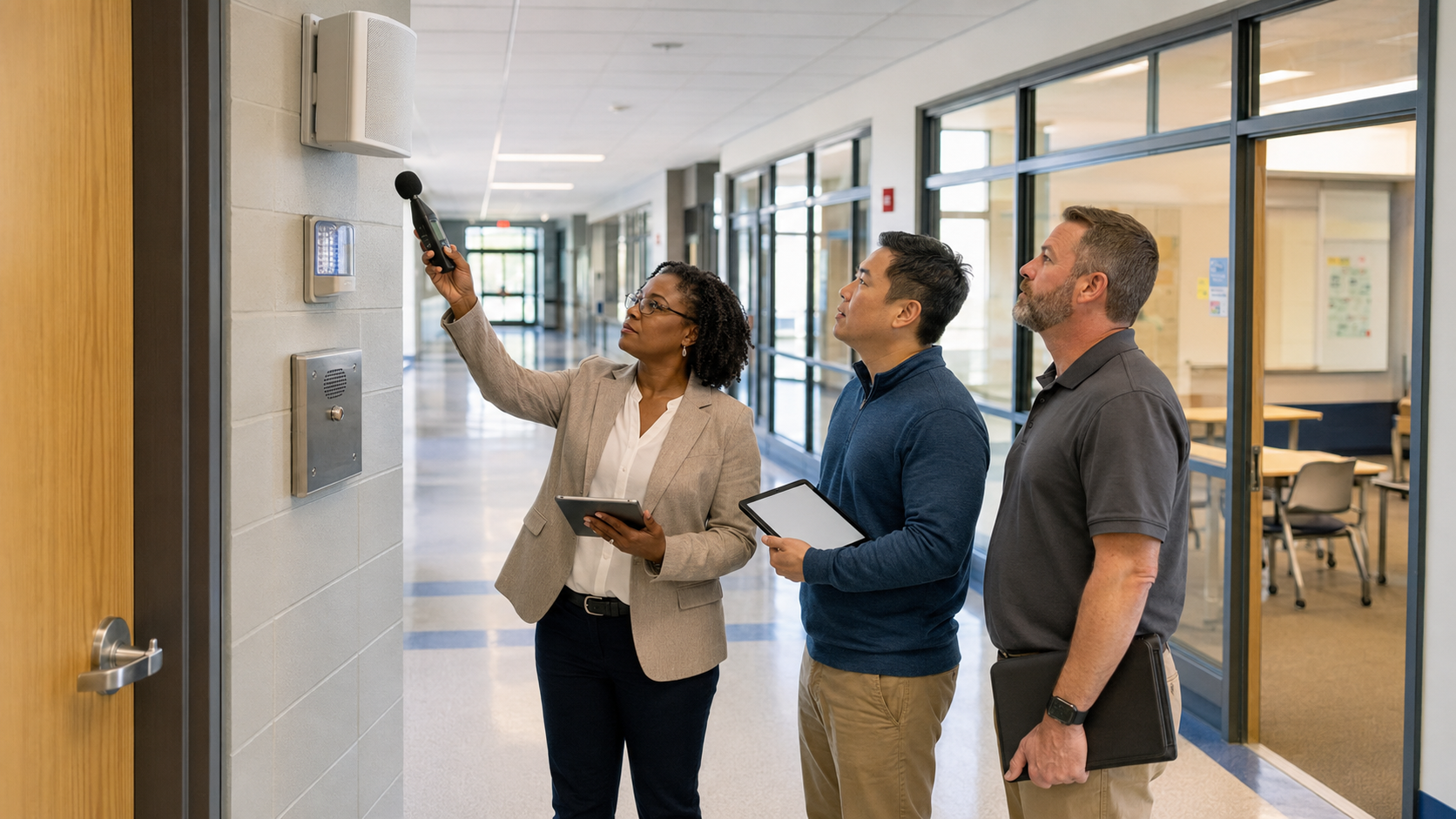
Survey the Whole Campus
Emergency communication systems often perform well near the main office and poorly in other areas.
An announcement may sound clear in a quiet hallway but become hard to understand in a cafeteria. A visual alert may cover the main building while missing portable classrooms. Phone alerts may reach full-time employees while missing substitutes and visitors.
Survey:
- Classrooms
- Hallways
- Restrooms
- Gyms
- Cafeterias
- Auditoriums
- Libraries
- Offices
- Maintenance areas
- Outdoor gathering points
- Athletic spaces
- Buses when relevant
- Detached buildings
- Portable classrooms
For each area, record:
- Background noise
- Existing speakers and displays
- Network access
- Power
- Accessibility needs
- Expected message source
- Backup communication method
Clear speech matters more than volume alone. Some locations may also need visual alerts, text messages, or other communication methods.
Plan for students, employees, and visitors with hearing, vision, language, cognitive, or mobility needs.
Define Every Integration
Vendors may claim that public address, clocks, access control, video, intercom, digital signage, radios, and mass notification systems will integrate.
Ask the vendor to define how each connection works.
Document:
- Which system starts the event
- Which systems receive the alert
- Whether the system uses live, recorded, text, or automatic messages
- Who can activate each message
- How the system manages user identities and permissions
- Which functions require internet access
- Which functions remain available on the local network
- How the system prevents false alerts
- How staff cancel or correct an alert
- What the system records for later review
- What staff do if an integration fails
Require the vendor to demonstrate each key connection with similar equipment. Test it again at the school after installation.
A system diagram cannot prove that an alert will reach the right people during an emergency.
Plan for at Least Five Years
VDOE states that an eligible school should remain open for at least five more years. The school should also have no planned renovation or addition during that period that would make the equipment obsolete.
Review:
- Facility plans
- Planned renovations
- Cable pathways
- Network replacement schedules
- Classroom standards
- Planned additions
- Product support dates
Choose systems that the division can expand, move, or update without replacing the full investment.
Document how staff will:
- Track equipment
- Install updates
- Apply security patches
- Test the system
- Replace failed parts
- Plan future replacement
Build a Complete Cost Record
The application budget should list quantities, locations, installation needs, and the local match.
The division should also keep an internal record of all lifecycle costs:
- Network changes
- Electrical work
- Mounting
- Construction
- Software subscriptions
- Recurring services
- Staff training
- Annual drills
- Spare parts
- Support
- Firmware updates
- Cybersecurity work
- Testing
- Expected replacement year
Clear ownership matters as much as cost.
Safety leaders should define the required emergency outcomes. IT and cybersecurity teams should manage connected technology. Facilities should prepare the building. School administrators should manage local procedures. Procurement should protect the buying process. The integrator should deliver the contracted design, installation, records, and testing.
Assign a named owner to each responsibility.
Review the Application Before Submission
Hold a brief review with every team involved.
Connect each proposed line item to:
- An emergency need
- A campus location
- An allowable-equipment category
- A scoring criterion
- A responsible owner
Confirm that the quantity, cost, location, and installation assumptions make sense. Remove any item that the team cannot link to a clear need and grant requirement.
This review can expose missing work while the division still has time to correct the application.
VIcom can help Virginia school divisions assess communication gaps, confirm technical needs, coordinate AV, network, and facility requirements, and prepare projects for installation.
The school division and VDOE remain responsible for grant eligibility and final application decisions. A clear technology plan can help the division support those decisions with stronger evidence.
Connect with VIcom by filling out the form below.