
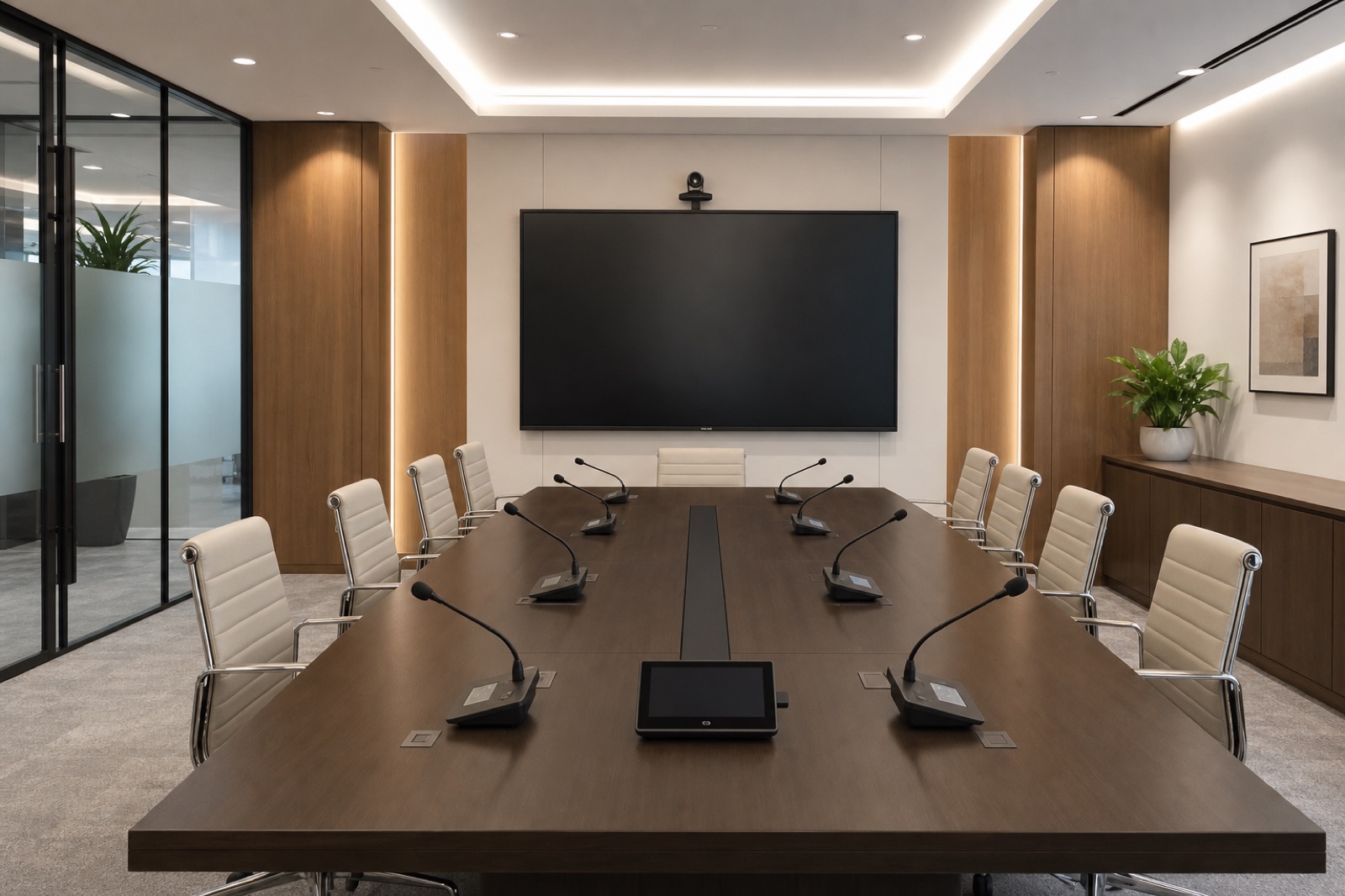
Hybrid work made meeting rooms more important, but it also exposed how inconsistent they are. One building has Teams Rooms. Another has Zoom Rooms. A third depends on BYOD adapters. A boardroom has a custom control panel no one understands. A huddle room has a camera that frames half the table. Support teams spend time rediscovering room behavior instead of improving the environment.
Enterprise meeting room standardization is the answer to that drift. It is not about making every room identical. It is about making the experience, support model, design logic, and lifecycle plan predictable. When users know what to expect before they walk into a room, meetings start faster. When support teams know what is installed, issues are easier to diagnose. When procurement has standards, scaling becomes less chaotic. When future AI and analytics initiatives arrive, the enterprise has a cleaner foundation.
Start With Room Archetypes, Not Product Lists
A useful room standard begins with archetypes. Focus rooms may support one or two people with personal video needs. Huddle rooms may need fast informal collaboration. Small and medium rooms need reliable hybrid meetings with clear audio and camera coverage. Large rooms may need multiple microphones, larger displays, and better control. Boardrooms require premium experience, confidentiality, and higher-touch support. Training rooms need content capture, instructor visibility, and audience participation. Divisible spaces need flexible audio, video, and control behavior that changes as partitions move.
Each archetype should describe the intended user experience before it lists devices. Who uses the room? What meeting types happen there? How many in-room and remote participants are typical? What platform is preferred? What does a successful meeting start look like? What should a user never have to think about?
Product decisions become easier when the experience definition is clear.
What Should Be Standardized
The most obvious standard is platform, but the standard should go further. Enterprises should define camera approach, microphone strategy, display size and placement, speaker coverage, scheduling panels, touch controls, content sharing, cabling, network requirements, device naming, monitoring, signage, documentation, and support ownership.
The control experience deserves special attention. Users should not need to relearn the room every time they change floors. Join meeting, share content, adjust volume, mute, change camera view, and end meeting should feel consistent. If a room requires a special workaround, the standard should either eliminate that workaround or document why the room is an exception.
Network and security requirements also belong in the standard. Collaboration devices need predictable VLANs, firewall rules, quality of service expectations, certificate handling, firmware policies, and monitoring access. Without this, AV teams and network teams end up troubleshooting the same issues repeatedly.
Documentation should be treated as a deliverable, not an afterthought. A standard room should have drawings, device lists, configuration notes, support instructions, warranty information, and refresh expectations. That documentation turns a design into an operating model.
Standards Improve Adoption Because They Reduce Guesswork
Users do not adopt rooms because a spec sheet is elegant. They adopt rooms because the experience is predictable. If the first five minutes of every meeting are spent finding the right cable, changing the input, joining audio twice, or asking remote participants whether they can hear, people lose trust. They bring laptops, avoid rooms, or blame the platform.
A good standard reduces those moments. The touch panel is in the same place. The join flow is familiar. The camera frames the room properly. The microphone picks up the people at the table. The display is readable. Scheduling is clear. Support knows the room type before a ticket is opened.
That consistency has financial value. Support teams spend less time on avoidable tickets. Procurement can buy against known patterns. Training becomes simpler. New offices open faster. Refresh planning becomes more realistic.
Standards Should Allow Smart Flexibility
Standardization does not mean ignoring the building. Acoustics, ceiling height, glass, furniture, lighting, network pathways, and room geometry can require adjustments. Executive spaces, multipurpose rooms, labs, training areas, and customer-facing environments may need different design decisions.
The key is to define controlled flexibility. A standard might specify three approved microphone approaches for a medium room depending on ceiling conditions. It might define a preferred platform, but allow an exception for customer-facing spaces. It might set display size ranges instead of one fixed model. The point is to prevent random variation while still respecting real-world constraints.
Exceptions should be documented and governed. If a room deviates from the standard, the reason should be visible to IT, facilities, procurement, and support. Otherwise, exceptions slowly become a new form of chaos.
A Practical Maturity Model
Most enterprises move through five stages. First, inventory the current environment. Identify platforms, devices, room types, pain points, support tickets, utilization patterns, and refresh risk. Second, pilot a standard in representative rooms. Test user experience, support workflow, installation complexity, and platform behavior. Third, deploy the standard across priority locations with documented procurement and implementation practices. Fourth, monitor room health, adoption, and support trends. Fifth, refine and refresh based on data, user feedback, and technology changes.
This maturity model also prepares the organization for AI meeting features, room analytics, and managed services. Those initiatives depend on consistent room data and device health. If every room is a custom snowflake, insights are harder to trust and support is harder to scale.
VIcom helps enterprises create room standards that work in real buildings, not just design documents. That means bringing IT, facilities, workplace experience, procurement, and support into the same plan. The best standard is not the most rigid one. It is the one users trust, support teams can maintain, and leaders can scale with confidence.