
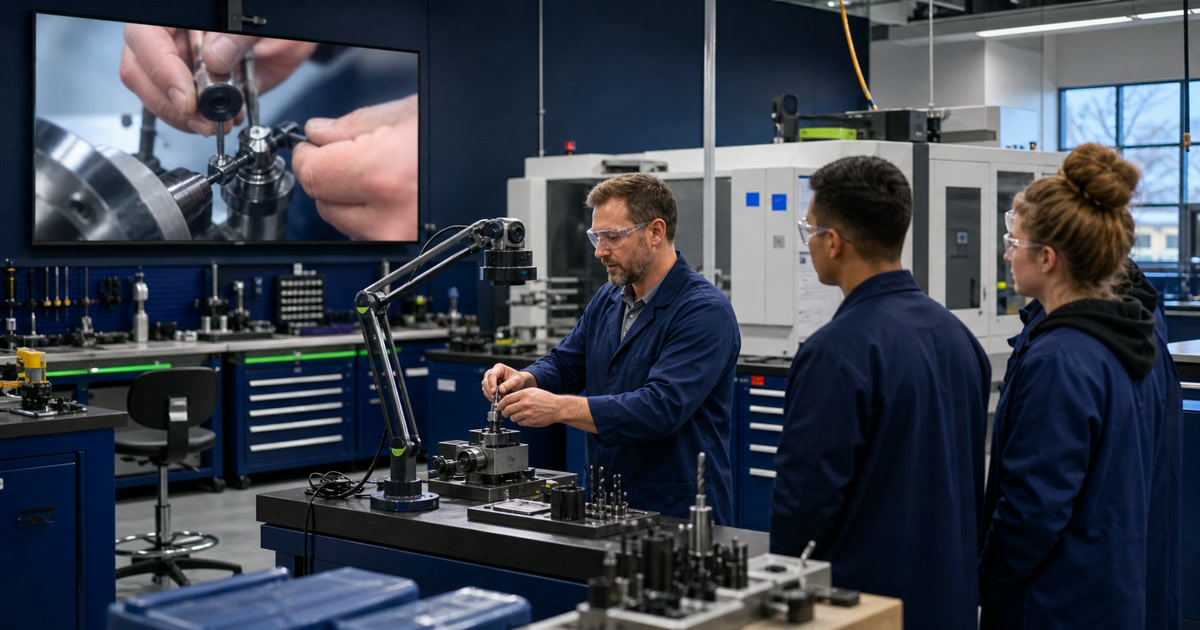
The flagship machine is the easiest decision in the project, which is why it is an easy one to make before the harder ones are settled.
What follows is harder: whether a student at the back can see the instructor’s hands, whether instruction is intelligible over the room, whether work can be captured as evidence of competency, and whether anyone can move safely while a demonstration is running.
None of that appears on the equipment quote. All of it decides whether the lab teaches.
What to settle before a CTE lab is quoted:
| Decision | Where it lands |
|---|---|
| The student task the lab exists to teach | Written down first; the equipment list follows from it |
| Who has to be in the room | Instructors, CTE director, facilities, IT, safety — before the quote, not after |
| What the demonstration has to show | Close-up capture is a different problem from a classroom camera |
| What the quote does not include | Power, ventilation, network, pathway, mounting, storage, consumables |
| What acceptance means | A finished student task, not a device that powers on |
Key Takeaways
- Start from the student’s end-to-end task and the instructor’s workflow, then design the room around the equipment already selected.
- The demonstration problem in a trades lab is a close-up problem, not a screen-size problem.
- Put the CTE instructor, a student, safety, facilities, IT and the equipment specialist in the room together before the design is fixed.
- Define acceptance as a completed class task, not as a powered-on device.
- This article states no grant amount, no deadline, and no allowable cost. Those change, and only the funding authority can confirm them.
On this page
- The Funding Context, Stated Carefully
- Why the Flagship Machine Goes First and Backfires
- Start From the Student’s Task
- Who Has to Be in the Room
- The Demonstration Is a Close-Up Problem
- Collaboration and the Employer Connection
- Infrastructure the Quote Does Not Include
- Accessibility and Safe Circulation
- Accept Against a Finished Task
- Plan the Second Year
The Funding Context, Stated Carefully
Virginia divisions plan CTE equipment against a mix of state competitive grants and federal Perkins allocations, and both are administered by the Virginia Department of Education.
This article deliberately states no dollar amount, no award date, no application window, and no list of allowable costs. A figure copied from the wrong year reads as current.
Confirm all of this with VDOE and the division’s CTE director before scoping anything against it: the current round, the amounts, whether any window is open, and — critically — whether AV, UC, network or cabling items are allowable under the specific program.
Treat allowability as unresolved until the program office confirms it in writing. A design that assumes an ineligible item is grant-funded puts both the item and the grant at risk.
Why the Flagship Machine Goes First and Backfires
Equipment is concrete, quotable, and photographs well. It is also the part of the lab that teaches least without the room around it.
A room designed around the machine can arrive with one large display at the front, an instructor who cannot be heard once the equipment runs, no way to show a hand position at working distance, and no route for a student to capture what they made.
The machine works. The lesson does not.
Start From the Student’s Task
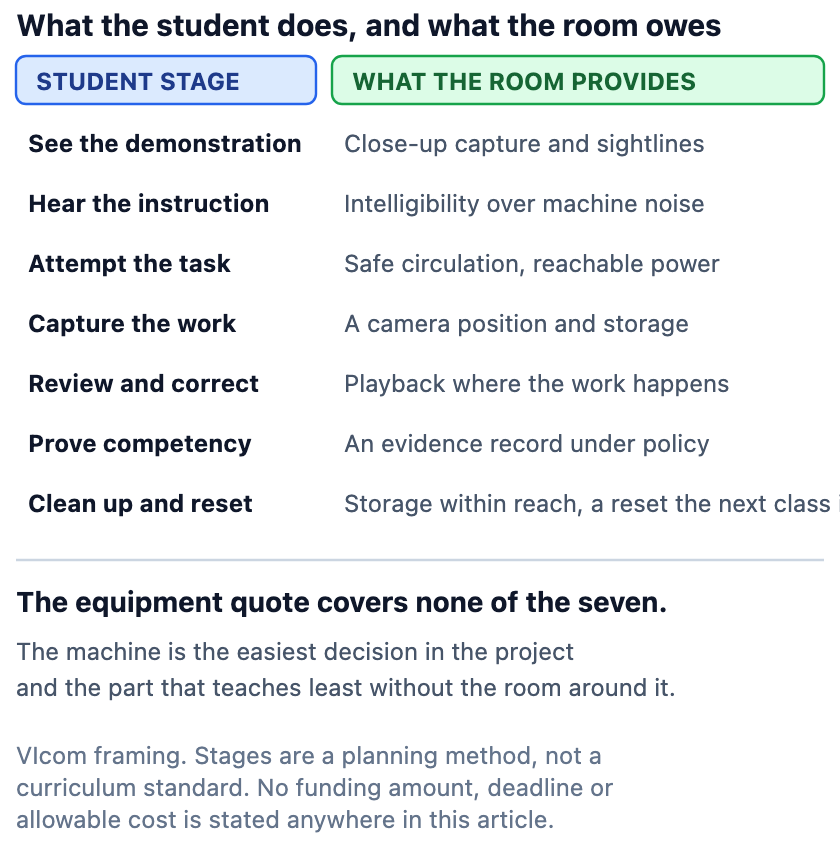
Write down what a student actually does, end to end, then ask what each step needs.
| Stage | What the room has to provide |
|---|---|
| See the demonstration | Close-up capture and a sightline from every position |
| Hear the instruction | Intelligibility over machine and ventilation noise |
| Attempt the task | Safe circulation, reachable power, room to work |
| Capture the work | A camera position, and somewhere the file goes |
| Review and correct | Playback where the work happens, not in another room |
| Prove competency | An evidence record that fits district policy |
| Clean up and reset | Storage within reach, a reset the next class inherits, and surfaces that survive the cleaning agent |
Two illustrative cases, offered as design problems rather than as projects VIcom has delivered.
In a welding or advanced-manufacturing lab, the display is large and the demonstration still fails. A camera at the front cannot safely show the fine hand position, and the microphone is overwhelmed by the room.
The fix is a close-up capture position and a working audio design, not a bigger screen.
In practice that means naming the capture device for the task — a document camera, a movable close-up camera, or a scope — an instructor-worn microphone that survives the machine noise, and a way to annotate the live image so the detail can be pointed at.
In a health-sciences lab, students need to see a close-up skill, hear the instruction, record competency evidence under approved policy, and sometimes connect to a remote practitioner without exposing student records.
That last constraint is a policy question, and it belongs to the people who own student data.
Who Has to Be in the Room
Where one of these is absent from the workshop, the design has nobody to catch the failure at that person’s boundary.
- The CTE instructor who will teach in the room, not a representative of the department
- A student, or a recent completer, who can describe what is hard to see and hear
- The safety authority for the equipment and the shop environment
- Facilities, for power, ventilation, structure and circulation
- IT and network, for capacity, segmentation, identity and support
- The equipment specialist or manufacturer’s applications engineer
- Whoever owns student data and competency records
- CTE administration, who holds the program standards the lab has to satisfy
- Special education or accessibility, before the layout is fixed rather than after
- Procurement, who will run whatever bid this becomes
- An employer or advisory-board partner, who can say what the workplace actually uses
- The integrator who will install and support it
- The person accountable for the budget and the acceptance decision
The instructor and the student are the two the room is actually for, and a design meeting without them has nobody to correct it.
The Demonstration Is a Close-Up Problem
A demonstration fails when the detail that matters is small, moving, and at an angle no fixed front camera can reach safely. More screen area does not solve it.
What solves it is a capture position chosen for the task: a movable close-up camera, a bench camera at the work surface, or a camera mounted at the machine where that can be done safely.
Sizing the display is a separate question, and it has a defensible method: size against the smallest element a student must resolve, not against the room’s dimensions.
Audio deserves equal attention. Existing guidance on classroom audio as accessibility infrastructure covers why intelligibility rather than loudness is the requirement, which matters more in a shop than in a classroom.
Collaboration and the Employer Connection
Industry relevance is a workflow, not a logo on a wall.
Decide how a remote practitioner joins a session, what they can see, and what they must not see. Decide how student work reaches an advisory board or employer partner, in what form, and with whose approval.
The same section carries four decisions that are easy to defer until the room is built:
- Small-group displays where students work in teams, rather than one screen everyone turns toward
- Wireless sharing from a student device, and what it is permitted to show
- Guest speakers and employer interviews joining a class, and from where
- Portfolio and competency review with an outside panel, and the consent that has to exist first
Each of those is an AV and UC decision with a policy constraint attached, and the policy constraint is owned by the division rather than by the design.
A note on scope discipline: esports facilities attract attention and budget. They belong in a CTE plan only where they connect to an approved local program and a workforce outcome, and not as a substitute for one.
Infrastructure the Quote Does Not Include
These are the lines that can appear late, after the equipment budget is committed.
- Electrical capacity, circuits and placement for both equipment and technology
- Structured cabling and pathways, in a room whose layout may change
- Network capacity, segmentation for shop equipment, and wireless coverage that survives metal and machinery
- Storage and retention for captured work, with a stated owner
- Identity and access for students and instructors
- Mounting that tolerates dust, vibration, heat and cleaning
- Support ownership after handover, and who is called when it fails mid-class
The same eligible-versus-ineligible discipline applies to other funding streams, and the habit of separating scopes cleanly transfers directly.
Accessibility and Safe Circulation
A lab has constraints a classroom does not, and they interact.
Sightlines have to work from a seated position as well as a standing one. Captions and recorded demonstrations serve students who cannot get close to the work. Circulation routes have to stay clear of the demonstration position, and no mount may intrude into a path or a machine’s working envelope.
This article does not give machine-safety, building-code, or instructional-credential advice. Those determinations belong to the safety authority, the code official, and the division.
Accept Against a Finished Task
Powering on proves the invoice. It does not prove the lab.
Acceptance should be a class task run end to end, under realistic noise, lighting and occupancy rather than in an empty quiet room.
The instructor demonstrates. Students at the farthest position confirm they can see the detail and hear the instruction. A student completes the task, the work is captured, the file lands where policy says it should, and the evidence is retrievable afterwards.
Write that test before procurement, so the design is aimed at it.
Plan the Second Year
A one-time award funds the opening. It does not fund the second year, which is why the second-year plan has to exist before the ribbon is cut.
Decide before opening who supports the technology, what spares exist, how instructors new to the room are trained, and what the refresh horizon is for the technology layer as distinct from the industry equipment.
Five more belong in the same decision, and each has a cost that arrives after the ribbon is cut:
- Consumables and calibration, budgeted per year rather than per project
- Software licenses and warranties, with renewal dates and a named owner
- A cybersecurity and device-management review before the lab joins the network
- Documentation and help-desk routing, so a mid-class failure has a number to call
- Who reimages the machines, and on what cycle
Existing guidance on running a classroom experience drill before faculty return covers the rehearsal that keeps a room working across years.
Sources
No amount, date, deadline or allowable cost from the sources below is reproduced in this article; the funding section explains why those details belong in the current program materials.
- Virginia Department of Education, CTE Director Memos, retrieved 2026-08-28.
- Virginia Department of Education, Strengthening CTE for the 21st Century Act — Perkins V, retrieved 2026-08-28.
- Virginia Department of Education, News Releases, retrieved 2026-08-28.
Take the Workflow Into the Design Meeting
The stage-by-stage student task, the people who have to be in the room, the infrastructure a quote leaves out and the acceptance record are on a one-page worksheet for a CTE director and an instructor to complete together.
Download the CTE lab student-workflow worksheet — PDF, one page, no registration.
Related Reading
- Classroom audio is accessibility infrastructure — intelligibility in a noisy room.
- Before faculty return: run the classroom experience drill — rehearsing the finished space.
Where VIcom Fits
VIcom can facilitate the student-workflow workshop, design the AV and UC layer around the selected industry equipment, coordinate network and structured cabling, stage and test the systems, integrate remote experts and content capture, train instructors, and support the lab after it opens.
VIcom complements the CTE equipment specialist and the safety authorities rather than replacing them, does not determine grant eligibility or allowable costs, and does not give machine-safety or instructional-credential advice.
Connect with VIcom by filling out the form below.