
A statewide network program ends at a demarcation point. The operational outcome does not.
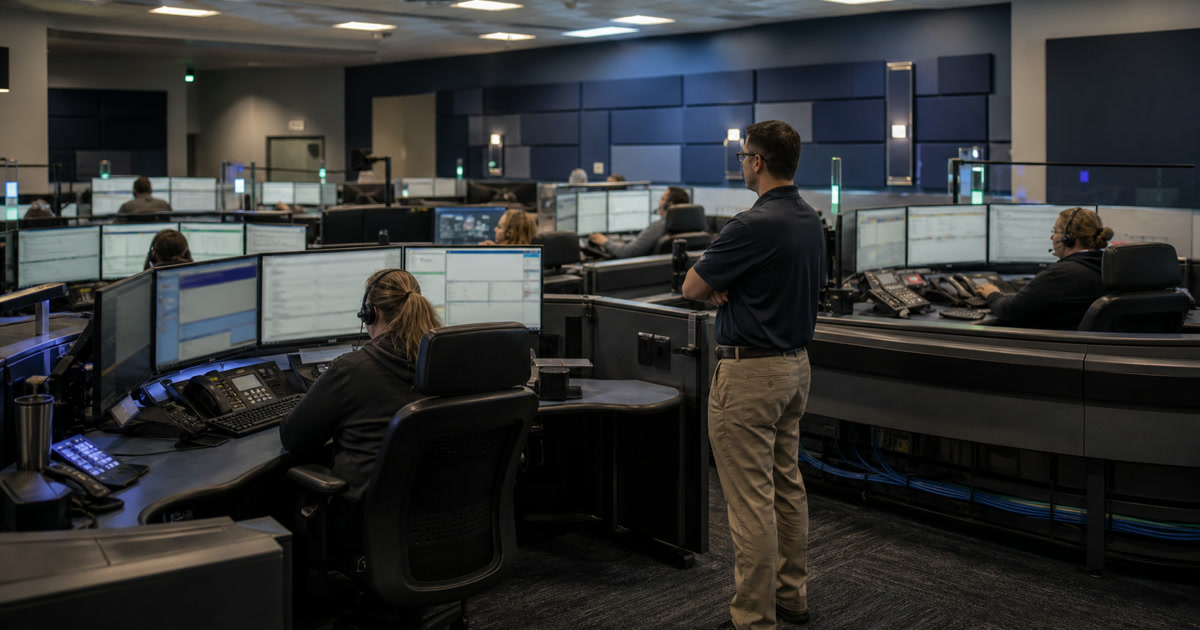
What a call becomes after it arrives depends on the room: what an operator can see without turning, what can be heard over everything else, what a supervisor can share during a major incident, and what remains available when a component fails.
None of that was in scope for the network migration, and none of it improves on its own.
What to settle before a dispatch-room refresh is scoped:
| Decision | Where it lands |
|---|---|
| What the network program did and did not cover | The network layer is not the room layer, and the room layer has its own owner |
| Where mission systems end and presentation begins | Everything downstream inherits this boundary |
| Which workflows the room has to serve | Answered before any display or console is specified |
| How the assessment happens without disturbing operations | A live PSAP does not stop for a survey |
| Who owns each program question | Named roles, not “the vendor” |
Key Takeaways
- VDEM announced that “the final local government deployments are scheduled for October 22, 2025, in Craig County and Covington, Virginia” (VDEM, retrieved 2026-08-24).
- The program set out to migrate “125 local government 9-1-1 centers from legacy circuit-switched technology to a modern Emergency Services Internet Protocol network (ESInet)”, described as a “$49.6 million project” (VDEM, retrieved 2026-08-24).
- The room layer — displays, audio, sightlines, lighting, furniture, power, cooling, support access — was outside that scope.
- Keep the shared display downstream of the mission systems. A wall that becomes a second, ungoverned copy of CAD creates a conflicting source of truth.
- A large video wall is not automatically the answer, and sometimes it is the wrong one.
On this page
- What the Network Program Covered
- Where the Room Layer Begins
- Keep Mission Systems and Presentation Separate
- Answer the Workflow Questions First
- Human Factors Decide Whether It Helps
- Resilience Is a Room Property Too
- Assess Without Disturbing Live Operations
- A Video Wall Is Not Automatically the Answer
- Route Program Questions to the Right Owners
- Take the Assessment Into the Room
What the Network Program Covered
The milestone matters only if it is stated precisely, because the scope boundary is what the rest of this depends on.
VDEM’s October 2025 announcement stated that “the final local government deployments are scheduled for October 22, 2025, in Craig County and Covington, Virginia.”
It described a program that, beginning in 2020, set out to migrate “125 local government 9-1-1 centers from legacy circuit-switched technology to a modern Emergency Services Internet Protocol network (ESInet)”, and characterized it as a “$49.6 million project” (VDEM, retrieved 2026-08-24).
VDEM listed three intended outcomes, stated as goals rather than as delivered results.
Faster call routing “to the appropriate 9-1-1 center with enhanced caller and location information”. Enabling “seamless call transfers among 9-1-1 centers, including critical data associated with the call.” Integration of “9-1-1 networks with other public safety systems and databases.”
Two cautions belong with those quotations.
The announcement is dated 17 October 2025 and describes the final deployments as scheduled rather than completed, so current statewide status should be confirmed with VDEM and the 9-1-1 Services Board.
What a specific center can do today also depends on its own platform, configuration and local agreements, not on the network alone.
Where the Room Layer Begins
The room layer is everything the ESInet program did not touch.
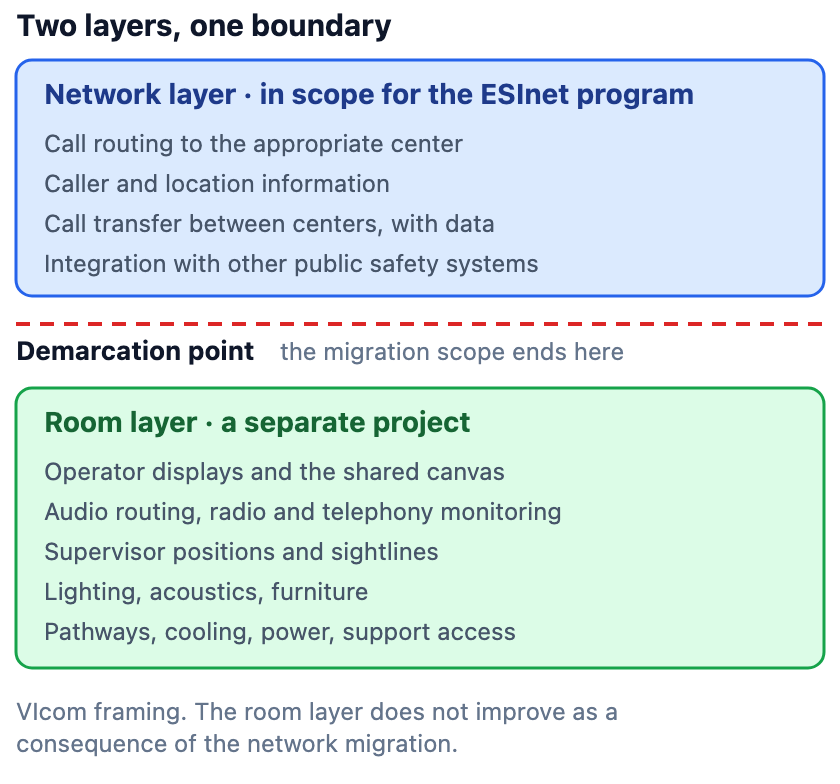
- Operator displays: count, size, arrangement, and what occupies each one
- The shared situational-awareness canvas, if one is justified
- Audio routing: radio, telephony, intercom, alerting, and how they mix at a position
- Supervisor and incident-command positions, and what they can see that operators cannot
- Lighting, acoustics, furniture, sightlines, and reflection control
- Cable pathways, cooling, power paths, and secure support access
Each of those has an owner, a lifecycle, and a failure mode. None of them was in the migration scope.
Keep Mission Systems and Presentation Separate
Everything downstream inherits this decision, which is why it belongs at the start of a refresh rather than in the middle of one.
The 911 platform, radio, CAD, GIS and the network are governed and owned by people who are accountable for them, and each operates under its own approval regime.
An AV presentation layer should take feeds from those systems and display them. It should not reimplement them, cache them, or become a second path by which their data reaches an operator.
A shared wall that shows a stale or independently assembled copy of CAD is worse than no wall. It creates a second source of truth in a room whose entire function is knowing which one is correct.
The practical test is a question: if the presentation layer is powered off entirely, does any mission function stop? The answer should be no.
Answer the Workflow Questions First
Hardware selected before these are settled is a guess.
| Question | What it determines |
|---|---|
| What must every operator see at all times | The per-position display count and layout |
| What belongs only at a supervisor position | Whether a shared canvas is needed at all |
| What should move to a shared display during a major incident | The source-switching design, not the screen size |
| Who controls what appears there, and how quickly | The control interface and its governance |
| What is the fallback when the shared display is unavailable | Whether the room degrades gracefully or stops |
| Who is accountable for the content shown | Whether the canvas stays trustworthy over time |
The last two are the ones most easily deferred, and they are the ones that decide whether the investment is still trusted in its second year.
Human Factors Decide Whether It Helps
A room can add information and reduce awareness.
- Display placement that does not require repeated head and neck movement across a shift
- Map and text legibility from the actual seated eye position, with the fonts and symbology in use
- Alarm and alert design that does not train operators to dismiss things reflexively
- Intelligible audio at every position, with clear separation between radio, telephony and alerting
- Lighting and finishes chosen to control reflections on displays, at night as well as by day
- Sightlines between operators and supervisors, and to any shared canvas
- Shift handoff, which is a workflow with its own information needs
- Maintenance access that does not require working across an occupied position
These are stated as design considerations rather than safety findings. Whether a given change improves operator performance in a given center is a question for that center’s own evaluation, and this article makes no claim about response outcomes.
Resilience Is a Room Property Too
The network can be redundant while the room is not.
- Independent power paths where the criticality justifies the cost, with the panel and circuit documented
- UPS runtime measured rather than specified, and generator coverage confirmed for the positions that matter
- Redundant processors or controllers for shared presentation, where its loss would matter
- Local fallback at a position when a central component fails
- Spare displays and hot-swappable components held on site, with someone accountable for the stock
- Maintenance bypass so a component can be serviced without taking the room down
- Network separation between presentation and mission systems, documented and tested
- Recovery documentation that has been exercised, not just written
Assess Without Disturbing Live Operations
A PSAP does not close for a survey. The method has to assume that.
Two hypotheticals show what the survey is looking for.
Supervisors gather around one small screen during a significant incident, because the shared display cannot securely show the source they need.
A pair of redundant processors sits in a rack with one power circuit and no service clearance, so the redundancy exists on paper and cannot be maintained without taking the room down.
- Interview operators, supervisors and the mission-system owners separately. Each describes a different room.
- Observe across shifts, including nights and a weekend, because the room does not behave the same way at every hour.
- Inventory every source and every destination, and record which are mission and which are presentation.
- Build a dependency map covering power, network, control and support ownership.
- Read the maintenance history. Recurring faults point at problems a fresh survey would have to rediscover.
- Review recent significant incidents with the people who worked them, for information gaps rather than performance.
- Take non-disruptive measurements: light levels, acoustics, sightline geometry, temperature.
- Mock up any proposed change and let operators use it before it is procured.
- Stage and configure off-site, then plan a cutover with a rehearsed rollback.
Existing guidance on emergency operations center AV for local government covers the adjacent room type, where the same separation and resilience questions apply.
A Video Wall Is Not Automatically the Answer
The reflexive purchase is a large shared canvas. It is not automatically the intervention with the best return.
Depending on what the workflow questions surface, the right outcome may be better personal displays at each position, a smaller shared canvas used deliberately, improved source control rather than more screen area, changes to audio routing and separation, furniture and sightline correction, or simply making the existing estate supportable.
A shared canvas that nobody is accountable for filling becomes wallpaper. A wall sized for a photograph rather than for the map and text actually shown may not be readable from the positions that need it.
Route Program Questions to the Right Owners
Nothing in this article answers a program, funding, or certification question.
The Virginia 9-1-1 Services Board, VDEM’s Public Safety Communications division, and each locality’s own PSAP governance own program direction, grants, and the requirements a center must meet. Those questions belong with them, and so does confirmation of current statewide deployment status.
The room-layer work described here sits underneath that governance rather than beside it.
Take the Assessment Into the Room
The separation boundary, the workflow questions, the human-factors and resilience checks, the nine-step assessment method and the case against a reflexive video wall are on a one-page worksheet for a PSAP director and a technology lead to complete together.
Download the PSAP room readiness worksheet — PDF, one page, no registration.
Sources
- VDEM, Virginia Nears Completion of Statewide NG9-1-1 Deployment, 17 October 2025
- VDEM, Public Safety Communications
- VDEM, 9-1-1 and Geospatial Services
Program status, governance, and requirements all change. Confirm current status and obligations with VDEM and the Virginia 9-1-1 Services Board before relying on anything above.
Related Reading
- Emergency operations center AV for local government — the adjacent mission room.
- Every networked AV endpoint needs an owner — the ownership record this assessment depends on.
- Council chamber AV in 2026 — the other public-sector room with a live audience.
Where VIcom Fits
VIcom can assess the room layer without interrupting operations, inventory sources and destinations against their owners, map power, network and control dependencies, mock up a proposed change for operators to use before it is bought, stage and configure off-site, and plan a cutover with a rehearsed rollback.
VIcom does not operate, certify, or replace the 911 platform, radio, CAD, GIS or network, and does not set program requirements. Those belong to their owners and to Virginia’s 911 governance.
Connect with VIcom by filling out the form below.