
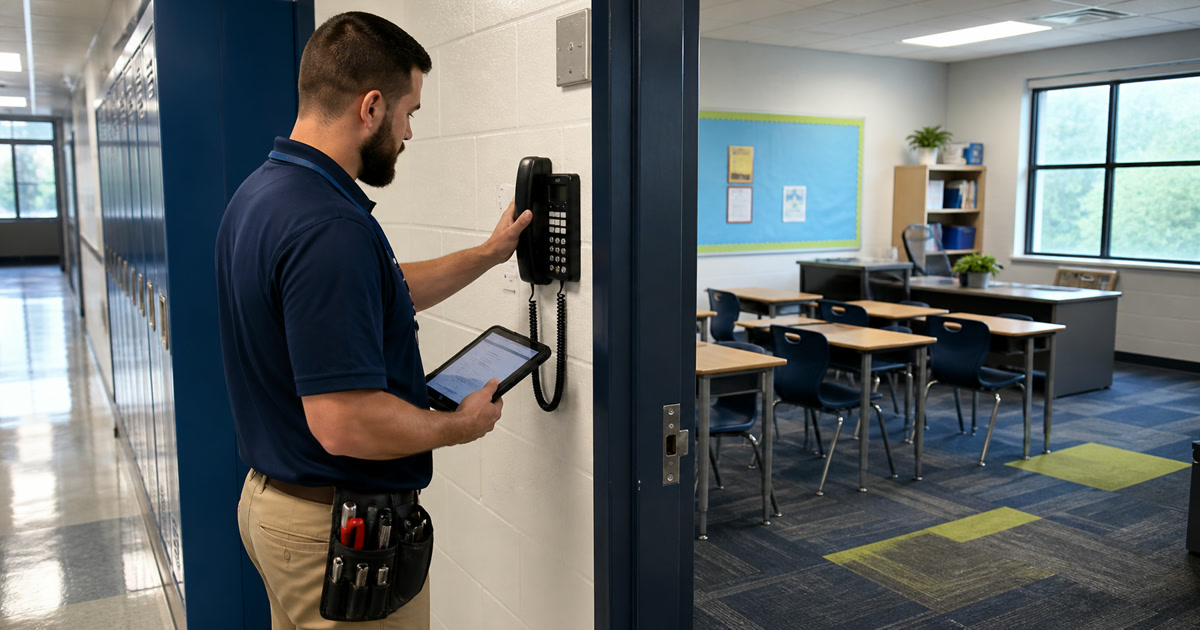
A 911 call that connects has not proved very much.
The call has to arrive with enough information to send someone to the right door. On a campus with a dozen buildings, a shared street address does not do that.
August is when the assumptions break. Rooms reopen, staff move, modular classrooms appear, softphones reconnect from new subnets, and a system that tested correctly in June meets a building full of people.
The back-to-school check, in five steps:
| Step | What it settles |
|---|---|
| 1. Never test-call 911 uncoordinated | Use the carrier or platform test method, or arrange with the local 911 authority |
| 2. Inventory every endpoint that can dial | Including analog lines, elevators, modulars and softphones |
| 3. Compare the record to a dispatchable location | Building, floor, wing, room — plus how a responder gets in |
| 4. Watch a notification arrive | Who receives it, what it says, and whether anyone is there |
| 5. Name the owner and the service level | “Within one business day of the move ticket” — not “when someone notices” |
Key Takeaways
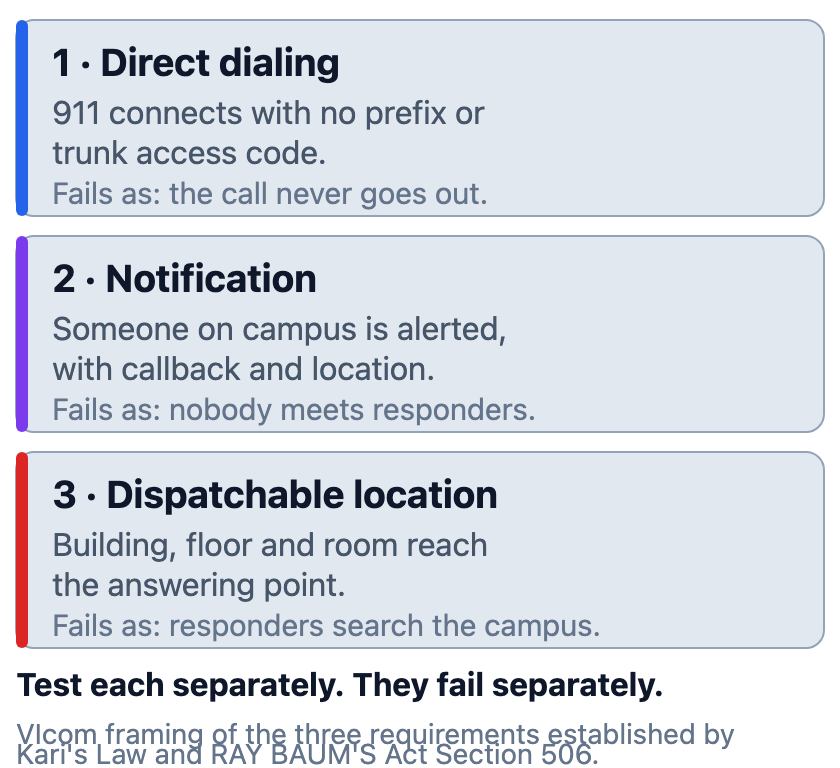
- Three separate things have to work: direct dialing without a prefix, notification to somewhere staffed, and a dispatchable location detailed enough to find the caller.
- A successful desk-phone test does not validate a softphone, a moved extension, or a modular building.
- Never place an uncoordinated test call to 911. Use the carrier or platform test method, or arrange a test with the local 911 authority.
- Applicability and exact obligations depend on the system and the circumstances. Those are questions for the FCC, counsel, the service provider, and the local 911 authority.
- The durable fix is ownership: who updates the location record when a room is renumbered, and how fast.
On this page
- The Three Things That Have to Work
- Never Test-Call 911 Without Coordination
- Build the Endpoint and Location Inventory
- A Street Address Is Not a Dispatchable Location
- Test the Notification Path, Not Just the Call
- Softphones, Wi-Fi, and Anything That Moves
- Decide Who Owns the Location Record
- Make It an Auditable Annual Check
- What This Does Not Replace
- Take the Check Into the Building
The Three Things That Have to Work
They fail independently, so they have to be tested independently.
Direct dialing. A person dials 911 and the call goes through. No 9 first, no prefix, no trunk access code, no front-desk transfer.
Notification. When that call is placed, someone on campus is told. The alert carries a callback number and information about where the caller is.
Dispatchable location. What reaches the answering point is specific enough to act on — the street address plus the detail that narrows it, such as building, floor, and room.
Those three come from two federal laws: Kari’s Law and Section 506 of RAY BAUM’S Act, implemented through FCC rules. The two statutes carry different obligations and different phase-in timing, which is one reason applicability is a question for counsel rather than for an article (see Sources).
This article does not attempt to state what any specific institution must do. Applicability turns on the system, its age, how it was upgraded, and how it is configured. Those determinations belong to the FCC’s published rules, the institution’s counsel, its service provider, and the local 911 authority.
What follows is the operational half: how to find out what actually happens today.
Never Test-Call 911 Without Coordination
This is the one instruction in the article with no exceptions.
An uncoordinated test call consumes a dispatcher during a real emergency somewhere else. It is also a poor test, because nobody on the receiving end is recording what arrived.
Use one of these instead:
- The carrier’s or UC platform’s designated test number or test mode
- A scheduled, agreed test with the local 911 authority, on their terms and their timing
- A non-emergency coordination line, arranged in advance with a named contact
- A vendor-supplied simulation that exercises the location lookup without placing a call
Whichever route, agree in advance what the answering point will report back. A test that produces no record of what the answering point (PSAP) saw has tested the phone, not the system.
Build the Endpoint and Location Inventory
The inventory is the precondition for everything that follows.
One row per endpoint that can dial:
- Classroom phones and administrative phones
- Analog lines, including elevators and areas of refuge
- Security desks, nurse offices, and front-office phones
- Athletic facilities, field houses, and outbuildings
- Modular and temporary classrooms
- Residence halls, labs, and shared-area phones
- Softphones on laptops and mobile devices
- Remote and hybrid staff who may dial from off campus
- Conference room and paging-integrated devices
For each: what location record is registered against it, when that record was last confirmed, and who owns changing it.
A Street Address Is Not a Dispatchable Location
A district office address on a call from a middle school is a failure that looks like success.
The gap between a campus address and an actionable location is where responders lose time:
| What arrives | What responders still have to do |
|---|---|
| District street address only | Identify which of several campuses, then which building |
| Campus address only | Search buildings on foot |
| Building identified | Find the floor and wing |
| Building, floor, room | Go directly, if the room label matches the signage |
The last row is the goal, and it has a condition attached. A location record that says “Room 112” is only useful if the door says 112 and the responder can find it from the entrance they will actually use.
Access instructions matter as much as coordinates. A locked vestibule, a service corridor, or an athletic entrance that is chained after hours all belong in the record where the platform supports it.
Test the Notification Path, Not Just the Call
Notification is easy to configure once and never observe again.
Watch a coordinated test rather than read a configuration screen.
Start with who actually receives the alert, by name and role, and what the alert contains when it arrives: callback number, endpoint, location record. Then ask whether that destination is staffed at the hour tested, and what becomes of it at 6am, during a game, and over a holiday.
Two questions remain that a configuration screen cannot answer. Can a responder be met and guided to the room without delaying the call, and does the alert reach a device someone is carrying rather than a screen someone walks past?
A notification that lands on an unattended monitor in a locked office is a configuration that passes inspection and fails in use.
Softphones, Wi-Fi, and Anything That Moves
Fixed desk phones are the easy case. Anything else on campus that can dial 911 is the harder one.
A softphone reports the location the platform infers, which may come from a subnet, a wireless controller, or a value the user typed months ago and forgot. A device on VPN can appear to be somewhere it is not. Wi-Fi calling behaves differently again.
Physical moves are the quiet case. A phone carried from Room 112 to a modular classroom keeps its old record until someone changes it, and nothing about the phone announces the discrepancy. A staff member dialing from home is a different problem entirely, and one worth deciding about deliberately rather than discovering.
Test at least one endpoint of each type, by the same coordinated method. A validated desk phone establishes nothing about the laptop in the same room.
Existing guidance on running a classroom experience drill before faculty return covers the same principle applied to teaching technology: rehearse the real journey, not the equipment.
Decide Who Owns the Location Record
A location record goes stale one move at a time, not all at once.
Name an owner and a trigger for each event:
- A phone is moved between rooms
- Rooms are renumbered or a wing is renamed
- A building opens, closes, or is renovated
- A modular classroom is placed or removed
- A network port or subnet changes
- Staff move offices
- The carrier or platform is migrated
Then set a service level. “Within one business day of the move ticket closing” is an ownership statement. “When someone notices” is not.
Existing guidance on giving every networked AV endpoint a clear owner covers the same ownership discipline applied across a connected estate.
Make It an Auditable Annual Check
The check is worth little if it leaves no record.
Produce, each year and after any significant change:
- The endpoint inventory with location records as tested
- Which endpoints were tested and by what coordinated method
- What the answering point reported receiving
- Exceptions, each with an owner and a due date
- The date of the next scheduled check
That record is also what makes the following year cheap. The second audit is a diff, not a discovery exercise.
What This Does Not Replace
Emergency calling and mass notification are different systems solving different problems.
Mass notification tells many people something. Emergency calling brings responders to one person. A campus needs both, and neither substitutes for the other. The same holds for paging, signage, radios, and crisis communication plans.
Passing a technical test also does not establish legal compliance. It establishes what the system did on the day it was tested, which is a necessary input to a compliance determination made by people qualified to make it.
Take the Check Into the Building
The inventory rows, coordinated test methods, dispatchable-location comparison, notification test and ownership triggers are on a one-page sheet for a walkthrough with facilities and the phone-system owner.
Download the school E911 back-to-school check — PDF, one page, no registration.
Sources
- Federal Communications Commission, Multi-line Telephone Systems — Kari’s Law and RAY BAUM’S Act 911 Direct Dialing, Notification, and Dispatchable Location Requirements, retrieved 2026-08-28.
- National 911 Program, Kari’s Law and RAY BAUM’S Act, retrieved 2026-08-28.
Related Reading
- Before faculty return: run the classroom experience drill — rehearsing the real journey rather than checking equipment.
- Classroom audio is accessibility infrastructure — the other campus system where intelligibility decides whether it works.
- Virginia’s school security grant window — scoping communication technology against a funding cycle.
Where VIcom Fits
VIcom can map endpoints and their location records, coordinate testing with platform and carrier resources, observe and document what the notification path actually delivers, and connect emergency calling to the wider campus communication estate. That work supports the institution’s own determination rather than making one.
Regulatory requirements, platform test methods, and local 911 procedures all change. Institutions should confirm current obligations with the FCC, their counsel, their service provider, and their local 911 authority before acting on anything here.
Connect with VIcom by filling out the form below.