
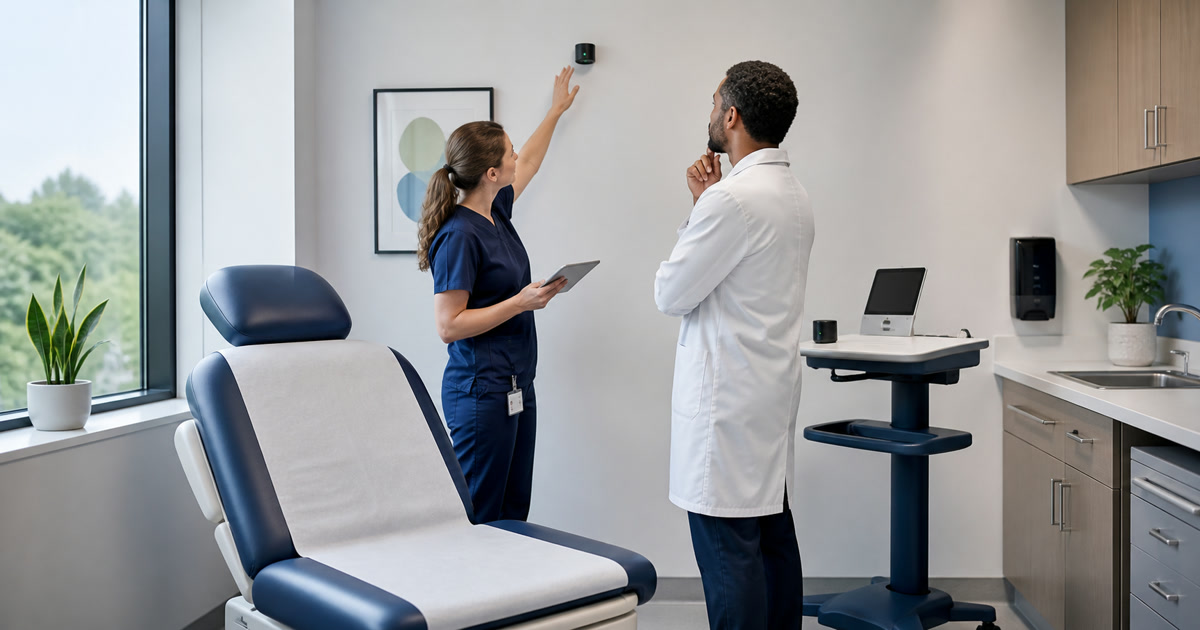
A pilot that performs well in a carpeted consultation room and poorly in an exam room is reporting on the room as much as on the model. Without holding the room constant, the result describes both.
Before the software can be judged, the space, the capture chain, the device, the network, the controls, the consent workflow, the data path and the failure behavior all have to be known quantities. Otherwise the evaluation measures the building.
Before the pilot starts:
| Do this | Because |
|---|---|
| Survey every room type that will host it | A result is only attributable if the room was characterized first |
| Build a matrix, not a demo | A quiet executive room is among the least informative places to test |
| Make capture state legible from where the patient sits | Policy can only be followed if the state is observable |
| Map the data chain before any content exists | Audio, transcript and draft note are three artifacts with three answers |
| Measure the note, not the transcript | A clean transcript can still carry a wrong note |
Key Takeaways
- Joint Commission launched a voluntary Responsible Use of AI in Healthcare certification on June 1, 2026, organized around five areas: governance; effective data management; risk and bias reduction; monitoring, evaluating and validating safety performance, effectiveness and responsible use; and transparency, education and training.
- The certification assesses organization-level governance, not individual AI products, and organizations do not need to be Joint Commission accredited to apply.
- Room conditions affect transcript quality separately from the model. Where a pilot lets the room vary along with the software, its results describe both.
- Capture state has to be visible to the patient and unambiguous to the clinician, and stopping it has to be immediate.
- A clean transcript is not a clinically accurate note. Measure correction rate, missed speakers, and added or omitted facts, not word error alone.
On this page
- What This Article Does Not Cover
- The Governance Frame the Pilot Sits Inside
- Why the Room Changes the Output
- The Room Survey
- Build a Pilot Matrix, Not a Demonstration
- Make Capture State Legible
- Map the Data Chain Before the First Recording
- Measure the Note, Not the Transcript
- Decide What Happens When It Fails
- Take the Survey Into the Pilot
What This Article Does Not Cover
This is about the capture environment around ambient documentation. It is not an evaluation of clinical efficacy and it does not compare vendors.
Ambient documentation support is also a different thing from diagnosis or autonomous clinical decision-making. The distinction matters for governance, because conflating them imports the wrong review process.
Nothing here is legal, clinical, privacy or compliance advice. Room design does not make an organization compliant with any regulation.
The Governance Frame the Pilot Sits Inside
There is now an organization-level frame to hang this on.
Joint Commission launched a voluntary Responsible Use of AI in Healthcare certification on June 1, 2026.
Its standards are organized around five areas: governance; effective data management; risk and bias reduction; monitoring, evaluating and validating safety performance, effectiveness and responsible use; and transparency, education and training (Joint Commission, Responsible Use of AI in Healthcare, retrieved 2026-08-28).
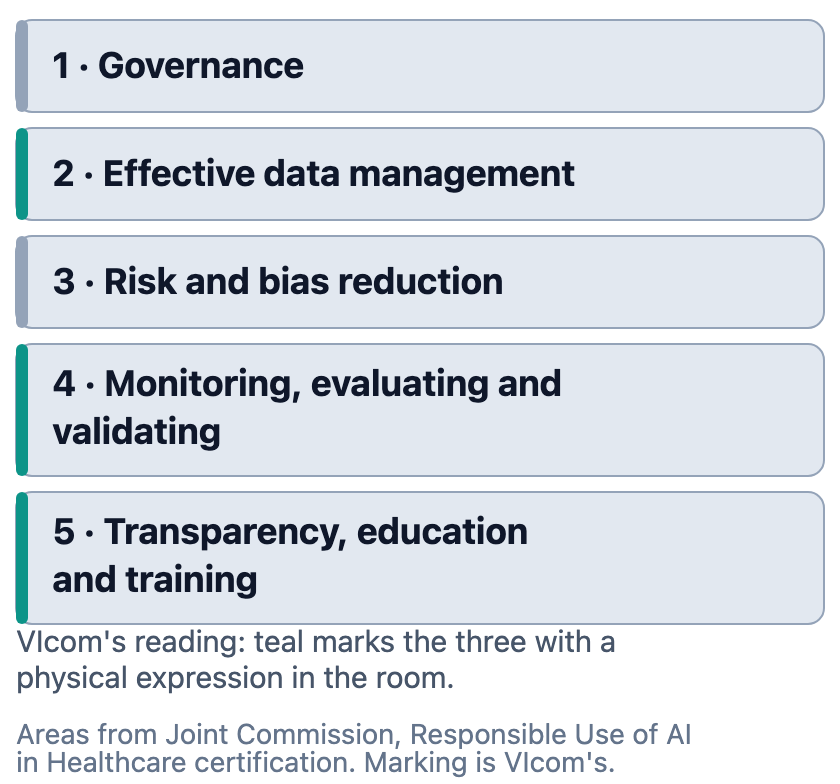
Two features shape a pilot: the certification assesses organization-level governance rather than individual AI products, and organizations do not need to be Joint Commission accredited to apply.
Neither VIcom nor any room design confers this certification, and nothing here is a certification requirement.
The connection to a room is narrower than the framework but real. Data management, monitoring and validation, and transparency all have physical expressions: what the microphone captured, whether conditions were recorded alongside the result, and whether the patient could tell the system was listening.
Why the Room Changes the Output
Exam rooms supply difficult inputs, and speech recognition degrades on them.
- Reverberation from hard, cleanable surfaces
- Continuous noise from air handling, and intermittent noise from corridors
- Distance and orientation between speaker and microphone
- Overlapping speech when a caregiver or interpreter is present
- Masks, soft voices, and patients who are unwell
- Rolling workstations and equipment that move the microphone between encounters
- Privacy conditions outside the door that change what people are willing to say
None of these are model problems. Any of them can show up in model output.
Existing guidance on clinical telehealth room reliability makes the same argument for testing the care workflow rather than the call.
The Room Survey
Before the pilot, characterize each room type that will host it.
- Room type, dimensions, and surface treatment
- Measured background noise under occupied conditions
- Microphone location, pickup pattern, and distance to the usual speaking positions
- Device position, mounting, and whether it moves between encounters
- Network coverage and segmentation at the point of use
- Power and charging, including what happens overnight
- Cleaning protocol and whether the device tolerates it
- Physical security and tamper exposure
- Login method and how long it takes
- Capture indicator, mute control, and stop control
- The workflow for a conversation that should not be captured
The survey is what makes a later result attributable to something.
Build a Pilot Matrix, Not a Demonstration
A quiet executive room is among the least informative places to test.
Cover the range the service will meet, where clinically appropriate and approved: different specialties and room geometries, encounters with interpreters or family present, patients with limited mobility, and locations with weaker connectivity.
Hold one variable constant at a time. If room, device position and encounter type all vary between sessions, the pilot produces anecdotes.
Make Capture State Legible
Two people need to know what the system is doing, and they need to know it differently. The patient needs an unambiguous signal that does not depend on reading a screen. The clinician needs certainty about whether pressing mute stops the audio output, the capture, or the session.
Practical requirements:
- Capture state is visible from where the patient sits
- The state changes visibly when capture starts and stops
- Stopping is immediate and does not require a menu
- A person entering mid-encounter can tell what is happening
- The clinician can confirm state without breaking the conversation
Whether consent is required, and in what form, is a question for the health system’s clinical, privacy and legal teams. What the room owes those policies is the mechanics that let them be honored in the moment.
Four of those mechanics are worth specifying before a pilot begins.
- An immediate stop. A refusal is only respected immediately if stopping is a single action, reachable without navigating a menu and without the clinician signing in again. Decide whether the patient may take that action directly.
- A confirmable state. The clinician needs to confirm capture is off without turning away from the patient, and needs to know whether the control stopped the audio output, the capture, or the whole session. Audio output, capture and session are three different outcomes, and one control may not distinguish them. Establish which of the three the control stops before the pilot begins.
- A way the patient is told, in the room. A notice has to be readable from the chair rather than from the doorway, and someone has to decide whether the clinician says anything at the start and who supplies that wording. Whether notification is required at all remains a question for the teams named above.
- A defined behavior when a third person enters. An interpreter, a family member, or a colleague arriving mid-encounter changes who is being captured. Decide in advance whether the session pauses, whether the arrival is announced, and who is responsible for saying so.
Map the Data Chain Before the First Recording
Draw the path once, completely, before content exists.
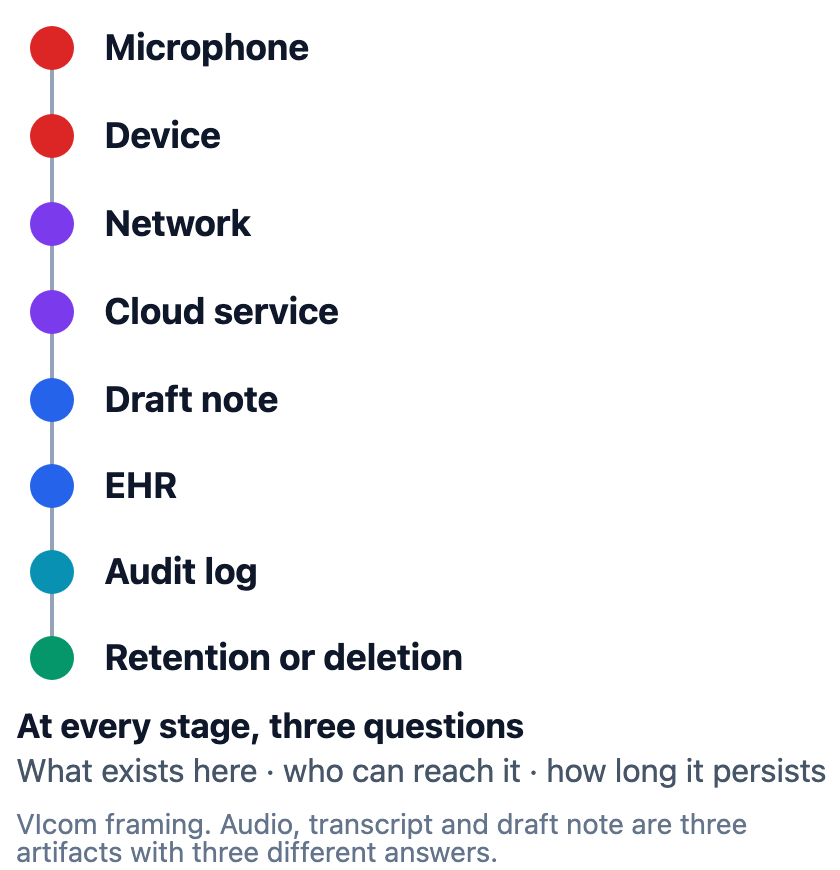
At each stage, three questions: what exists here, who can reach it, how long does it persist. The audit log is the stage that answers the second one. Audio, transcript and draft note are three artifacts with three different answers.
Two further questions belong to the organization rather than the room: which parties are business associates, and what agreements or security review that implies. Neither should wait until a pilot has accumulated content.
HHS telehealth privacy guidance is not an ambient-documentation rulebook and is not treated as one here.
Its themes around privacy, consent for recording, secure communications and patient education are useful as an analogy for the questions worth asking (HHS, Develop a privacy and security policy, retrieved 2026-08-28).
Measure the Note, Not the Transcript
Word error rate is the wrong headline number.
A transcript can be clean and the note still wrong, because the failure that matters is at the summarization step: a fact added that nobody said, a fact omitted that someone did, or the wrong speaker credited.
Worth measuring across the pilot:
- Clinician correction rate per note, and what category of correction
- Missed or misattributed speakers
- Facts present in the note but absent from the encounter
- Facts present in the encounter but absent from the note
- Time from encounter close to signed note
- Patient comfort and whether anyone declined
- Support tickets, by room rather than in aggregate
Record room conditions alongside those numbers. A correction rate without the ambient noise level beside it cannot be acted on.
Decide What Happens When It Fails
The room still has to work when the software does not.
- The failure state is visible rather than silent
- Manual documentation remains possible without a workaround
- Local cache behavior is understood, including what is held and for how long
- Support routing is known before it is needed
- The clinical conversation is unaffected
Observe the pilot failing at least once before drawing conclusions from it.
Existing guidance on upgrading healthcare AV without compromising infection control covers installing any of this in a live clinical area.
Take the Survey Into the Pilot
The room survey, the pilot matrix, the capture-state requirements and the measurement list are on a one-page
sheet built for a clinical-informatics or facilities walkthrough.
Download the ambient AI room-readiness survey — PDF, one page, no registration.
Sources
- Joint Commission, Responsible Use of AI in Healthcare Certification, retrieved 2026-08-28.
- Joint Commission, Joint Commission Launches Responsible Use of AI in Healthcare Certification, published 2026-06-01; retrieved 2026-08-28.
- U.S. Department of Health and Human Services, Develop a privacy and security policy, last updated 2025-07-29; retrieved 2026-08-28.
Related Reading
- The clinical telehealth room reliability audit — testing the care workflow rather than the call.
- When video remote interpreting fails, communication fails — the interpreter path that ambient capture has to accommodate.
- How to upgrade healthcare AV without compromising infection control — doing the physical work in a live clinical area.
What VIcom Can Do Here
VIcom can make the physical and network environment measurable before software conclusions are drawn: acoustics, microphone coverage, device placement, network readiness, secure connectivity, power, room controls, cleaning and serviceability, and a repeatable room profile for deployment. That work complements the health system’s clinical, privacy, security, legal and vendor-governance teams rather than substituting for any of them.
Certification programs, guidance pages and vendor capabilities all change. Organizations should confirm current requirements with the publishing bodies and route clinical, privacy and legal questions through their own governance.
Connect with VIcom by filling out the form below.