
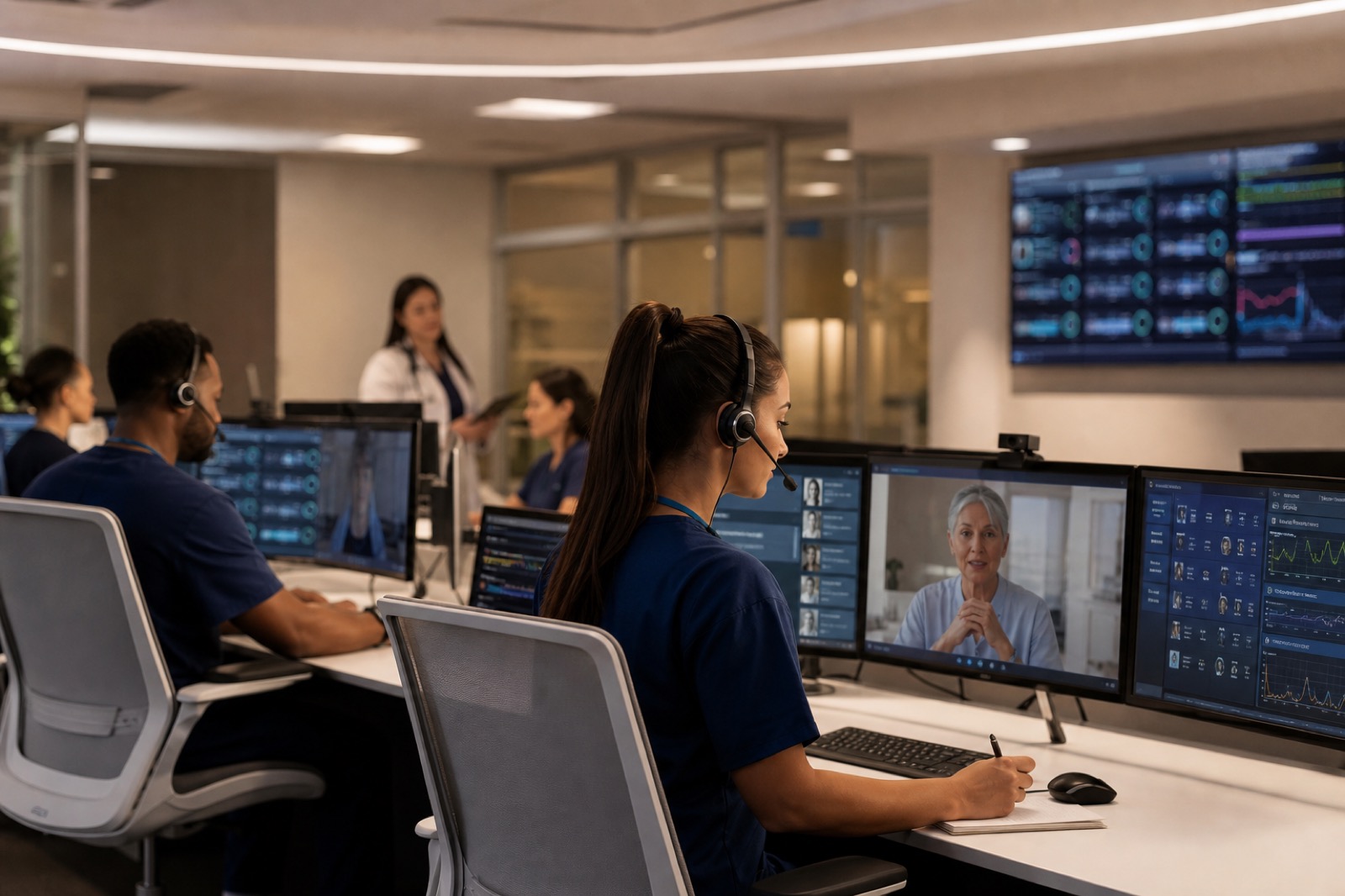
Virtual nursing is not solved by a camera
Virtual nursing has become a serious priority as health systems look for ways to support bedside teams, reduce documentation burden, improve patient safety, and extend experienced nursing resources. But the technology foundation cannot be treated like a generic video call. A patient room is not a small conference room. A command space is not a standard office. The workflow is clinical, time-sensitive, privacy-sensitive, and human.
A nurse must be able to see, hear, speak, document, escalate, and hand off without fighting the technology. A patient must understand when virtual support is active, who is present, and why the interaction is happening. A bedside nurse must trust that the virtual workflow will help rather than create another system to manage. IT and clinical operations must know how rooms are supported, monitored, cleaned, secured, and improved over time.
That is why virtual nursing AV should be designed as clinical infrastructure. Cameras, microphones, speakers, displays, command spaces, collaboration tools, privacy indicators, integration points, training, and managed support all need to work together.
Define the use cases before standardizing devices
Virtual nursing can support admissions, discharge education, rounding, documentation assistance, patient observation, family updates, interpreter support, medication education, escalation, and handoff. Each use case changes the requirements. Admissions and discharge education may require clear two-way conversation and content sharing. Observation may require reliable camera placement and escalation rules. Family updates may require guest participation and privacy controls. Interpreter support may require audio clarity and workflow coordination.
The mistake is to pick a device first and force every workflow into it. Instead, teams should map who initiates the interaction, who joins, what information is shared, what must be documented, what happens if the patient declines, how privacy is communicated, and how the interaction ends. That workflow map should guide patient-room AV requirements and command-space design.
Technology alone does not solve staffing challenges. But well-designed technology can reduce friction, extend team capacity, and help nurses focus more time where human care is most needed.
Patient-room AV requirements
Patient rooms need careful camera placement. The camera should support meaningful conversation without feeling intrusive. It should avoid awkward angles, poor backlighting, or views that compromise dignity. Microphones should capture the patient and bedside team clearly while reducing unnecessary noise. Speakers should be intelligible without broadcasting private information into hallways. Displays should be positioned so patients can understand who is speaking and participate comfortably.
Privacy indicators matter. Patients and staff should know when video or audio is active. Consent workflows and organizational policy should be clear. Cleaning considerations should guide device selection, mounting, cable management, touch surfaces, and maintenance. Reliability should be designed in from the start because a failed device during a sensitive interaction damages trust.
Nurse call integration considerations, escalation buttons, secure communication pathways, and room status visibility should be evaluated with clinical and technical teams together. Even when systems are not deeply integrated, the workflow must be clear: who responds, how quickly, and through which channel.
Command spaces need their own design discipline
Virtual nurses also need a work environment designed for sustained clinical focus. A command space may include workstations, dashboards, video wall elements, communication tools, headset or speaker options, secure access to systems, and escalation pathways. Ergonomics matter because staff may spend long periods monitoring, documenting, and communicating. Acoustic design matters because multiple nurses may be on sensitive conversations at the same time.
Dashboard and video wall design should provide situational awareness without creating alert fatigue. More screens do not automatically mean better decisions. The command space should help staff see what requires attention, coordinate with bedside teams, and escalate appropriately.
Security and privacy should be built into the room. Screens should not expose sensitive information to public areas. Access should be controlled. Conversations should remain confidential. Collaboration tools should align with approved platforms and support policies. The command space should feel calm, clinical, and purposeful, not like an improvised monitoring desk.
Patient trust, staff adoption, and uptime are design requirements
Virtual nursing succeeds only if patients and staff trust the workflow. Patients need a clear explanation of who is joining virtually and why. Staff need confidence that the technology will not create extra burden. Bedside nurses need to know when virtual nurses can help, what tasks remain local, and how escalation works. Virtual nurses need reliable tools and clear visibility into room status.
Uptime is not a luxury. If a virtual nursing program depends on room cameras, microphones, displays, collaboration platforms, and command space workstations, then device health, support ownership, and lifecycle planning need to be part of the program. Waiting for support tickets after a failed interaction is too late.
A managed approach can include monitoring room status, tracking incidents, standardizing device configurations, planning spares, documenting escalation, and reviewing trends. That operational layer makes the difference between a pilot that works only when champions are present and a program that can scale.
A practical pilot framework
Start by selecting a unit where the use case, leadership support, patient population, and operational readiness are clear. Map workflows with nursing, IT, clinical operations, facilities, privacy, security, and support teams. Define the patient-room standard, command-space requirements, training plan, consent and communication approach, support model, and success metrics.
Metrics might include nurse satisfaction, patient experience feedback, documentation support time, avoided interruptions, response time, room uptime, support incidents, escalation patterns, and adoption by use case. Review the data regularly and adjust the room standard before expanding.
VIcom helps healthcare organizations connect AV, UC, command spaces, clinical workflow requirements, privacy expectations, and managed support. Virtual nursing is a human care model supported by technology. Better AV makes that support more reliable, more trusted, and easier for care teams to use.