
HIPAA-compliant telehealth is not just a software setting
Many healthcare organizations have done the visible part of telehealth modernization. They standardized on Zoom for Healthcare or Microsoft Teams, reviewed their business associate agreement requirements, and tightened meeting controls inside the application. On paper, that can look like the compliance box is checked.
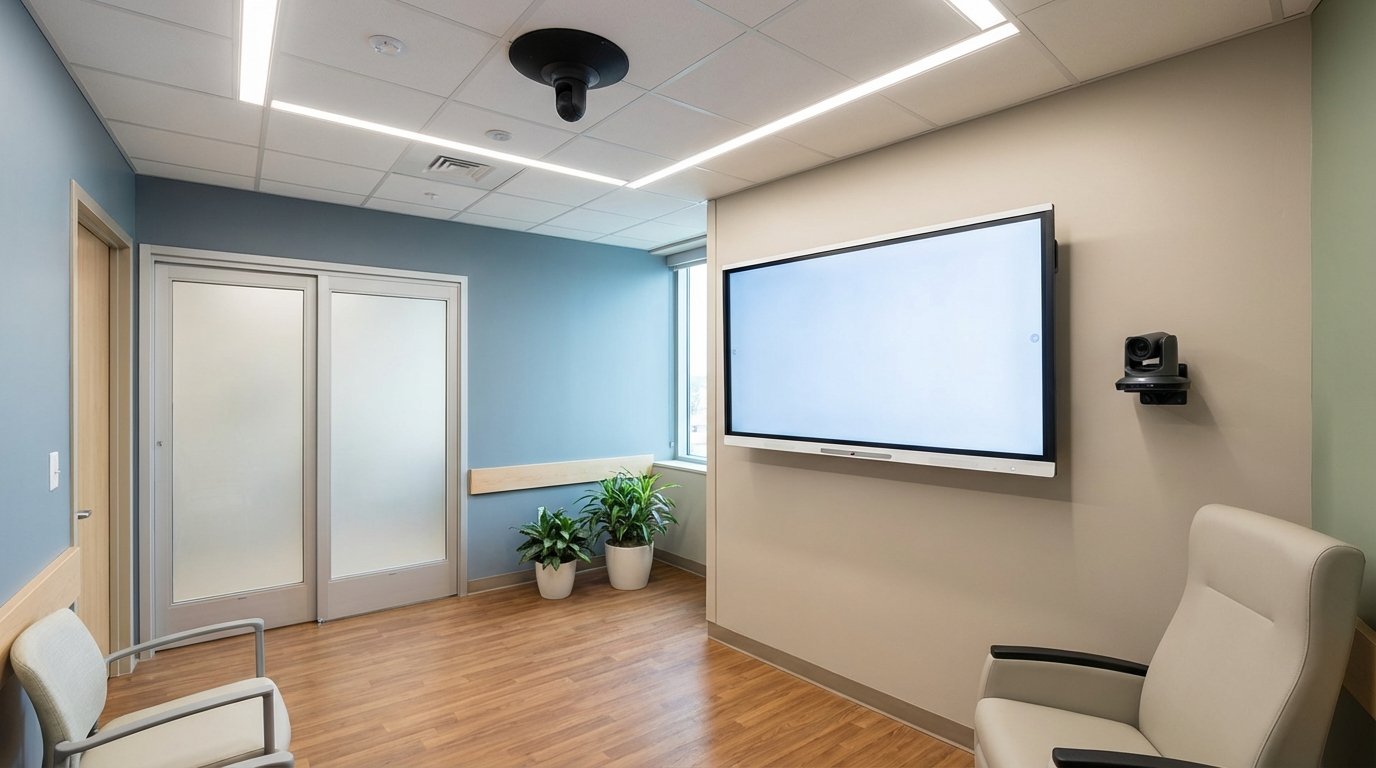
But telehealth does not happen on paper. It happens in physical rooms, on microphones, cameras, displays, control systems, switches, and endpoints that sit on the hospital network. If those room systems were designed like generic conference spaces or inherited from older cart-based video programs, the organization may have secure software sitting on top of insecure AV infrastructure.
That is the gap more health systems are running into in 2026.
The telehealth market continues to scale, with Fortune Business Insights research summarized by GlobeNewswire projecting the global market to reach $266.8 billion by 2026. At the same time, healthcare rooms built around legacy Polycom or Tandberg-era assumptions are reaching the end of their useful life. Firmware support is thinning out. Point-to-point signal paths are harder to manage. Room standards drift from site to site. And what used to be an isolated video endpoint now needs to behave like a governed device inside a larger clinical IT environment.
The result is a simple but important reality. A telehealth platform may support HIPAA obligations, but a telehealth room still has to be designed, secured, and operated correctly.
Where the compliance gap actually shows up
When IT and clinical operations teams say a telehealth room feels risky, the problem is usually not one dramatic failure. It is the accumulation of quiet design mistakes.
A consultation space may have a capable telehealth application but still route video through unmanaged hardware. A nurse station may have an always-available microphone in a space with constant side conversations. A patient consult room may share infrastructure with other spaces without clear segmentation or documented control over how endpoints authenticate to the network.
This is why the phrase HIPAA-compliant telehealth AV matters. The risk is not limited to software encryption during the meeting itself. Risk also lives in how the room captures audio, how devices are administered, how signals traverse the network, and how consistently those standards are enforced across every location.
Common weak points include:
Aging endpoints with limited security posture
Many hospitals still have older room systems that were deployed when telehealth was a specialty workflow rather than a daily operational one. Those environments often include unsupported firmware, proprietary codecs, aging DSPs, or video hardware that was never intended to be managed under modern identity and patching practices.
Flat or loosely governed network design
If displays, cameras, microphones, and control processors are simply plugged into available ports without role-based segmentation, the AV estate becomes a blind spot. In a modern healthcare environment, every room endpoint should be treated as a managed network asset, not as passive room furniture.
Physical and acoustic leakage
Protected health information does not only leak through a misrouted file or a compromised application. It can leak because a room was built with poor isolation, the wrong microphone pattern, or no intentional control over where the pickup zone begins and ends.
Audio privacy is the overlooked telehealth risk
If there is one part of the room healthcare teams routinely underestimate, it is audio.
Video is visible, so it gets attention. Audio leakage is harder to notice until someone in the hallway hears part of a consult, a nurse station captures side conversations, or a telehealth session sounds noisy enough that participants start repeating sensitive information more loudly than they should.
That is why telehealth room design should start with acoustic privacy before anyone talks about screen size.
Beamforming ceiling microphones are a strong example of how infrastructure decisions affect privacy and intelligibility at the same time. Shure’s MXA920, for example, supports Automatic Coverage, Virtual Acoustic Boundary, and onboard IntelliMix DSP. Those capabilities matter because they help define where the room listens, reduce unwanted pickup outside the intended consult zone, and improve speech clarity without depending on a table microphone placed wherever the furniture happened to land.
That still is not enough on its own. A good healthcare telehealth room also needs the basics handled correctly:
- acoustic treatment that reduces intelligibility bleed into adjacent spaces
- ceiling and wall conditions that do not undermine privacy through gaps or reflective surfaces
- clear microphone placement and pickup design matched to the actual workflow
- mute behavior and control interfaces that are obvious to clinical staff
- commissioning that validates how the room performs under real conversational conditions
A consultation room with a standard omnidirectional mic and weak acoustic separation is not just an annoyance. It is a PHI leak waiting for the wrong moment.
AV-over-IP is now the mature replacement path
Healthcare organizations do not need bleeding-edge room technology to fix this problem. They need a better architecture.
That is why AV-over-IP has become the practical upgrade path for telehealth refresh projects. Instead of extending the life of aging point-to-point HDMI and proprietary video chains, health systems can move toward network-native audio, video, and control that fits the way enterprise healthcare infrastructure is already managed.
In practice, that often means:
- Dante for audio networking between microphones, DSP, and room audio systems
- network-native video workflows, including NDI where appropriate for the use case
- IP-based control and monitoring rather than isolated room logic
- centralized visibility into endpoint health, configuration, and lifecycle status
The value is not novelty. The value is standardization.
With AV-over-IP, a telehealth room becomes easier to document, scale, support, and secure. Signals are no longer trapped inside a collection of one-off physical runs that only a few installers understand. IT teams gain a better path to segmentation, monitoring, and policy alignment. Clinical teams get more consistent room behavior from site to site. And the organization reduces dependence on proprietary hardware refresh cycles that do not match broader infrastructure planning.
Clinical AV belongs inside the hospital security model
A modern telehealth room should be governed more like a connected clinical workspace than like a standalone boardroom.
That means the AV design conversation needs to include the same security questions healthcare IT leaders already ask elsewhere on the network.
Does every endpoint have a clear identity?
Displays, cameras, microphones, DSPs, touch panels, and control processors should not be treated as invisible edge devices. They should fit within the organization’s authentication and asset-management standards as cleanly as possible.
Is traffic segmented appropriately?
VLAN segmentation matters for healthcare AV because telehealth is no longer isolated from other workflows. A room may support patient consults, internal care coordination, staff collaboration, and training use cases. Segmenting those environments properly reduces unnecessary exposure and improves operational control.
Are you designing for zero-trust expectations?
Zero-trust is not a product label in this context. It is a design mindset. Assume each endpoint needs to earn access, live within a defined role, and be visible enough to monitor, patch, and replace before it becomes a problem.
Is 802.1X part of the conversation?
For many health systems, 802.1X authentication is now baseline thinking for connected devices. AV teams that cannot design around that reality will create friction for infrastructure and security teams later in the project.
This is where telehealth room upgrades often break down. An integrator may specify good room hardware but fail to design for the governance model the hospital already uses. That creates exceptions, workarounds, and operational drag after installation.
Accessibility requirements are raising the bar for room design
Healthcare telehealth rooms also need to support a broader range of participants and communication needs than many legacy rooms were built for.
Microsoft’s accessibility guidance for Teams meetings for deaf and hard-of-hearing users highlights several practical requirements: live captions, clear visual presentation, visible speakers for lip reading where appropriate, reduced background noise, and meeting practices that make turn-taking understandable. Those are software features only on the surface. In reality, they have direct room-design implications.
If a camera is poorly placed, a participant cannot reliably read facial cues. If the room has distracting noise or poor microphone coverage, captions degrade. If presenters disappear into a blurred or cluttered background, accessibility suffers. If the room system was designed only around a single generic conferencing workflow, it may not support the communication clarity healthcare teams increasingly need.
There is also a forward-looking reason to care now. Microsoft Teams voice tethering is rolling out from mid-March to mid-April 2026, according to public Microsoft 365 release coverage. Whether or not a particular healthcare organization uses that specific feature on day one, the direction is clear: collaboration platforms are expanding accessibility-supporting workflows, and room systems need to keep up.
That means healthcare AV design should account for more than meeting participation. It should support clear camera composition, readable faces, stable audio capture, low background noise, and predictable user controls that do not force clinicians to troubleshoot accessibility in real time.
Telehealth is part of a larger healthcare AV estate
One reason this upgrade conversation matters is that telehealth rooms are rarely isolated projects anymore.
The same organization may also be modernizing nurse station displays, patient room communication surfaces, digital signage, training spaces, simulation labs, and wayfinding systems. In Virginia, references such as VCU Health’s simulation environments help illustrate how far healthcare AV already extends beyond conference-room technology. PTZ cameras, recording workflows, and instructional capture are now normal parts of medical education and clinical operations.
That larger context matters because hospitals do not benefit from solving telehealth as a standalone exception. They benefit from building a repeatable AV infrastructure model across the facility portfolio.
When AV is treated as an IT discipline, the organization can create repeatable standards for:
- endpoint classes and approved hardware
- network segmentation and authentication
- support ownership and escalation paths
- audio design criteria for privacy-sensitive spaces
- remote monitoring and firmware lifecycle management
- interoperability across Zoom for Healthcare, Teams Rooms, signage, and training environments
That is a much better position than maintaining six different room philosophies across six campuses.
Questions healthcare leaders should ask before an upgrade
Before approving a telehealth refresh, healthcare CIOs and IT directors should push beyond the device list and ask how the room is actually being engineered.
Here are five useful questions to put in front of an AV partner:
1. How are you preventing audio pickup outside the intended consult zone?
If the answer centers only on microphone brand and not on coverage design, acoustic boundary control, and room treatment, it is incomplete.
2. Which room endpoints can authenticate, be segmented, and be managed under our network standards?
This quickly separates integrators who understand healthcare infrastructure from those who mostly think in terms of mounting hardware.
3. How will audio, video, and control traffic be documented and secured?
A hospital should be able to understand the room as a networked system, not as a black box.
4. How will the design support both telehealth workflows and accessibility expectations?
That includes camera placement, caption readability, low-noise audio capture, and clean user control behavior.
5. Who owns day-two support?
A room that works on turnover day but drifts out of standard six months later is not a successful healthcare deployment. Ask who handles monitoring, firmware reviews, issue response, and lifecycle planning.
VIcom’s approach: healthcare AV as infrastructure, not room décor
This is where a healthcare-focused integration approach matters.
VIcom approaches healthcare AV as an IT infrastructure discipline, not a display-hanging exercise. That means network-native AV design, careful room audio specification, support for platforms such as Zoom for Healthcare and Teams Rooms, and local project understanding across Virginia health systems and medical organizations.
For healthcare teams in Richmond, Hampton Roads, Northern Virginia, and across the Commonwealth, the right partner should be able to translate clinical workflow, compliance pressure, security policy, and room performance into one coherent design standard. That is the real upgrade in 2026.
Telehealth rooms do not need more disconnected hardware. They need secure, supportable infrastructure that treats every microphone, camera, display, and control endpoint as part of the hospital environment it serves.
If your organization is planning a telehealth room refresh, a Teams or Zoom standardization effort, or a broader healthcare AV modernization initiative, connect with VIcom by filling out the form below.