
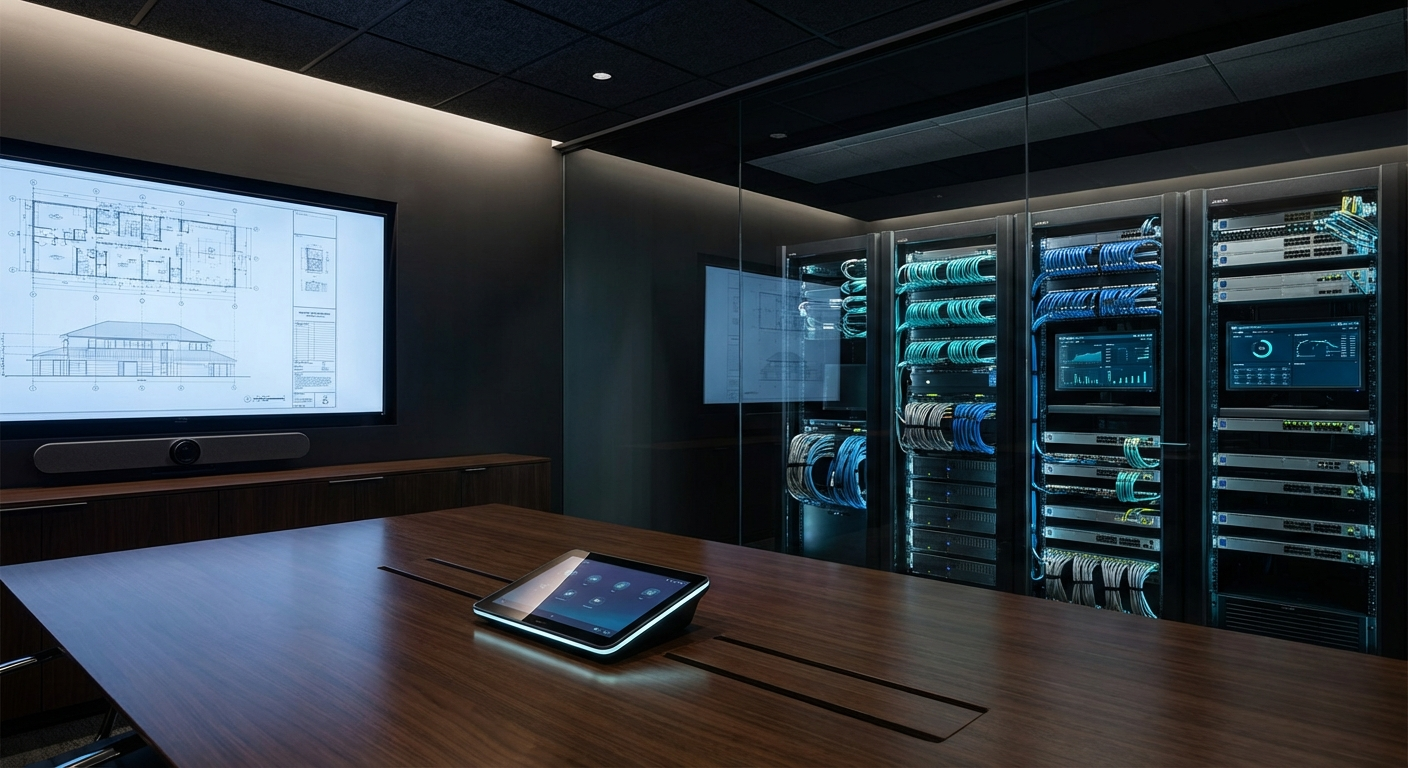
The conference room is now part of your security perimeter
Most security teams already know the old perimeter is gone. They think about identity, device posture, segmentation, least privilege, and continuous monitoring across laptops, mobile devices, servers, and cloud apps.
What many organizations still miss is that the conference room has joined that same list.
Every networked display, camera, microphone, DSP, touch panel, room controller, codec, and wireless presentation appliance is now an IP endpoint on the same enterprise network that carries production traffic, collaboration platforms, and sensitive business data. Yet AV systems are still often deployed as if they belong to facilities alone, outside the normal security review, patching schedule, and access-control model.
That gap is getting harder to defend. ISE 2026 launched an inaugural CyberSecurity Summit focused on urgent risks in professional AV and systems integration. Metrigy reported in late 2025 that attacks on workplace collaboration and contact center platforms had surged more than 300 percent since 2021. In Virginia, government and regulated organizations are under even more pressure to prove that connected devices are inventoried, controlled, and monitored.
The practical takeaway is simple: zero trust now applies to conference rooms too.
Why AV can no longer be treated as “just room technology”
The biggest mistake in AV security is organizational, not technical. Many enterprises still split responsibility this way:
- Facilities owns the room
- IT owns the network
- Security owns policy
- The integrator owns the AV stack until turnover
That structure creates blind spots. When nobody owns the full chain, basic questions go unanswered:
- Which room devices are actually on the network today?
- Which ones support modern authentication methods?
- Which ones are still running default credentials?
- Which protocols are exposed between the AV environment and the rest of the business?
- Which devices are in the patch cycle, and which are effectively unmanaged?
- Which collaboration components process or transport sensitive audio, video, or meeting content?
Those questions matter because modern AV systems are not passive endpoints. They often include embedded operating systems, web interfaces, APIs, SSH or vendor management ports, remote support tools, multicast media traffic, wireless guest workflows, and direct integration with Microsoft Teams, Zoom, or cloud control portals.
In other words, the conference room is no longer a hardware island. It is a distributed application environment sitting on your network.
What the AV attack surface looks like in a real deployment
If you want to secure room systems properly, start by defining the attack surface the way a network engineer or auditor would, not the way a furniture planner would.
Typical enterprise or government room environments include:
Displays with embedded operating systems
Large-format displays and interactive panels may include Android, Windows, or vendor-specific embedded software, plus remote management services, browsers, and network-accessible control features.
Cameras and collaboration bars
Conference cameras, USB bridges, and all-in-one room bars often connect to cloud collaboration services and expose management interfaces over the network.
Room controllers and touch panels
These devices are convenient operationally, but they are also network clients that may communicate with control processors, room schedulers, occupancy systems, and cloud services.
DSPs, codecs, and AV-over-IP endpoints
Audio processors, video encoders, decoders, and matrix-over-IP systems move real-time traffic across the network. If poorly segmented, they can create visibility and lateral-movement concerns.
Wireless presentation systems
These are especially important to review because they often bridge user devices into the room environment. Default credentials, outdated firmware, permissive discovery settings, and guest workflows can all expand risk.
Room PCs and mini compute devices
Many deployments still rely on Windows-based room PCs, signage players, or appliance-style compute devices. If they are domain-joined, unmanaged, or inconsistently patched, they become a familiar but frequently neglected attack path.
This is why a security audit can suddenly flag conference rooms as unmanaged infrastructure. It is not because AV is exotic. It is because AV has become ordinary IT without always being governed like ordinary IT.
Zero trust starts with identity at the endpoint
NIST SP 800-207 defines zero trust as a model that removes implicit trust based on network location or asset ownership. That principle matters in conference rooms because too many AV environments still rely on exactly that kind of implicit trust.
A device is often considered safe simply because it lives on an internal switch port inside a corporate office.
That is no longer good enough.
For networked AV, the first practical zero-trust question is: how does this endpoint prove what it is before it gets network access?
802.1X should be the target state
Wherever the device platform supports it, 802.1X should be the preferred admission-control model for AV endpoints. It lets the network enforce authentication before the endpoint receives normal access, which is far stronger than assuming that anything plugged into a conference-room jack belongs there.
For security teams, the value is straightforward:
- unauthorized devices do not get the same open access as approved endpoints
- policy can follow device identity, not just switch location
- onboarding and deprovisioning become easier to manage centrally
- audit conversations become more concrete because access rules are documented and enforceable
The challenge is that not every AV device supports certificate-based onboarding equally well. Some newer devices do. Some support username and password methods. Some legacy devices still require a fallback.
Legacy AV gear still needs a controlled access path
A real-world AV security plan has to account for mixed fleets. In many rooms, especially across campuses or government sites, you will find older hardware that cannot participate in a modern certificate workflow.
That does not mean you abandon zero-trust principles. It means you apply them pragmatically:
- use MAC Authentication Bypass where necessary, but treat it as a constrained exception, not a default architecture
- place exception-based devices into tightly restricted roles or VLANs
- document every non-802.1X endpoint with owner, model, business justification, and replacement timeline
- limit east-west traffic so a constrained legacy device cannot talk broadly across the enterprise
- tie replacement planning to the security roadmap, not just the AV refresh budget
The important point is that 802.1X is not only a checkbox. It is a forcing function for better device governance.
Segmentation is where most AV security programs win or lose
Once a device is admitted to the network, the next question is what it can talk to.
This is where many organizations still get into trouble. A room endpoint may sit on a flat network segment with access to services it never needs, simply because nobody designed policy around the way AV traffic actually behaves.
That is risky and unnecessary.
Dedicated AV VLANs are the baseline
The minimum starting point for most enterprises is a dedicated AV VLAN strategy. Room devices should not casually live on the same unrestricted segment as user laptops, printers, or sensitive application infrastructure.
Segmenting AV traffic helps teams:
- reduce accidental exposure between room systems and the rest of the environment
- make firewall policy easier to define and review
- isolate multicast and media traffic patterns that would otherwise create operational noise
- troubleshoot performance and security issues more quickly
A surprising number of security findings begin with a simple discovery: dozens of room systems were deployed, but none were placed on a protected or intentionally designed VLAN. That is exactly the kind of issue that turns an AV project into an audit problem later.
Microsegmentation and policy-based fabrics go further
In larger environments, VLANs alone are not enough. Organizations that need tighter control should look at policy-driven segmentation and fabric-based approaches that can separate device classes, room types, user populations, and service flows more precisely.
That matters because not every AV endpoint has the same trust level or business purpose. A digital signage player, an executive boardroom codec, a public-facing meeting space, and a secure operations room should not inherit the same access policy just because they all happen to be “AV.”
This is where VIcom’s network plus AV positioning matters. If the integrator understands switching, identity, traffic behavior, and security policy as well as displays and control systems, the room can be designed around the security model from day one instead of retrofitted after an audit.
Write explicit rules for allowed traffic
Good segmentation is not just about putting devices in a different bucket. It is about deciding which conversations are allowed.
Typical policy questions include:
- Which devices need internet egress, and which should have none?
- Which room components need to communicate with cloud collaboration platforms?
- Which management interfaces should be reachable only from IT admin networks?
- Which controller-to-endpoint or DSP-to-control-system flows are required?
- Which traffic should be blocked entirely between AV and production systems?
When teams answer those questions before deployment, the security posture of the room changes significantly.
Encrypt what the room controls, manages, and transports
Segmentation is not enough if sensitive control or media traffic is still exposed in cleartext or left at insecure defaults.
For modern AV environments, zero trust should also push teams to review encryption and management security in three areas.
Management traffic
Any web-based or API-based management path should use secure protocols, current TLS settings, and properly controlled administrative access. If a device still supports insecure management methods, those services should be disabled whenever possible.
Control traffic
Control systems are often overlooked because they feel operational rather than security-critical. But if an attacker can manipulate control traffic, they may be able to disrupt room operation, pivot into other interfaces, or use the room as a foothold for reconnaissance.
That is why encrypted and authenticated control paths matter, especially in boardrooms, government facilities, training spaces, and other rooms tied to sensitive workflows.
Media transport
AV-over-IP and collaboration media paths deserve the same scrutiny. Platforms such as Crestron DM NVX and Biamp Tesira support stronger security features, but those protections are only valuable when they are actually configured as part of the deployment standard.
The lesson is simple: secure capability is not the same as secure implementation.
Inventory, patching, and monitoring are not optional maintenance tasks
One of the clearest takeaways from Virginia’s Information Security Standard is that agencies are expected to know what is on their network and maintain it accordingly. The standard requires inventories of system components, including hardware, software, firmware, machine names, and network addresses. It also requires security-relevant updates to be installed within defined timelines, restricts unneeded ports and protocols, and requires monitoring for attacks and unauthorized connections.
That logic applies well beyond state government.
If a room endpoint is important enough to connect to the production network, it is important enough to appear in:
- asset inventory
- configuration baselines
- vulnerability scanning workflows where appropriate
- patch and firmware management schedules
- logging and monitoring practices
- incident response planning
This is often where AV programs break down. Teams can spec great hardware, deploy clean cabling, and still fail the security test because nobody owns the lifecycle after commissioning.
A security-ready AV deployment should answer these operational questions before handoff:
- Who owns firmware currency for each device class?
- Where are default credentials removed and documented?
- Which alerts indicate a room endpoint is behaving abnormally?
- How are devices added to CMDB or inventory systems?
- How are end-of-support AV devices identified and replaced?
- Which ports, protocols, and services were disabled as part of hardening?
Those are not secondary details. They are the difference between a room that passes audit review and a room that becomes technical debt.
Government, regulated, and defense environments need a higher bar
For Virginia agencies, public-sector institutions, defense contractors, and regulated enterprises, the AV conversation gets more serious quickly.
Cloud collaboration platforms may bring GovRAMP or FedRAMP questions into scope depending on the environment and procurement path. Defense contractors may also feel CMMC pressure when collaboration infrastructure touches controlled workflows or sensitive discussions. In these environments, the room is not separate from compliance. It is part of the system that has to be defended.
That does not mean every conference room needs the same controls. It does mean the organization should be able to explain:
- which room technologies connect to which environments
- how access is authenticated
- how traffic is segmented
- how endpoints are patched and monitored
- how cameras, microphones, and remote support functions are controlled
- how cloud-connected collaboration services fit the organization’s compliance posture
Virginia buyers should expect their integrator to be able to hold this conversation comfortably with the security team, not just the facilities team.
The questions security teams should ask their AV integrator
If you are planning a new deployment or cleaning up an existing one, these questions will reveal quickly whether your integrator is thinking like a security partner or just a hardware provider:
- Which room endpoints support 802.1X today, and what is the fallback plan for the ones that do not?
- What is the VLAN and policy design for AV traffic, control traffic, and management access?
- Which ports, protocols, and services are required, and which will be disabled by default?
- How are admin interfaces secured and restricted?
- Which media and control paths can be encrypted, and how will that be configured during deployment?
- How will devices be inventoried, labeled, and handed off for lifecycle management?
- What is the patching and firmware plan after go-live?
- How will the design align with Virginia government security expectations or enterprise audit requirements?
- How will cloud collaboration components be evaluated for compliance-sensitive environments?
- What evidence can you provide that similar deployments have passed security review?
A serious integrator should welcome those questions.
Why VIcom’s full-stack approach matters
The organizations handling this transition best are the ones that stop separating room design from network design.
That is where VIcom has a credible advantage. Security teams do not need an AV vendor who only knows displays and DSPs. They need a partner who understands the full chain from switching and segmentation through collaboration endpoints, control systems, and day-two support.
That matters in practice because secure room outcomes depend on details like:
- the right VLAN and policy model before installation
- 802.1X planning during design, not after deployment
- realistic exception handling for legacy gear
- intentional configuration of encrypted control and media features
- monitoring, inventory, and lifecycle ownership after turnover
When those decisions are built into the design from the beginning, conference room systems are much more likely to pass security audits on day one instead of becoming a remediation project later.
AV zero trust is now a baseline requirement
The industry has moved. ISE 2026’s cybersecurity focus and Metrigy’s attack data both point in the same direction: collaboration and AV systems are now part of mainstream security planning.
For Virginia enterprises, agencies, and regulated organizations, the real question is no longer whether AV belongs in the security conversation. It is whether your current rooms were designed with that reality in mind.
If your conference room endpoints still rely on implicit trust, flat network placement, unclear ownership, or default deployment settings, now is the time to fix that.
Connect with VIcom
Connect with VIcom by filling out the form below.