
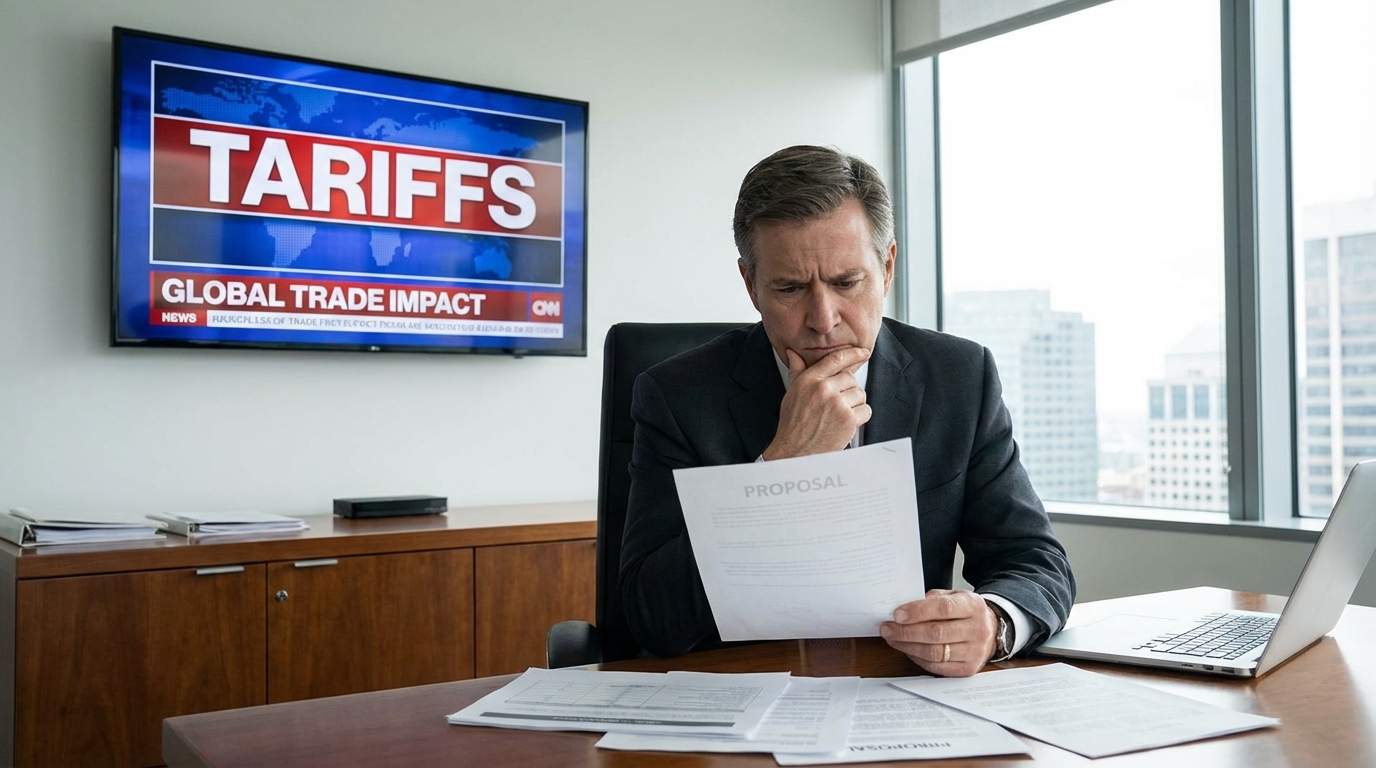
An AV integration project that was budgeted in December 2025 may cost significantly more by the time the equipment ships in Q2 2026. Tariff surcharges on AV hardware are not theoretical — Crestron has added explicit tariff line items to invoices, implementing a flat 5 percent surcharge on hardware, and integrators across the industry are navigating the same pricing instability on behalf of clients who built budgets based on stable-world assumptions.
This is the AV procurement reality of 2026. Organizations that understand it and plan for it will complete projects within budget. Organizations that don’t will be managing change orders.
What’s Actually Being Affected and Why
Most AV hardware — commercial displays, cameras, microphones, DSPs, control systems, collaboration room systems — is manufactured in China, Taiwan, Vietnam, or other parts of Southeast Asia. Tariff rates on electronics from these regions have shifted wildly in the past 18 months. Just recently, on February 20, 2026, the Supreme Court struck down the sweeping 2025 IEEPA tariffs, prompting the administration to immediately implement a temporary 10 percent global tariff under Section 122 on February 24. While certain electronics are exempt from this new global duty, ongoing Section 301 tariffs on China and potential Section 232 tariffs mean the AV supply chain remains heavily exposed. The specific rates in effect for a given product category on the date of importation determine the exact tariff cost — which creates immense budget uncertainty rather than just a predictable budget increase.
“Made in USA” is not a simple solution to the tariff problem, and buyers who assume it is will be surprised. Even products assembled in the United States typically incorporate components sourced globally. A DSP assembled in a US facility may contain chipsets, capacitors, and circuit boards subject to tariffs — the assembly location doesn’t change the tariff treatment of the components. Manufacturer cost increases from component tariffs flow through to product pricing regardless of final assembly location.
TAA (Trade Agreements Act) compliance for government procurement specifies acceptable countries of origin — and some TAA-compliant countries of origin are also subject to tariffs. An AV system specified for a federal installation may simultaneously comply with TAA requirements and be affected by tariff cost increases, creating both a compliance requirement and a cost management challenge.
Crestron’s response has been the most transparent in the industry: an explicit 5 percent tariff surcharge itemized on invoices, giving clients visibility into what’s tariff-related versus base product cost. Other manufacturers have absorbed tariff impacts into price increases or passed them through less transparently. Asking your integrator specifically how tariff costs are handled in their pricing is a reasonable and important question.
What This Means for Budget Planning
Fixed-price AV proposals carry more risk in 2026 than they did 18 months ago. An integrator who commits to a fixed price on a project with a 4-month delivery timeline is bearing tariff risk — and that risk often surfaces as project scope reduction, product substitution, or margin-protecting decisions that affect quality. Understanding who bears the tariff risk in a given proposal is as important as understanding the total price.
Project budgets in 2026 should include an explicit tariff contingency of 10 to 15 percent. This is separate from standard project contingency (which covers scope changes and unforeseen conditions). A dedicated tariff contingency acknowledges the specific and quantifiable risk of hardware cost changes between proposal and delivery, and it prevents the tariff exposure from being hidden inside an inflated base estimate.
Contract structure matters significantly. Procurement contracts should specify how tariff-related price changes are handled: are they passed through at documented cost? Absorbed by the integrator within a defined percentage? Split between client and integrator above a certain threshold? These terms are negotiable, and organizations that negotiate them explicitly before signing are in a better position than those who discover the treatment at invoicing.
Timing Strategies That Actually Work
Timing decisions can meaningfully reduce tariff exposure for organizations with the flexibility to act on them.
Lock in pricing when the project scope is firm. For projects where the equipment list is defined and the design is complete, confirming pricing with the manufacturer or distributor and establishing a price-hold period protects against further tariff increases during the procurement and delivery window. Price holds are typically available for 30 to 90 days; for larger projects, longer holds may be negotiable.
Pre-purchase for multi-phase projects. If a project is phased over 12 months, purchasing Phase 2 and Phase 3 equipment during Phase 1 — when the equipment list is defined and the Phase 1 delivery confirms the design — can protect against mid-project price increases. This requires warehousing considerations and cash flow planning, but for large projects, the tariff savings can justify the operational complexity.
One illustrative example from the industry: an integrator on a major LED wall project chartered the panels by air freight to beat an anticipated tariff deadline. The air freight premium — significant for large, heavy display components — was still less than the projected tariff increase on the hardware value. This illustrates the magnitude of tariff exposure on high-value AV components and the lengths to which sophisticated procurement teams are going to manage it.
When to wait: if the project scope is not finalized, pre-purchasing creates risk of over-buying or buying equipment that doesn’t match the final design. Speculative pre-purchase to beat tariffs without a locked design is a procurement gamble, not a strategy.
Alternative Financing Models That Shift the Risk
For organizations where tariff uncertainty makes capital hardware procurement uncomfortable, VIcom’s financing alternatives provide a structural solution rather than a timing workaround.
Technology as a Service (TaaS) converts AV hardware from a capital purchase to a monthly operating expense. Instead of buying equipment outright at a tariff-affected price, organizations subscribe to technology at a predictable monthly rate. The hardware, installation, maintenance, and refresh are bundled. Tariff exposure is absorbed by the financing structure over the service term rather than hitting as a lump sum at procurement.
Hardware as a Service (HaaS) is a similar model focused specifically on hardware: organizations pay monthly for equipment use, and the integrator manages the hardware lifecycle including refresh. This model is particularly useful for organizations facing hardware refresh cycles that coincide with tariff uncertainty — the monthly model insulates the organization from point-in-time pricing volatility.
The broader OpEx argument is stronger in 2026 than in most recent years. The combination of tariff-driven hardware price instability and a high-interest-rate environment makes capital-intensive technology purchases harder to justify financially. Converting capital to operating expense at a predictable monthly rate gives CFOs and controllers clearer budget visibility, eliminates the tariff exposure at procurement, and aligns technology refresh cycles with operational needs rather than capital budget cycles.
Manufacturer-Specific Notes for Procurement Planning
These manufacturer characteristics affect tariff exposure and pricing stability in ways worth knowing before finalizing equipment specifications.
-
Crestron has been the most transparent about tariff impacts, implementing an explicit 5% tariff surcharge on hardware invoices. They have domestic manufacturing for some product lines, which provides more pricing stability for those specific products. Procurement officers can request tariff exposure documentation from Crestron for specific product categories.
-
Extron maintains strong US inventory management, which buffers some tariff timing exposure. Products on the DoDIN APL and JITC-certified list have generally more stable supply and pricing than commercial product lines, partly because of the additional qualification requirements that limit supply chain substitutions.
-
Samsung displays are primarily manufactured in Vietnam and South Korea — both TAA-compliant countries with relatively less tariff exposure than Chinese-manufactured products. For organizations simultaneously managing TAA compliance and tariff cost exposure, Samsung’s manufacturing geography is a relevant consideration.
-
Logitech and Yealink products are primarily manufactured in Asia with more direct exposure to tariff variability. Both maintain strong TAA-compliant product lines, but at premium pricing compared to their standard product lines. Organizations specifying government-compliant hardware from these manufacturers should understand that the TAA-compliant variants carry different pricing than the commercial variants.
How VIcom Helps Clients Navigate This
Tariff uncertainty is an argument for earlier integrator engagement, not later. The earlier VIcom is involved in a project, the more options exist for procurement timing, contract structuring, and financing model selection. An integrator brought in three months before a desired delivery date has far fewer tools available than one engaged at the beginning of the planning process.
VIcom’s consultative approach means clients understand what’s driving cost changes before they appear on invoices. The combination of transparent pricing communication, TaaS/HaaS financing options, and procurement timing flexibility gives organizations concrete tools for managing tariff exposure — not just documentation of the problem.
If your organization is planning an AV project for delivery in 2026 and hasn’t explicitly addressed tariff exposure in your budget and contract planning, the right time to have that conversation is before the project scope is finalized. VIcom can provide a procurement planning consultation that addresses tariff contingency, contract structure, and financing alternatives for your specific project. Let’s get started!