
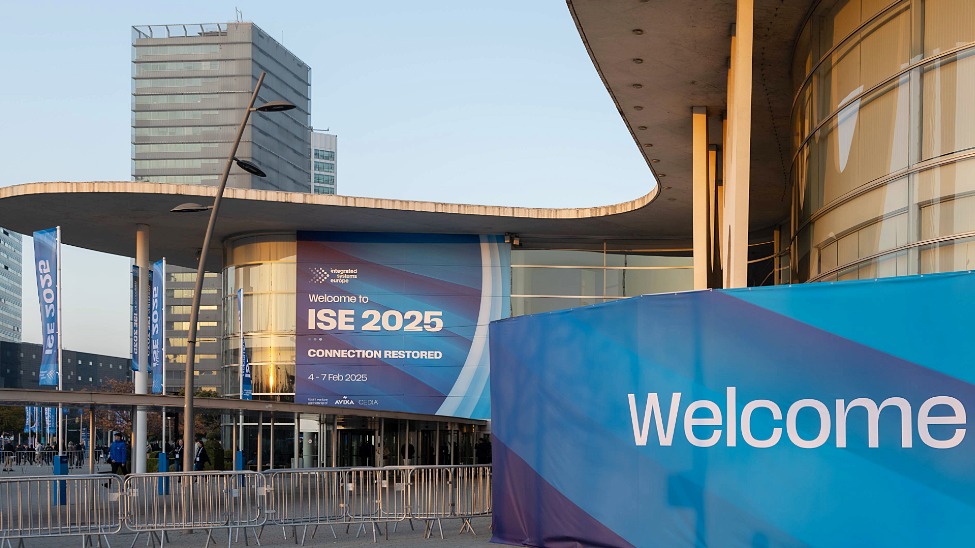
92,170 AV and IT professionals descended on Barcelona for ISE 2026, and the show floor delivered more legitimate product news in four days than most years produce in twelve months. The challenge isn’t finding something to be excited about — it’s figuring out what actually matters for real organizations with real budgets and real refresh cycles.
This article skips the booth theater and focuses on the ten announcements that should change how you plan your AV and collaboration infrastructure over the next 18 to 24 months.
Why ISE 2026 Was Different
ISE consistently draws the largest AV-specific audience in the world, but this year’s 1,751 exhibitors and record attendance reflected something more than post-pandemic pent-up demand. Manufacturers are converging on two themes simultaneously: AI processing embedded at the device level, and enterprise IT manageability built in from the start rather than bolted on later. Both of those shifts have real consequences for procurement decisions happening right now.
The other notable first: ISE 2026 hosted its inaugural dedicated Cybersecurity Summit. The fact that the world’s largest AV trade show felt compelled to create a standalone security track tells you everything about where the industry’s attention is moving. AV security is no longer a niche conversation.
The 10 Announcements That Earned Attention
1. Cisco Room Kit Pro G2
The Room Kit Pro G2 represents the most significant single-product leap in enterprise room systems in at least three years. Cisco claims 25 times the AI processing power compared to the previous generation, and this time the architecture choice matters: the G2 is AVoIP-first, built around 8 PoE ports that support direct connection of IP cameras, ceiling microphones, and peripherals without a separate control rack. It ships Q2 2026.
For organizations running Microsoft Teams Rooms or Webex-certified deployments in medium-to-large conference rooms, this announcement is worth factoring into any purchases you were planning for Q3 or Q4. The AVoIP-native architecture also simplifies IT’s management story considerably — fewer proprietary connection types, more standard network infrastructure tools.
2. Crestron’s Five-Product ISE Launch
Crestron arrived in Barcelona with five distinct announcements, and unlike some multi-product launches that feel padded, each one addresses a real operational gap.
- Collab Compute: A purpose-built compute appliance for Teams and Zoom Rooms, separating the processing burden from the display hardware and simplifying upgrades
- 80 Series touch screens on Microsoft MDEP: Display hardware enrolled directly into Microsoft’s Device Endpoint Management Platform, which matters enormously for enterprise IT teams who want AV managed alongside the rest of their device fleet
- 1 Beyond i12D camera: Intelligent 12x PTZ with computer vision for autonomous speaker tracking — no external controller required
- DM NAX distributed audio networking: A standards-based approach to distributed audio that integrates with existing Dante and AES67 ecosystems rather than requiring a proprietary island
- AutoMeasure 6.5: AI-driven room acoustic calibration that measures and adjusts DSP settings automatically — this could reduce commissioning time significantly
The MDEP enrollment capability in the 80 Series is the item most enterprise IT managers should pay attention to. Getting AV displays into the same management console as laptops and phones has been a persistent frustration for years.
3. Shure IntelliMix Bar Pro
Shure has never built a video collaboration bar. That changed at ISE 2026. The IntelliMix Bar Pro is an all-in-one AI video bar targeting medium-to-large rooms — a segment previously dominated by Poly, Logitech, and Jabra. The significance here isn’t the form factor; it’s whose name is on it.
Shure’s audio processing reputation is unmatched in professional AV, and bringing that credibility into the all-in-one bar category raises the bar for audio quality expectations across the segment. Organizations that have struggled with mediocre audio in collaboration bars now have a purpose-built alternative from the manufacturer that sets the standard for conference microphone performance.
4. QSC RoomSuite Modular
QSC announced a no-code, web-based room deployment platform that allows AV configurations to be built, deployed, and adjusted without traditional programming. If the platform delivers what QSC demonstrated on the show floor, this could meaningfully compress integration timelines for standardized room deployments.
This is one to watch rather than act on immediately. No-code AV platforms have promised simplified deployment before and often required significant workarounds for non-standard room configurations. Real-world customer deployments over the next two quarters will tell the actual story.
5. Samsung Spatial Signage — Glasses-Free 3D
Samsung’s commercially available 85-inch glasses-free 3D display is genuinely impressive technology. It also has a narrowly defined set of use cases right now: retail product visualization, destination wayfinding, and branded environments where the “wow” factor justifies the cost.
This is not a meeting room technology in 2026. It belongs in the category of announcements worth understanding so you can set appropriate expectations when your executive team asks about it after seeing it at a trade show.
6. Biamp Parlé Participant Lift
Biamp’s software-based voice lift for the Parlé microphone ecosystem eliminates handheld or tabletop microphones in large meeting and training rooms. The system uses beamforming ceiling microphone arrays to detect and lift individual participant voices without requiring anyone to pick up or pass a microphone.
For healthcare facilities, government chambers, training rooms, and boardrooms where handheld microphone logistics consistently create meeting friction, this is a practical solution with immediate applicability. No new hardware required for organizations already running Parlé — it arrives as a firmware and software update.
7. HP Poly VideoOS 5.0
The detail that matters most in HP Poly’s VideoOS 5.0 announcement is the lifecycle support commitment: Android 13 with security updates through 2032. In an era where AV hardware often becomes a compliance liability before it becomes a performance liability, a six-year support window from a major manufacturer changes the procurement math.
For organizations buying room systems today, VideoOS 5.0 devices offer a defensible answer to the “how long will this be supported?” question that procurement committees and security teams increasingly ask. That’s worth more than the platform features alone.
8. Logitech Rally AI Camera
Logitech’s Rally AI Camera brings autonomous multi-camera directing to rooms that previously needed an external camera controller or a dedicated camera operator. The system uses computer vision to track speakers and switch camera angles without any additional hardware beyond the cameras themselves.
This lowers the cost and complexity barrier for organizations that want professional camera production in training rooms, boardrooms, and hybrid meeting spaces without the operational complexity of traditional multi-camera setups. It pairs naturally with Rally Bar deployments already in the field.
9. Microsoft MDEP First Wave Hardware
Microsoft’s Managed Device Enrollment Platform — their enterprise display and endpoint management standard — arrived in actual hardware at ISE 2026. Crestron’s 80 Series and Dell’s commercial display line were among the first wave of devices supporting MDEP enrollment.
The practical implication: IT teams can now manage certified AV displays through the same Microsoft Endpoint Manager console used for PCs and mobile devices. For enterprise organizations with large Microsoft 365 deployments, this is infrastructure alignment that significantly reduces the administrative burden of managing AV endpoints as a separate category.
10. ISE’s First-Ever Cybersecurity Summit
The inaugural Cybersecurity Summit at ISE 2026 formally acknowledged what security-conscious organizations have known for years: networked AV devices are an enterprise attack surface that the AV industry has historically underestimated.
The summit drew security researchers, AV manufacturers, and enterprise IT security teams into the same room to address firmware vulnerabilities, default credential risks, and the gap between IT patch management processes and AV device update cycles. The fact that ISE made this a dedicated track — not a single panel session — signals a durable shift in industry priorities.
What These Announcements Mean for Your Planning
Most organizations make the mistake of treating trade show announcements as a shopping list. ISE 2026 is better used as a planning signal.
The 18-to-24-month horizon is the right frame for almost everything announced in Barcelona. Products announced at ISE in February typically ship in Q2 or Q3, work through early adopter integrations, and reach reliable large-scale enterprise deployment by the following year. If you’re planning a major meeting room refresh for 2027, the decisions you make in Q2 2026 about platform direction — Cisco vs. Logitech vs. Poly, AVoIP vs. traditional connectivity, MDEP-enrolled displays vs. standalone — should factor in what shipped at ISE this year.
The convergence of AI processing at the device level and IT-native management across the AV stack is not a trend that will reverse. Organizations that continue to treat AV as a separate procurement and management category from IT will pay for that decision in both operational complexity and security exposure.
The Cybersecurity Summit making its ISE debut is not a coincidence. It reflects where enterprise customers are pushing the industry. If your organization hasn’t assessed the security posture of its networked AV infrastructure, the right time to do that is before your next refresh cycle, not after.
VIcom works with organizations across Virginia to translate ISE announcements into practical technology roadmaps — factoring in your existing infrastructure, refresh timing, and operational requirements. If you want to talk through which ISE 2026 announcements are actually relevant to your environment, we’re happy to have that conversation.