
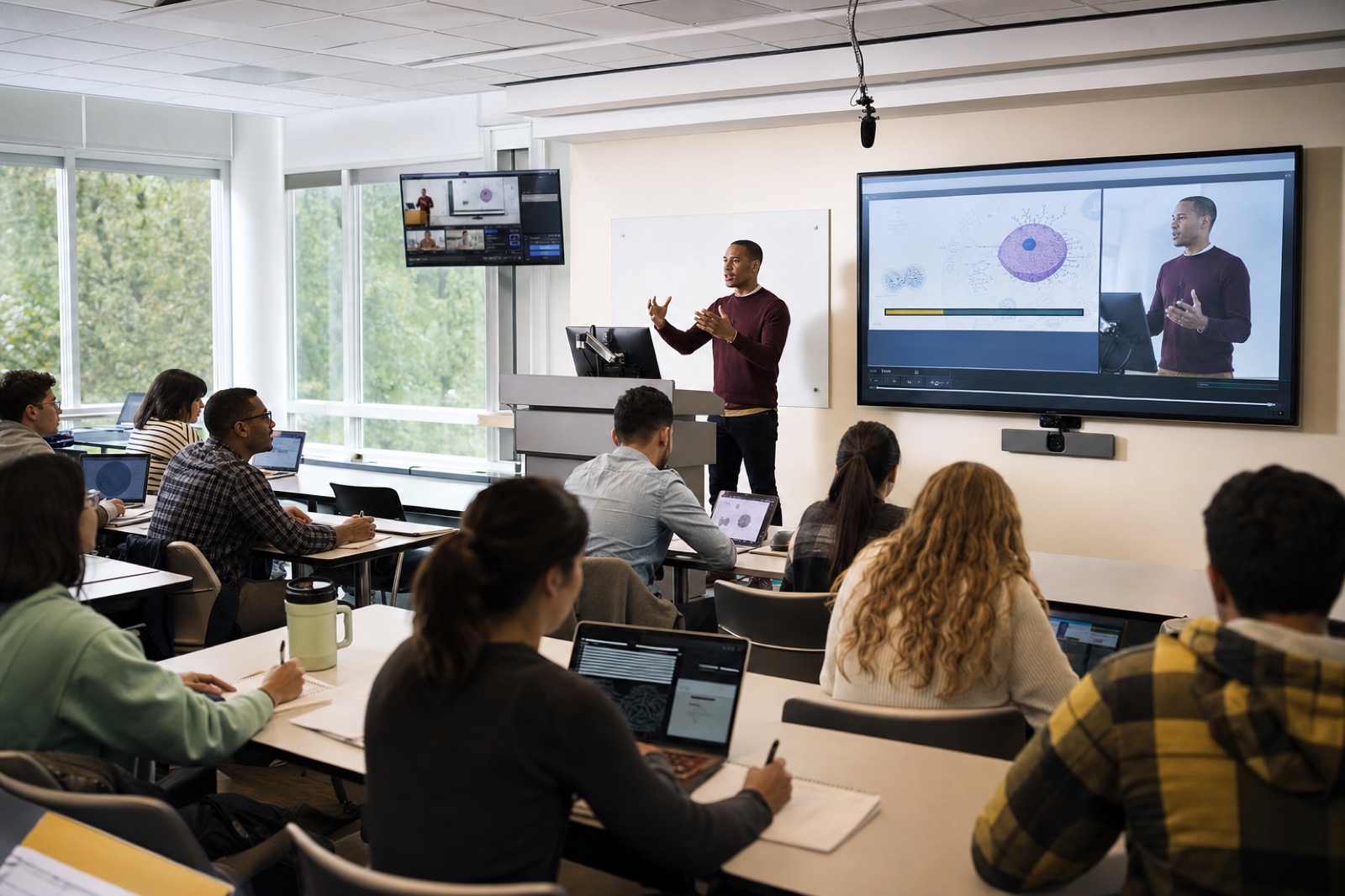
AI Readiness Starts Before the Model
Campus leaders are right to pay attention to AI. The 2026 conversation is no longer limited to one chatbot policy or a few experimental tools. AI is touching assessment, instructional design, tutoring, student support, academic integrity, accessibility, and the way faculty prepare and deliver coursework. But the physical learning space still decides whether those ideas work in front of a real class.
AI-ready classrooms depend on the quality and consistency of the signals the institution can capture and govern: instructor audio, student questions, shared content, camera views, whiteboard work, captions, recordings, room status, and support data. If those basics are inconsistent, AI-enabled teaching tools will inherit the same problems. A poor microphone does not become a good learning record because a summary tool is turned on.
Standardize the Room Inputs That AI Depends On
The first standard should be audio. Faculty, remote students, captions, transcripts, recordings, and AI summaries all depend on intelligible speech. A room with a camera but weak microphone coverage will frustrate everyone. Campuses should define microphone approaches by room type, including instructor pickup, audience questions, hybrid discussion, and spaces where movable furniture changes the acoustic picture.
Video standards matter too, but the goal is not cinematic production in every classroom. The goal is useful visibility. Can remote students see the instructor, presentation, board work, demonstrations, or discussion areas? Can the camera angle support lecture capture without making students feel surveilled? Are displays readable from the back of the room and legible in recordings? These choices should be documented before AI tools are asked to interpret the learning environment.
Governance Has to Be Part of the Learning-Space Standard
AI-ready rooms create data. Recordings, transcripts, captions, attendance signals, room telemetry, and usage analytics can all be valuable, but they also require decisions about consent, access, retention, review, vendor approval, and student privacy. Those decisions should not be improvised by each department or left to whoever installs the next classroom device.
A responsible standard connects instructional design, IT security, accessibility, privacy, legal, and AV operations. Some classes may need recording disabled. Some may need captions retained with the course archive. Some may need guest-speaker consent workflows. The room interface should make policy executable, with simple controls for recording, capture, source selection, and support.
Faculty Adoption Depends on Consistency
Faculty do not need every room to be identical, but they do need patterns they can trust. If a hybrid seminar room, lecture hall, and active learning classroom each behave differently, instructors will avoid advanced workflows or call support before every class. AI adds another layer of complexity unless the room experience is predictable.
The practical standard is a small set of room archetypes. Each archetype should define displays, cameras, microphones, content capture, instructor station, control panel behavior, accessibility features, network requirements, monitoring, documentation, and escalation. Training then becomes easier because faculty learn a system, not a pile of one-off rooms.
Pilot AI-Ready Spaces Before Campus-Wide Rollout
The right pilot does more than test a software feature. It tests the classroom as an ecosystem. Select representative rooms, define success criteria, validate captions and recordings, ask faculty what made the room easier or harder to teach in, check support tickets, and review whether AI outputs are accurate enough to be useful. Measure the basics before buying at scale.
VIcom can help institutions translate AI strategy into room standards, pilot designs, supportable infrastructure, and adoption planning. The practical target is a teaching space clear, accessible, secure, and consistent enough that AI-enabled tools have a reliable foundation.
What to Standardize by Room Type
A campus standard should be specific enough to guide purchasing but flexible enough to respect pedagogy. A 30-seat seminar room may need ceiling microphones that pick up discussion, a camera view that includes the table, and a display large enough for remote students to read shared work. A 120-seat lecture hall may need instructor tracking, audience microphones at aisles, confidence monitoring, and a capture workflow tied to the LMS. A lab or simulation space may need multiple camera views and a different privacy model.
The useful exercise is to define three or four room archetypes and test them with real teaching scenarios. Have an instructor write on the board, share slides, take a student question from the back row, record five minutes, turn on captions, and review the playback on a laptop. That short test reveals more than a spec sheet. It shows whether the room can produce clean enough inputs for captions, recordings, transcripts, or AI-generated study aids.
A Practical AI-Ready Room Scorecard
- Audio: instructor speech, student questions, and remote participant audio are intelligible in the recording.
- Video: camera views show the teaching action without turning the room into surveillance.
- Content: slides, document camera, whiteboard, and shared screens are captured in the right format.
- Accessibility: captions, readable displays, assistive listening, and remote participation paths are documented.
- Governance: consent, retention, transcript access, and AI-summary use are defined before rollout.
- Support: the room has a documented escalation path and remote health visibility where possible.
For Virginia colleges, community colleges, and K-12 districts, this is also a procurement discipline. A room standard helps IT, instructional technology, facilities, and academic leadership avoid one-off pilots that faculty cannot repeat across campus.
Where AI Pilots Usually Break
The weak point in an AI learning-space pilot is often the handoff between pedagogy and operations. An instructional design team may define an exciting use case, but the room may not capture student questions. IT may approve a platform, but faculty may not know when transcripts are retained. AV may install a capable camera, but the board work may still be unreadable in the recording. Those are not edge cases; they are the everyday details that determine adoption.
A good pilot should include at least one skeptical faculty member, one accessibility reviewer, one support technician, and one privacy or security stakeholder. Have them sit through the same class scenario and review the same recording. If each person sees a different problem, that is useful. It means the institution is learning before scale instead of after complaints.
For Virginia institutions with multiple campuses or distributed programs, this is especially important. A room standard that works only in the flagship building will not help adjunct faculty teaching at a satellite location or students joining from a different campus. The standard has to travel.
If your campus is discussing AI in teaching, start with the rooms where teaching actually happens. VIcom can help assess classrooms, define AI-ready room standards, and build a practical pilot path; connect with VIcom by filling out the form below.