
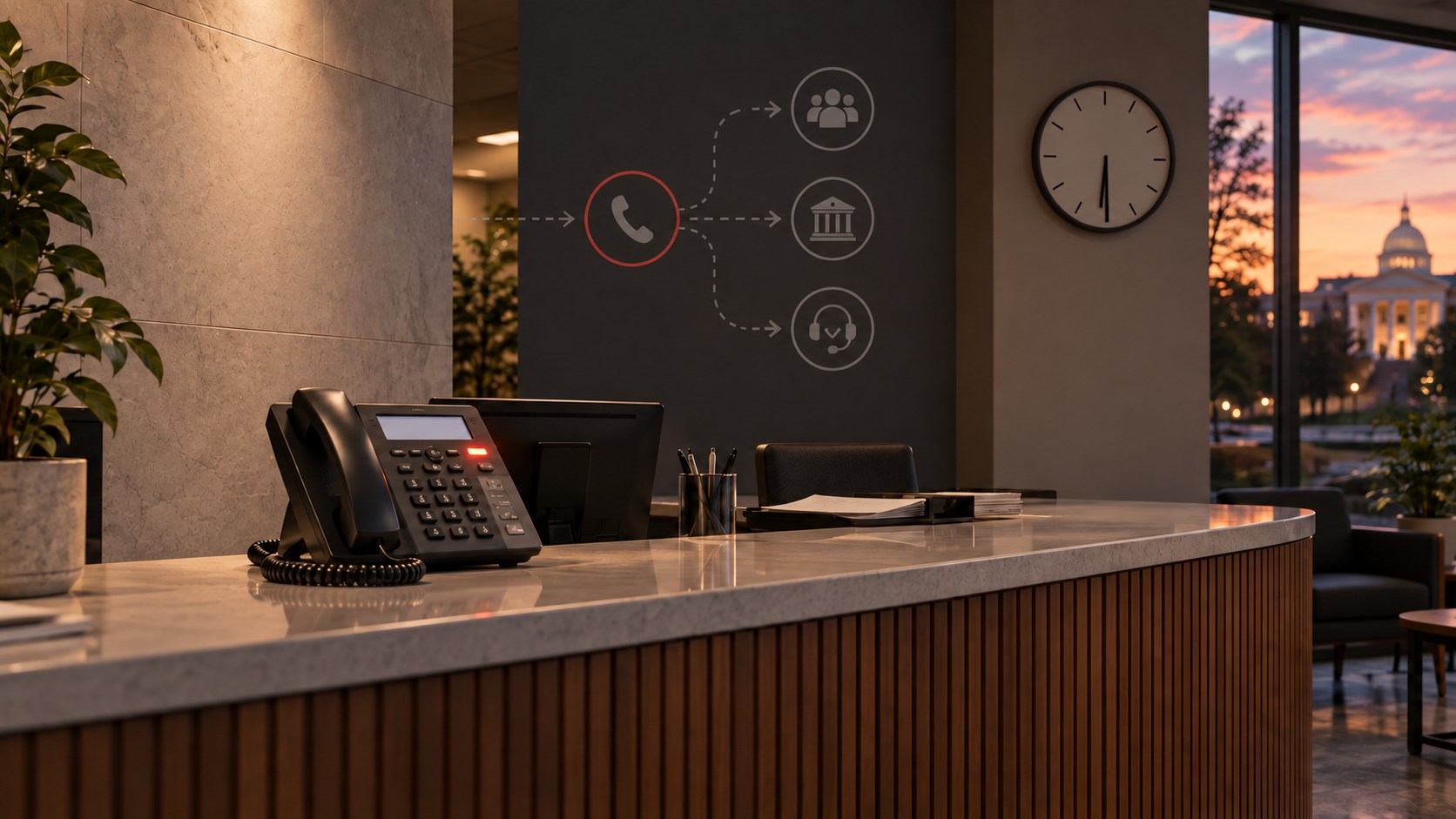
Imagine for a moment a resident calling the permits office after a holiday weekend. The main number announces that the building is closed. A direct number on an older form rings until the caller gives up. Another extension accepts a message, but the employee who monitored that mailbox has moved departments.
This is a hypothetical scenario, but it highlights three separate failures that a check of the main greeting would miss. Government after-hours call routing needs to be tested from the numbers residents use through to the person who handles the next action.
September is a useful time to review closure routing after Labor Day and before the next round of holiday schedules. The same tests belong after a department move, staffing change or phone-system update.
Key Takeaways
- Test from an external phone and follow each route to its final destination.
- Check direct department numbers as well as the main menu.
- Confirm closure start and end times, the configured time zone and the return to normal service.
- Have the responsible employee retrieve a test message before marking voicemail complete.
Start With the Numbers Residents Can Find
Build the test list from the agency website, appointment notices, printed forms and department contact pages. Add direct numbers that bypass the main auto attendant. An internal extension list alone will not show every public entry point.
For each number, record the department, published service hours, intended destination and employee responsible for the result. Agree on what should happen when that person is unavailable. A shared mailbox needs a backup reader and an agreed response process.
Keep this review within ordinary public service lines. Dispatch, emergency calling and 911 require their own coordinated procedures and are outside these tests.
Test 1: Call the Main Number From Outside
Use an external phone so the call takes the public incoming route. Listen to the entire greeting and select the options a resident would use. Note the wording, menu choices, transfer destination and approximate time spent ringing.
Check whether the greeting explains the next useful action. A caller may need to know when the office reopens, where to leave a message or how to reach a service that operates different hours. The department should approve that wording and any response promise.
Repeat the test without selecting an option. If an operator route is offered, follow it. An unattended operator extension can turn an otherwise correct menu into a dead end.
Test 2: Dial Department Numbers Directly
Call each published department number without going through the main menu. Compare the result with the route reached through the auto attendant.
The two paths may legitimately differ. Parks administration and facility reservations, for example, may have different schedules. Record the intended difference so a technician does not accidentally remove it while correcting another route.
Ask the department to check old web pages and documents when a number has been retired. Correcting the phone configuration will not correct an outdated contact sheet still being handed to residents.
Test 3: Check the Closing and Reopening Boundaries
Review the schedule with the phone administrator, then verify the public behavior around a planned boundary. Record local date, time and time zone in the test log. Check both closing and reopening.
Microsoft’s current auto attendant documentation explains that the selected time zone governs business-hour calculations and that periods outside configured business hours use the after-hours flow. Those settings deserve an explicit check on a Teams deployment. Other platforms require the equivalent review against their own documentation.
Include partial closures and lunch breaks where the agency uses them. Arrange testing with the administrator; changing a live schedule merely to demonstrate a result can divert real callers.
Test 4: Exercise the Holiday Override
Verify the holiday entry, its assigned call flow, its greeting and its end boundary. A correctly named holiday can still contain the wrong dates or point to last year’s temporary destination.
Microsoft’s holiday setup guidance specifies explicit start and end dates and times. Its full-day example ends at midnight on the following day. That detail matters when an administrator intends a full closure but enters an end time that cuts it short.
Use an approved test configuration or a scheduled verification window for future holidays. Record when normal routing should resume and who will verify it. Keep the agency’s calendar owner involved when dates change.
Test 5: Let the Destination Go Unanswered
Continue the call beyond the first transfer. Observe the outcome when the destination does not answer: voicemail, another queue, another number or a disconnect. Look for a loop that sends the resident back to an earlier menu without explaining what happened.
Leave a clearly identified test message with no resident information. Ask the assigned employee to retrieve it using the access they ordinarily have. Confirm the backup employee can perform the same task through authorized access.
Record the agreed handling process. If the greeting promises a return call, someone needs responsibility for checking the mailbox, assigning the request and following up.
Keep a Five-Row Call-Test Log
Copy this template into the agency’s working document. Add separate rows where one scenario applies to several numbers. “Pending” means the test has not been completed.
| Number | Scenario | Expected Route | Actual Result | Owner | Correction Date |
|---|---|---|---|---|---|
| Main public number | External call and menu selection | Approved department destination | Pending | Named service owner | Set after test |
| Published direct number | Bypass main menu | Approved direct-call route | Pending | Department owner | Set after test |
| Number under review | Closing and reopening | Correct flow at each boundary | Pending | UC administrator | Set after test |
| Number under review | Holiday override | Closure message, route and timely reset | Pending | Calendar and UC owners | Set after test |
| Final destination | No answer and voicemail | Usable fallback; message retrieved | Pending | Mailbox owner | Set after test |
Attach the greeting wording, timestamp, ring duration and detailed result to each row. Include the agency’s language and accessible communication requirements in the acceptance criteria. Test those supported options with the people responsible for them.
Review Outages Separately
A closure schedule assumes the calling service can receive and route a call. An internet, power or carrier outage may affect that assumption. Have the UC and network teams document where the incoming service runs, which dependencies it shares with the building and what approved fallback remains available.
Schedule a separate continuity review where that evidence is missing. A holiday test cannot establish carrier resilience.
Assign the Corrections and Retest
Give each failure an owner and a correction date. After the change, repeat the original external call and record the result. Include the next closure or staffing change in the maintenance schedule so the test does not depend on someone remembering it next year.
Related Reading
Sources
- Microsoft Learn: Auto attendant setup, reviewed September 14, 2026.
- Microsoft Learn: Holiday setup, reviewed September 14, 2026.
Where VIcom Fits
VIcom can help review the public call flows and the communications infrastructure behind them. Bring the published number list, current closure schedule and completed test log to a call-flow consultation.
Connect with VIcom by filling out the form below.