
The extension is runway, not a reason to wait
Federal telehealth flexibilities have been extended through December 31, 2027. Healthcare organizations should treat that timeline carefully. It does not remove the need for legal, compliance, reimbursement, or clinical review. It also does not mean every temporary policy will become permanent. What it does create is planning runway. Teams have time to move beyond temporary workarounds and improve the spaces, workflows, and support models that make virtual care dependable.
Telehealth quality depends on more than a video platform. The platform may connect the visit, but the room determines whether the visit feels clinical, private, clear, and reliable. If the camera is poorly placed, the microphone is weak, the lighting is harsh, the display is too small, the controls are confusing, or support is unavailable, the experience suffers for both clinician and patient.
Standardization does not mean every room looks identical. It means each room type has defined requirements, tested equipment, privacy expectations, support processes, and lifecycle ownership.
Start by defining telehealth room types
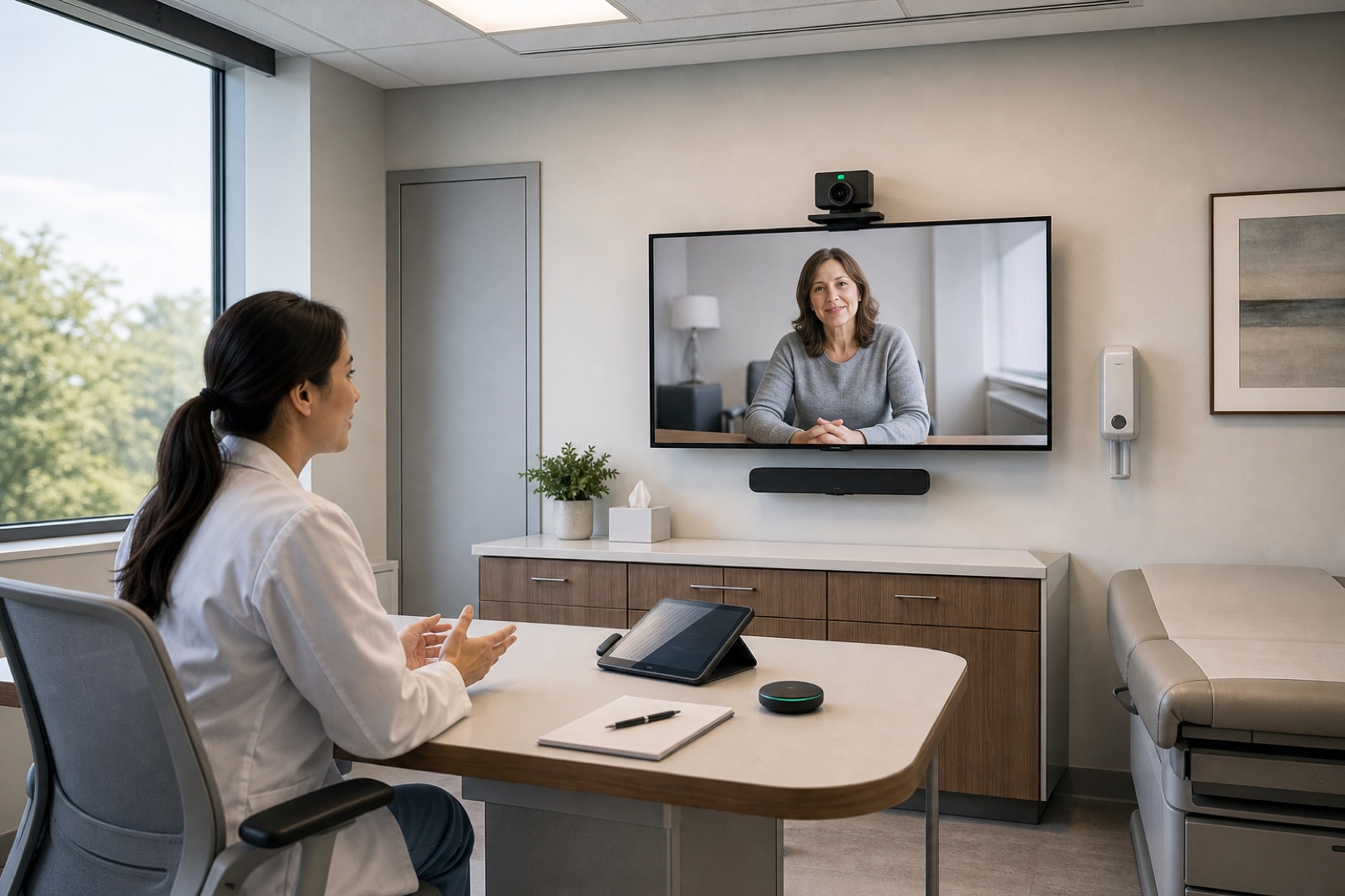
Different telehealth spaces serve different workflows. A provider office may need a compact camera, clear audio, good lighting, and easy access to clinical systems. A consult room may need a larger display, better acoustics, and space for multiple participants. An exam room may require camera placement that supports clinical conversation and appropriate views without compromising privacy. Behavioral health rooms may place a heavier emphasis on comfort, privacy, sightlines, and audio quality.
Specialty consult spaces may need higher-quality cameras, content sharing, or peripheral considerations. Patient access rooms may need simple controls and support for patients who do not have private technology at home. Mobile carts can support flexible use cases but need clear storage, charging, cleaning, network, and support practices.
Before buying equipment, healthcare teams should document which room types they operate, what each room is expected to support, who uses it, what privacy risks exist, and what level of reliability is required. That inventory becomes the foundation for telehealth room design standards.
Clinical AV requirements that affect care experience
Audio is often the most important requirement. Patients and clinicians need to hear each other clearly without strain. Microphones should capture the right voices while reducing room noise. Speakers should be intelligible without being so loud that confidential conversations spill into nearby areas.
Camera placement should support eye contact and clinical communication. A camera that is too high, too low, too far away, or pointed at a bright window can make the visit feel impersonal. Display size should match the room, the distance, and the number of participants. Lighting should make faces visible without glare or harsh shadows. Acoustic control should reduce echo and improve speech clarity.
Network reliability, easy controls, and room readiness matter just as much. Clinicians should not have to troubleshoot inputs, pair devices, or guess which microphone is active during a patient encounter. Infection control considerations should guide device placement, cleaning surfaces, cable management, shared touchpoints, and mobile cart handling. The best room designs respect clinical time.
Privacy, HIPAA-aware vendors, and business associate questions
This is not legal advice, and organizations should involve privacy, compliance, security, and legal teams when making telehealth technology decisions. At a practical level, teams should ask whether vendors will sign a business associate agreement when required, what data is created or stored, how access is controlled, whether sessions can be recorded or transcribed, what administrative settings exist, and how devices are managed.
Patient privacy also depends on the physical room. Can conversations be overheard? Can screens be seen from hallways? Is there a clear workflow for starting and ending sessions? Do patients and clinicians understand when cameras and microphones are active? Are guest participants handled appropriately? Are spaces designed for sensitive conversations, not just convenient video access?
Telehealth programs should avoid assuming that a general collaboration room automatically meets clinical needs. The same platform may be used in multiple contexts, but the configuration, room design, user training, and support model should reflect the healthcare use case.
A practical standardization checklist
A useful telehealth room standard should define the room type, primary use cases, user roles, camera requirements, microphone and speaker requirements, display size, lighting, acoustic treatment, privacy controls, network requirements, approved platforms, identity and access expectations, cleaning considerations, support path, monitoring approach, and lifecycle plan.
Include workflow details. How does a clinician start a visit? How does a patient or guest join? What should happen if audio fails? Who supports the room during business hours? Who handles after-hours needs? Which rooms are critical enough for proactive monitoring? What spare devices or replacement paths are available?
Standards should also include documentation for training and onboarding. Clinician ease of use is not a soft requirement. It affects adoption, visit quality, and the likelihood that teams will stay within approved workflows instead of improvising around technology friction.
Use a phased improvement plan
Healthcare teams do not need to rebuild every room at once. Start with an assessment of current telehealth spaces, incident history, user feedback, clinical priorities, and room utilization. Identify high-impact rooms where poor audio, privacy concerns, confusing controls, or unreliable support create the most risk.
Phase one may standardize critical rooms and create a support model. Phase two may update common room types, mobile carts, or provider offices. Phase three may integrate monitoring, analytics, and lifecycle refresh planning. Each phase should include training, documentation, success metrics, and feedback from clinicians.
VIcom helps healthcare organizations connect telehealth room design, AV systems, UC platforms, privacy considerations, deployment standards, and managed support. The 2027 extension gives teams time to build a more dependable virtual care environment. Waiting only preserves the weak spots that patients and clinicians already feel.