
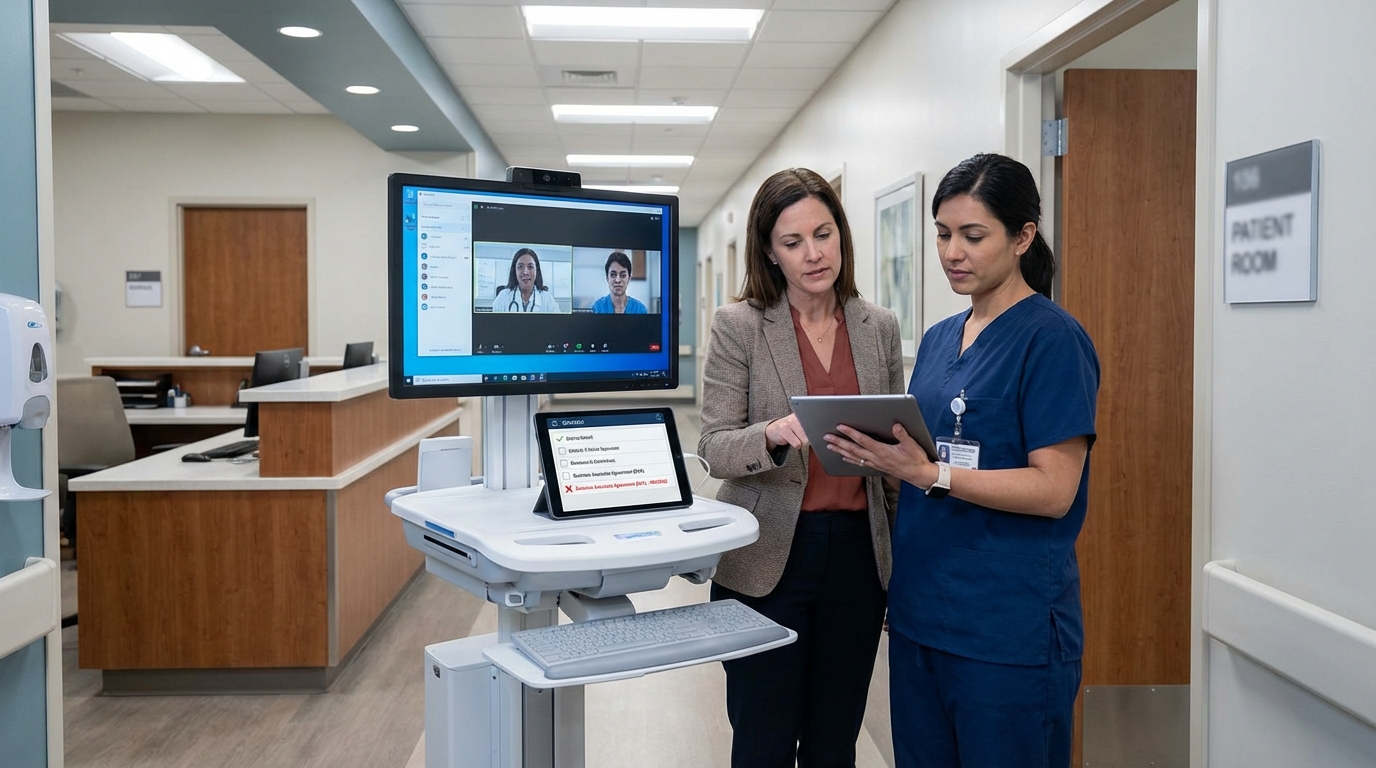
A hospital system recently deployed a telehealth cart without confirming whether the video platform had a signed Business Associate Agreement. The cart worked perfectly. The compliance audit did not go as well.
Healthcare AV is the fastest-growing vertical in the integration industry — 29.15% compound annual growth rate — driven by telehealth expansion, virtual hospitals delivering full-spectrum clinical services remotely, and AI-powered clinical workflows entering real patient care environments. The growth is real, but so is the compliance exposure that comes with deploying technology that touches protected health information without adequate safeguards.
The BAA Is the Beginning, Not the End
A Business Associate Agreement with your video platform vendor is table stakes, not a compliance strategy. All three major collaboration platforms — Microsoft Teams for Healthcare, Zoom for Healthcare, and Cisco Webex — offer HIPAA BAAs and support HIPAA-compliant configurations. The BAA establishes that the platform vendor will protect PHI appropriately. It does not address the endpoint devices in the room, the network the devices run on, the storage location for recordings, the access controls on meeting recordings, or the physical placement of cameras in clinical spaces.
Healthcare AV compliance requires addressing all of those layers, not just the platform contract.
Microsoft Teams for Healthcare provides the BAA under Microsoft’s standard Business Associate Agreement and adds Microsoft Cloud for Healthcare capabilities on top — clinical workflow integrations, virtual appointments, and care team collaboration features. Proper configuration requires ensuring that PHI stays within the compliance boundary: Microsoft 365 tenant settings, conditional access policies, and information barriers may all need adjustment for clinical environments.
Zoom for Healthcare is a separate offering from standard Zoom, with the BAA, end-to-end encryption for clinical meetings, and explicit controls over which AI features (Zoom AI Companion) can process meeting content. The separation matters: a hospital that deploys standard Zoom rather than Zoom for Healthcare may have a platform that doesn’t process PHI appropriately by default.
Cisco Webex’s HIPAA-compliant configuration is available across their platform tiers. Webex’s on-premises deployment option provides the strongest data sovereignty for health systems where cloud processing of patient interactions creates governance concerns. For large academic medical centers and health systems with significant IT infrastructure, the on-premises option is worth evaluating.
Room Design: Clinical Environments Have Specific Requirements Standard Conference Rooms Don’t
Most AV integrators design healthcare rooms the same way they design corporate conference rooms — and produce systems that fail clinical requirements in predictable ways.
Sound masking for patient privacy is not a nice-to-have in healthcare environments. HIPAA requires “reasonable safeguards” against incidental disclosure of PHI through oral communication — which includes conversations overheard through thin walls, from adjacent waiting areas, or across open clinical bays. Sound masking systems (Lencore, Cambridge Sound Management) installed in exam rooms, consultation spaces, and patient-facing telehealth areas satisfy this requirement in a documented, auditable way.
Camera placement for clinical telemedicine follows different rules than camera placement for business video calls. Clinicians need to see the patient’s full physical presentation for clinical assessment — not just their face. Camera angle, field of view, and zoom capability need to support clinical evaluation. In sensitive clinical areas (behavioral health, obstetrics, pediatrics), camera placement must be reviewed against patient dignity and privacy requirements before installation.
Touch-free controls for sterile environments eliminate a compliance and infection control problem that touch-based systems create in procedure rooms and sterile fields. Voice-activated room controls, foot pedals, or purpose-designed UV-resistant touchscreens with documented cleaning protocols address this. Standard corporate AV touch panels are not appropriate in sterile clinical environments.
Lighting for clinical video differs from standard office lighting. Clinical video assessment requires consistent, non-glaring illumination that allows the provider to accurately evaluate skin color, patient pallor, and physical presentation. Standard LED office lighting frequently creates shadows, color temperature issues, or glare that impairs clinical assessment via video. Lighting design for clinical telehealth spaces should involve someone who understands clinical assessment requirements, not just lumen calculations.
Telehealth Cart Design: More Than a Screen on Wheels
Telehealth carts are the most frequently deployed clinical AV system, and the most frequently under-specified. A compliant, reliable telehealth cart requires more than a display and a camera.
The camera must provide adequate resolution and zoom for clinical assessment — not a consumer webcam. Microphone placement must capture the provider’s voice clearly from a natural working position, not require the provider to lean toward a table microphone mid-consultation. Wireless connectivity (Wi-Fi or cellular) must be designed for reliability in a clinical environment with significant RF interference from medical equipment. UPS battery backup prevents session disruption during momentary power events. Remote management capability allows IT to monitor cart status, push updates, and troubleshoot without requiring a physical technician visit to the patient floor.
The cart’s network connection also needs specific security configuration: authentication, VLAN placement appropriate for clinical devices, and encryption in transit. A telehealth cart that connects to the general hospital guest network is not a compliant deployment.
AI in Healthcare AV: Where the Line Is
AI features are arriving in healthcare AV environments faster than compliance frameworks can keep pace. Understanding where AI is appropriate and where it creates exposure prevents both missed opportunities and compliance violations.
Ambient clinical documentation — AI systems that listen to patient-provider encounters and generate clinical notes — is growing rapidly. Platforms like Nuance DAX (Microsoft) and Amazon HealthLake are designed specifically for this use case with appropriate HIPAA controls. Standard meeting AI (Microsoft Copilot in a general Teams meeting, Zoom AI Companion) is not an appropriate substitute for ambient clinical documentation — the data handling, storage, and retention requirements differ materially.
AI for operational analytics — patient flow monitoring using video analytics, waiting room occupancy tracking, staff workflow optimization — uses aggregate, non-PHI data and carries lower compliance risk. CHKD’s AI-powered weapons detection integration is an example of operational AI that enhances physical safety without touching patient data directly.
Where caution is essential: enabling standard meeting transcription in clinical rooms without confirming PHI handling. A meeting transcript in a clinical context is a PHI record. It needs to be stored, retained, and deleted according to your organization’s HIPAA compliance policies — not treated as a standard business communication record.
Common Compliance Failures in Healthcare AV Deployments
These failures appear consistently in healthcare AV environments and in HIPAA audit findings related to AV systems.
Unsecured video endpoints are the most common finding — room cameras and conference systems deployed with default credentials, outside the organization’s device management framework, without network segmentation from clinical systems. The fix requires both IT and AV coordination, which rarely happens when AV systems are procured through facilities rather than IT.
Recording storage on unsecured local drives creates a documented PHI breach risk. Meeting recordings involving patient discussions should be stored in HIPAA-compliant cloud storage (Azure, AWS HIPAA-eligible services, or approved on-premises systems) with documented access controls and retention policies.
Inadequate access logging for who viewed or participated in clinical video sessions creates an audit trail gap. HIPAA requires the ability to track PHI access — which extends to clinical video sessions.
Consumer-grade video conferencing in clinical settings without BAA coverage is the simplest failure to prevent and the most common. Any video platform used in a clinical context where patient information may be discussed requires a signed BAA before the first patient session.
VIcom’s Healthcare Experience
VIcom has deployed AV systems for Sentara Healthcare, CHKD (Children’s Hospital of the King’s Daughters, including AI-powered weapons detection integration), and Children’s Hospital across Virginia. The clinical environments differ significantly from corporate environments: infection control protocols, clinical workflow requirements, patient dignity considerations, and compliance documentation requirements all shape what a correct deployment looks like.
The integrator who installed your corporate conference rooms may not be the right integrator for your telehealth deployment. Healthcare AV requires understanding both the technology and the clinical environment it operates in.
If your health system is expanding telehealth capabilities, modernizing clinical collaboration infrastructure, or assessing compliance gaps in existing AV deployments, We can provide a healthcare AV consultation that addresses both technical requirements and HIPAA compliance obligations. Let’s get started today!