
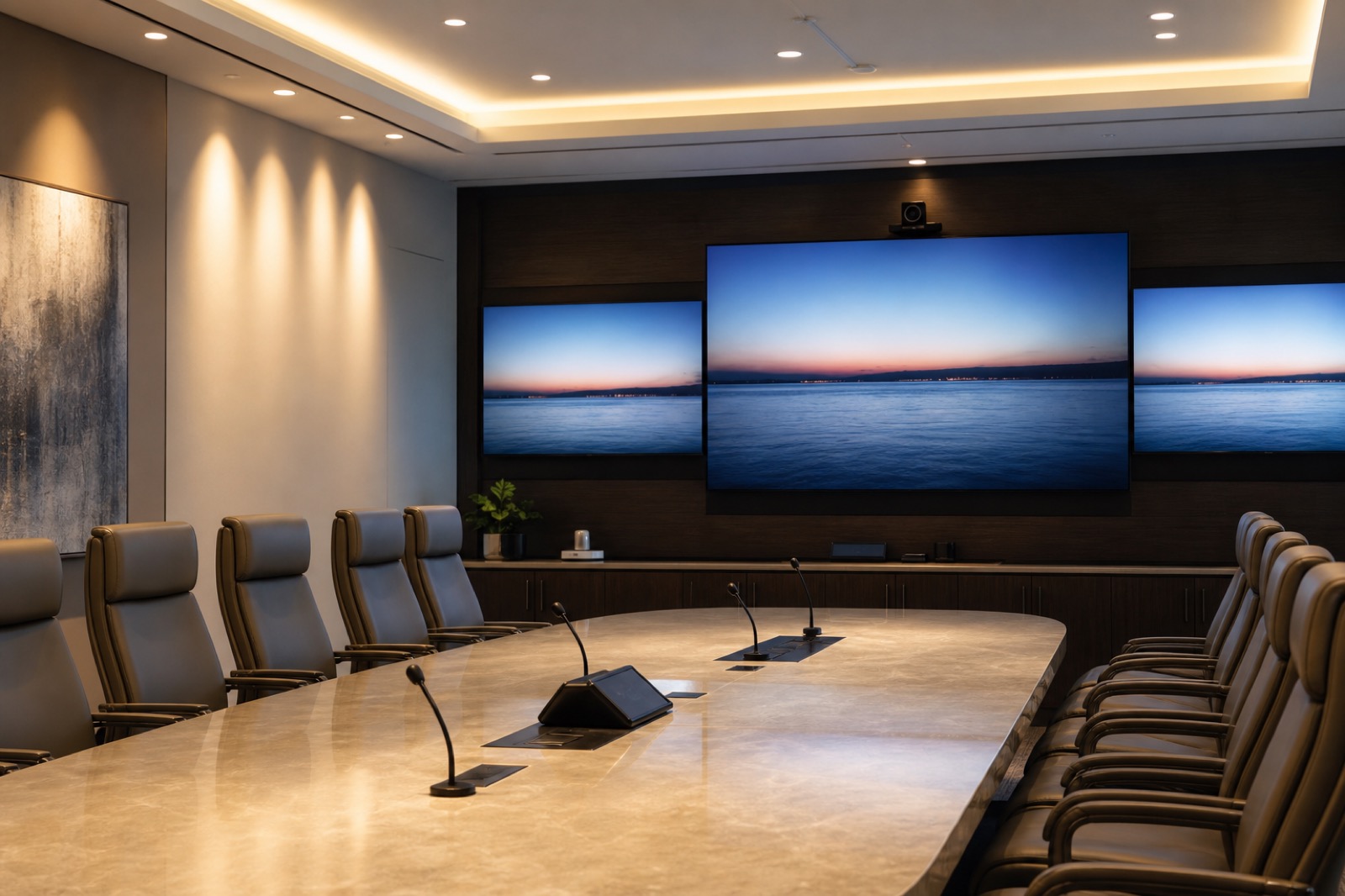
The Town Hall Is Now a Broadcast Moment
Enterprise town halls used to be internal meetings with a bigger room. Now they often function like broadcasts. Employees join from offices, homes, conference rooms, mobile devices, overflow spaces, and recordings after the event. A leadership update that is hard to hear, poorly framed, or unreliable does more than frustrate viewers. It weakens the message.
Corporate broadcast AV treats high-value internal communications like live events. Most companies do not need a full television studio, but the space, workflow, and support model should match the importance of the communication.
Design Around Real Executive Workflows
Start with the events the organization actually runs: quarterly all-hands meetings, CEO updates, earnings-related internal briefings, product launches, training broadcasts, customer advisory sessions, crisis communications, and hybrid leadership panels. Each format has different needs for cameras, microphones, presentation content, remote guests, audience Q&A, recording, streaming, and moderation.
A strong design defines presenter positions, camera shots, confidence monitors, lighting, audio pickup, cueing, content routing, countdowns, and backup paths. It also defines who does what before and during the event. A beautiful room will still feel improvised if the operator, presenter, and communications team are guessing.
Audio and Lighting Carry Professional Trust
Video quality gets attention, but audio determines whether people stay engaged. Presenters need clear microphones, reliable gain structure, return audio for remote guests, and monitoring for the production team. Audience questions need a predictable path into the stream. Panels need microphones that support natural conversation without distracting handling noise.
Lighting matters because executives should look credible without forcing a high-maintenance setup. Poor lighting makes cameras work harder and makes the event feel less intentional. The best corporate broadcast spaces give presenters a professional result with repeatable presets.
Hybrid Events Need Platform and Room Alignment
Town halls often cross platforms: Teams, Zoom, Webex, streaming services, recording tools, event pages, and internal portals. The room should be designed for those workflows. Remote speakers need clear return confidence. Moderators need Q&A visibility. Presenters need to know when they are live. Communications teams need recording and archive handoff.
Security and access also matter. Some broadcasts are company-wide, some are leadership-only, and some include sensitive information. The AV design should support approved channels, role-based operation, guest handling, and retention expectations.
Support Is Part of the Production Standard
The most important town halls are often the least forgiving. There is little tolerance for troubleshooting while executives wait. Pre-event checks, run-of-show templates, spares, monitoring, operator training, and escalation paths should be part of the service model. The room should be easy enough for routine updates and supported enough for high-stakes events.
VIcom helps enterprises connect AV design, UC platforms, network readiness, executive communications, and lifecycle support. The result is a town hall environment that feels planned, repeatable, and worthy of the message.
The Run-of-Show Is Part of the AV Design
A town hall room should be designed around the run-of-show, not only the camera shot. Who opens the meeting? Where does the executive stand or sit? How are slides advanced? Can the presenter see remote questions? Is there a countdown? Who mutes remote panelists? Where does the recording go? What happens if the primary laptop fails?
Those answers shape technology choices. A confidence monitor may matter more than a larger rear display. A simple production intercom may save more stress than another camera. A dedicated presentation input at the podium may prevent the awkward cable scramble that makes a leadership meeting feel improvised.
A Practical Town Hall Technical Check
- Presenter audio has a primary and backup microphone.
- Remote guests have return audio and know when they are live.
- The communications team can see Q&A, chat, or moderated questions without crowding the operator.
- Slides, camera, and audience views are routed to both the room and the stream.
- The recording path is tested before the event, including file ownership and archive location.
- Lighting presets work for seated panels and standing presenters.
- A support person owns the room 30 minutes before go-live.
For Virginia enterprises with distributed teams across Hampton Roads, Richmond, Northern Virginia, or branch offices, the town hall is often the one moment everyone experiences the same message. Production polish matters because it protects attention.
Design for the Moment the Script Changes
Town halls rarely follow the plan perfectly. An executive adds a video. A remote leader joins late. A sensitive question comes through Q&A. A slide deck changes ten minutes before go-live. The room should be designed for those realistic disruptions, not only the rehearsed version.
That means building operator visibility into the system. The operator should know what is live, what is next, what the remote audience sees, and whether the recording is active. The presenter should have confidence monitoring without turning around. Communications staff should have a place to manage questions and timing. Remote speakers should have a test path before they appear on screen.
For a company with offices across Virginia or the Mid-Atlantic, the production standard also shapes culture. If remote employees consistently receive a second-class version of leadership communication, they notice. Good corporate broadcast AV makes the message feel shared, not filtered through whatever room happened to be available.
The planning question before the next event is direct: would this room still work if the CEO changed slides, a remote executive joined late, and the Q&A moderator needed to hold one question back? If the answer is uncertain, the room needs workflow design as much as equipment.
If leadership updates still depend on a patched-together room, rehearse the next town hall before the calendar fills. VIcom can help design the space, workflow, and support plan so the message feels intentional; connect with VIcom by filling out the form below.