
When AV fails, learning stops
A delayed class rarely looks like a strategic IT issue at first. The instructor arrives, starts the session, and the camera does not appear. The microphone works for the instructor but not for student questions. Lecture capture records the slides but not the room audio. A video call starts in the wrong input. The help desk receives a ticket, but no one can tell whether the problem is AV hardware, network, platform settings, room control, or user workflow.
Multiply that moment across dozens or hundreds of rooms and campus AV support becomes more than troubleshooting. It becomes an operating model problem. Teaching, collaboration, accessibility, hybrid participation, lecture capture, and student experience now depend on classroom technology working predictably. At the same time, many institutions are managing small teams, tighter budgets, cybersecurity expectations, and rising user expectations.
Campus AV can no longer be treated as scattered equipment in individual rooms. It is essential infrastructure, and it needs the same strategic attention as other teaching and learning systems.
Inconsistency is the hidden support tax
The most expensive AV problems are not always the dramatic failures. Often, the cost comes from inconsistency. One room uses a different control interface than the next. Some rooms have cameras, but no consistent way to select them. Microphones differ by building. Lecture capture behaves differently across departments. Spare parts do not match. Documentation is incomplete. Faculty have to relearn inputs, audio, and hybrid workflows every time they move classrooms.
That inconsistency creates training burden, support time, downtime, delayed classes, faculty frustration, and poor student experience. It also makes budgeting reactive. Instead of knowing which systems are nearing end of life, teams respond to failures as they appear. Instead of using data to prioritize refreshes, the loudest complaint can drive the next spend.
A sustainable campus AV support strategy reduces variation where it hurts and preserves flexibility where pedagogy requires it. The goal is not to make every room identical. The goal is to make common tasks familiar, supportable, and documented.
Standards make support easier and teaching calmer
Standards should define room archetypes, not just hardware lists. A standard classroom, active learning room, HyFlex room, lecture hall, lab, collaboration room, and event space may have different needs. Within each archetype, the institution can define displays, microphones, cameras, lecture capture, control interfaces, inputs, assistive listening, network connections, scheduling, remote support, and documentation.
This approach helps faculty because the teaching experience becomes more predictable. It helps the help desk because first-line support can follow known steps. It helps procurement because replacements and spares can be planned. It helps cybersecurity because networked devices can follow known patterns. It helps budgeting because lifecycle refresh can be tied to room type, use, and support data.
Standards should also include usability. A technically powerful room that faculty avoid is not a successful room. Controls should be simple, labels should match teaching language, and training should show instructors how to accomplish common tasks without blaming them for system complexity.
Remote monitoring turns surprises into signals
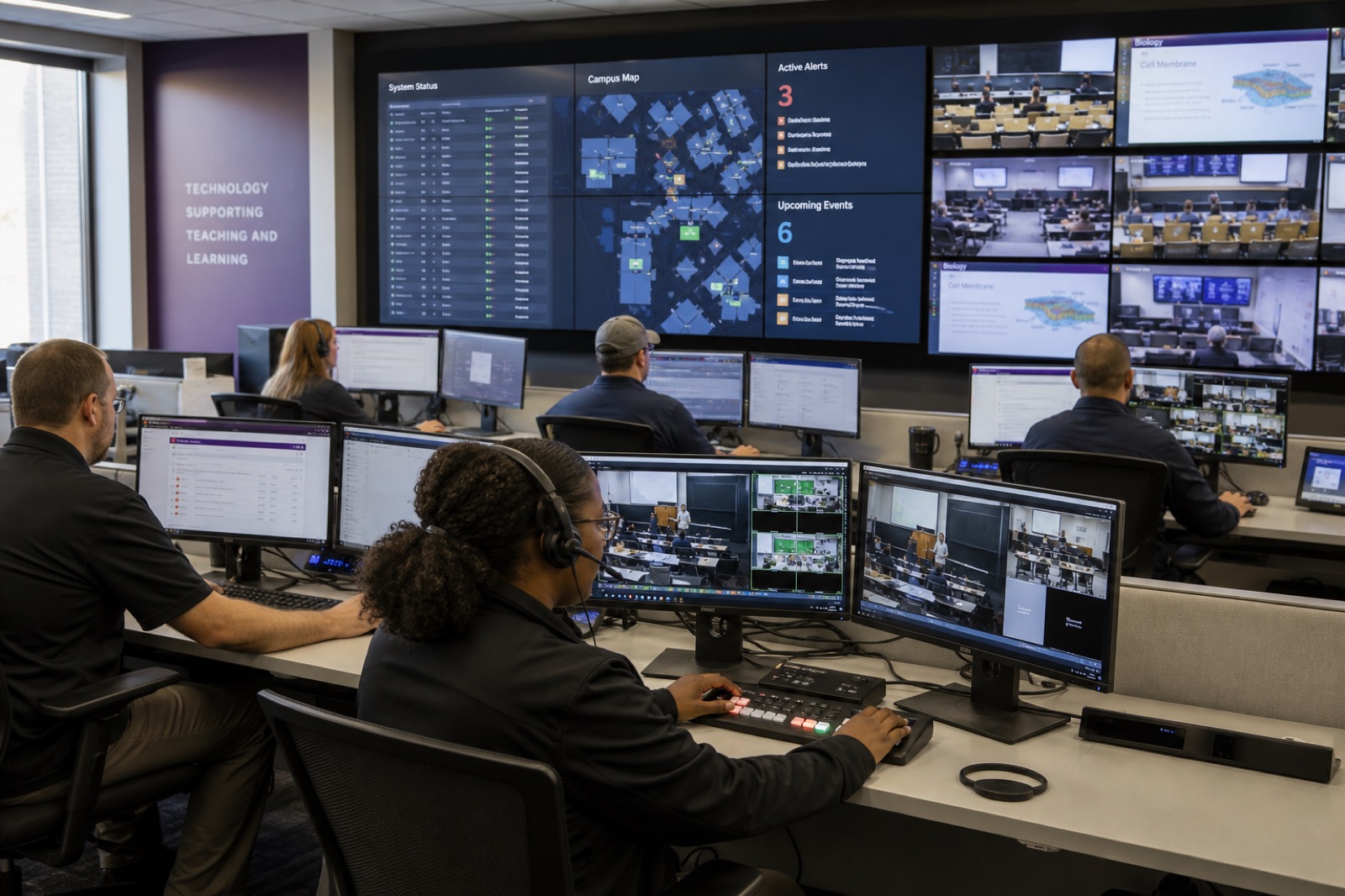
Remote monitoring is one of the clearest ways to move from reactive support to operational management. If a display, codec, microphone processor, control processor, or lecture capture appliance is offline before class, the support team can respond before the room is full. If logs show recurring failures in a building, the team can investigate root causes. If certain rooms generate unusual ticket volume, that data can guide upgrades or training.
Monitoring does not eliminate human support. It gives humans better information. The value comes when alerts are connected to ownership, escalation, and documentation. Who receives the alert? What action should they take? Is the room critical? Is there a backup workflow? Is the device under warranty? Is the issue part of a pattern?
Support data should feed budgeting conversations. Instead of asking for classroom AV funds in general terms, leaders can show which rooms are most used, most fragile, most expensive to support, or most important to teaching continuity. That turns AV refresh from a wish list into an evidence-based plan.
A sample operating model
A practical campus AV operating model assigns responsibilities clearly. IT leadership owns strategy, funding alignment, cybersecurity expectations, and service-level priorities. The AV or academic technology team owns standards, room design input, commissioning requirements, training, and advanced troubleshooting. The help desk owns intake, knowledge base articles, first-response scripts, and ticket routing. Facilities owns power, mounts, pathways, furniture coordination, and physical room conditions. Procurement owns approved standards, vendor terms, and lifecycle purchasing. Faculty support teams own adoption, communication, and feedback loops. Vendors and partners support design, remote diagnostics, preventative maintenance, documentation updates, warranty handling, and escalation.
The model should include inventory, room standards, monitoring, documentation, spare parts, refresh cycles, summer deployment planning, change control, and post-semester review. It should also include a way to capture faculty and student feedback without turning every comment into an emergency project.
Managed services can fit this model when they extend the institution’s capacity and improve continuity. They should not be a vague outsourcing pitch. The question is which tasks need external support: remote monitoring, preventative maintenance, emergency response, firmware management, documentation, or lifecycle planning.
How VIcom can help
VIcom helps higher education teams simplify campus AV complexity, standardize where it matters, reduce support drag, and build systems that remain supportable over time. That work can include standards development, room assessments, remote monitoring strategy, lifecycle planning, managed services, documentation, and deployment support.
If your campus is dealing with recurring classroom issues, rising support volume, inconsistent rooms, or an upcoming refresh cycle, VIcom can help you build a more sustainable AV operating model.