
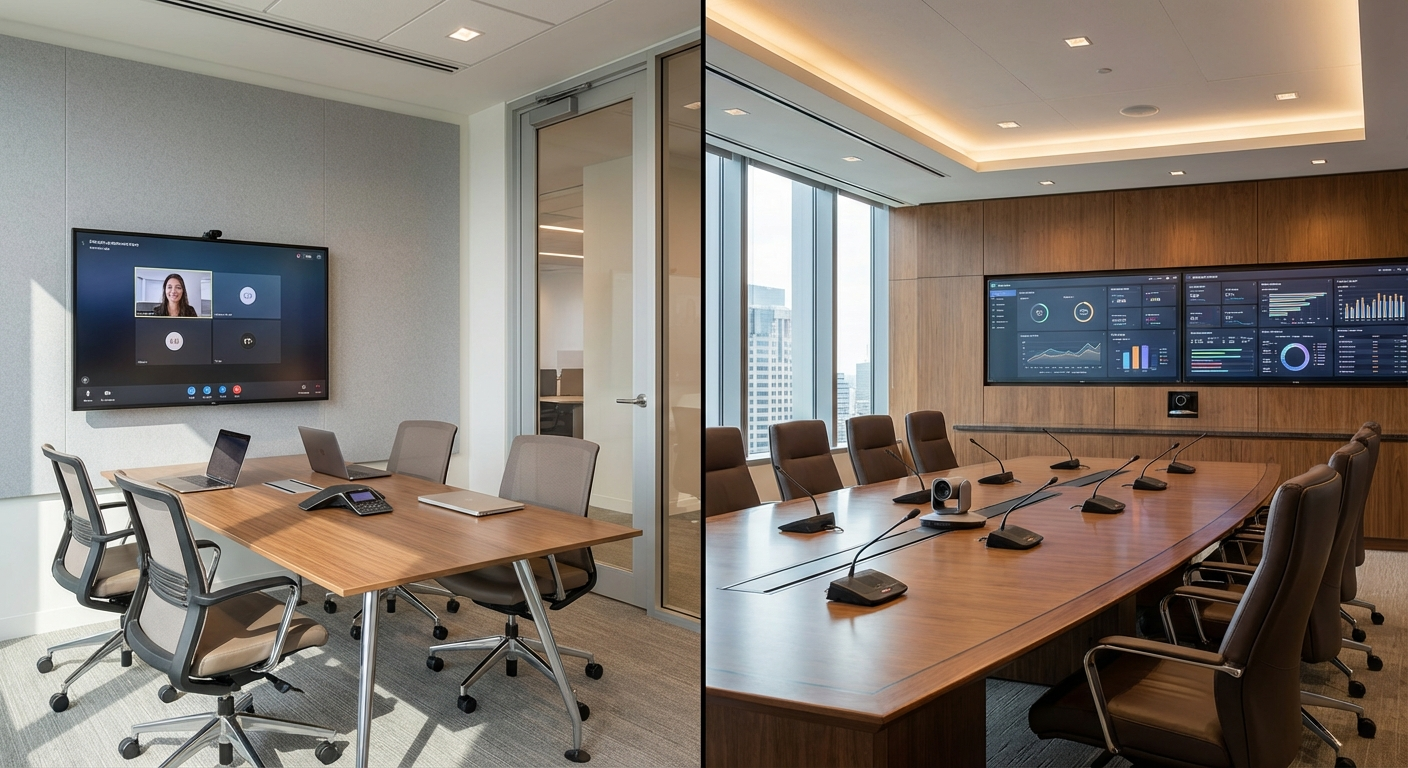
If you are planning new meeting rooms in 2026, let me ask you a blunt question: are you solving for the room, or are you just chasing the gear?
Because that is where a lot of organizations get this wrong.
A year or two ago, plenty of buyers treated certified room bundles like a compromise. Fine for a few simple rooms, maybe. Convenient, sure. But not serious enough for a broader room program. That was the assumption.
It is not a safe assumption anymore.
The market has changed. Vendors have made the bundle category more credible, more complete, and far easier to support at scale. And yet a lot of teams are still making the decision the old way. They get excited about products before they classify the rooms. They assume custom must be better because it sounds more capable. They spend premium engineering effort on ordinary spaces, then wonder why the rollout gets expensive, messy, and hard to support.
There is a simpler way to think about it.
Standardize the rooms that should be boring. Customize the rooms that cannot afford to be.
That is the heart of it.
For most organizations, certified bundles are now the default answer for repeatable huddle rooms, small conference rooms, and many medium rooms. Custom design still matters. It absolutely does. But it matters most in spaces where the experience depends on advanced control, more involved DSP, specialized camera behavior, divisible-room logic, executive-level polish, or training and presentation workflows that go beyond a straightforward meeting room.
So before you buy another room package or approve another one-off design, stop and ask the better question: what kind of room is this, really?
What a certified room bundle is actually buying you
A certified room bundle is not just a pile of hardware that happens to work together. It is not simply a camera, a compute device, a touch panel, and some audio stitched into the same quote.
It is a procurement model. An operating model. In a lot of cases, it is a sanity-preservation model.
When a system has already been assembled, validated, and certified around a platform like Microsoft Teams Rooms, you are buying more than devices. You are buying a cleaner path through design, deployment, support, and lifecycle management. You are buying fewer unknowns. You are buying fewer surprises. You are buying a room type that has a better chance of behaving like the next room of the same type.
That matters more than many teams expect.
1. Faster deployment
Most standard rooms do not need to begin with a blank sheet of paper.
That is one of the quiet advantages of bundles. The major components have already been validated to work together, so the team is not spending the same design energy over and over again solving a problem that has already been solved. That shortens design cycles, reduces coordination friction, and cuts down on the compatibility questions that can bog down procurement or installation.
Move faster.
2. Better repeatability across rooms
If you are rolling out ten rooms, twenty rooms, fifty rooms, the value is not just in getting the first room right. The value is in getting the fifteenth room to behave like the first without needing a heroic effort every time.
Repeatability is not glamorous, but it is powerful. It improves user confidence. It improves supportability. It helps employees walk into a room and know what they are dealing with instead of relearning the experience every time they move across the building.
Consistency wins.
3. Cleaner support boundaries
Support gets ugly when every room is its own little science project.
That is not me being dramatic. That is just how it goes.
When every space is unique, troubleshooting slows down because support teams have to rediscover the room every time something breaks. But when the core room experience is standardized, support has a known device set, a known signal path, and a known baseline configuration. That makes troubleshooting faster and less chaotic.
Less mystery. More control.
4. Lower lifecycle complexity
This is the part buyers underestimate all the time.
The true cost of a room is not the install. It is what happens after the applause dies down and the room becomes part of normal operations. Ticketing. Firmware updates. Staff turnover. Documentation. Replacements. Refresh planning. Escalations.
That is where a standard bundle often earns its keep. Not because it is exciting, but because it is consistent. And consistency makes the next three to five years less painful.
Think beyond day one.
5. More confidence for IT-led deployments
A lot of organizations want meeting rooms to behave more like managed infrastructure and less like artisanal AV projects. That does not mean they want low-quality rooms. It means they want rooms they can own without constant drama.
That is one reason certified bundles have become more attractive. They align well with IT-led models that prioritize fleet management, support consistency, and operational clarity.
Own what you deploy.
Why bundles feel more credible now
The category has matured. That is the big shift.
Barco’s Teams-certified ClickShare Hub bundles with Sennheiser are one example. Shure’s IntelliMix Room Kits and IntelliMix Bar Pro are another. Microsoft’s own planning guidance reflects the broader reality too: organizations can procure Teams Rooms as bundles or integrated partner solutions instead of treating every room like a one-off design exercise.
And that matters, because it changes the posture buyers should take.
The bundle path is no longer the side door. It is part of the mainstream planning conversation.
That does not mean custom rooms are obsolete. It means buyers should stop acting like standard rooms need custom engineering in order to be taken seriously. In many cases, they do not.
Be honest about the room.
Where certified bundles are usually the right answer
For repeatable room types, bundles now deserve the benefit of the doubt.
That usually includes huddle rooms, small conference rooms, medium conference rooms, and other common room types repeated across floors, offices, or sites. These are the spaces where business value usually comes from reliability, speed, consistency, and supportability, not from bespoke control logic or hyper-specific user workflows.
And that is exactly where certified bundles shine.
If your goal is straightforward native meeting performance with dependable audio, video, and content sharing, a bundle will often get you there faster and more cleanly than a fully custom design. It also gives procurement a clearer standard, IT a clearer support model, and leadership a clearer path to scale.
Not every room deserves premium engineering time. Some rooms just need to work. Quickly. Reliably. Repeatedly.
Let them be boring.
Where custom room design still earns its cost
Now let us be fair. Custom design still matters. Deeply. Just not everywhere.
There are rooms where the experience depends on behaviors that a standard bundle is not built to solve on its own. Those are the places where custom design stops being indulgent and starts being necessary.
Divisible rooms
The moment a room combines and separates, complexity ramps up fast. Audio zones change. Camera behavior changes. Control states change. Display routing changes. User workflows change. When the wall moves, the room logic has to move with it.
That is custom territory.
Executive boardrooms
Executive spaces often carry a different set of expectations. Better finish level. More polished room behavior. More intentional source switching. More refined camera framing. More pressure for the room to feel seamless.
Even if a bundle could technically function there, that does not mean it delivers the experience the room is supposed to support.
Some rooms carry more weight. Treat them that way.
Training rooms and presentation-heavy spaces
Training environments tend to outgrow simple room logic quickly. More sources. More routing complexity. More visibility requirements. More instructor-driven behavior. More emphasis on what happens inside the room, not just across the call.
That usually points toward custom design.
Advanced multi-camera rooms
Some spaces need more than a basic camera experience. Presenter tracking. Audience capture. Specific switching logic. More intentional framing behavior. The more the room depends on camera choreography rather than simple coverage, the more likely you are in custom territory.
Do not fake a custom problem with a standard kit.
Rooms with advanced DSP or acoustic demands
Certified bundles can sound very good. Sometimes excellent. But not every room is acoustically ordinary.
Large rooms, reflective finishes, unusual layouts, reinforcement needs, or more advanced processing goals can justify a deeper audio design. This is where experienced engineering still matters, because the room itself starts to dictate the system.
Listen to the room.
Rooms that need integrated control
The moment a space needs to coordinate displays, sources, lighting, shades, routing, occupancy behavior, or broader building workflows in a meaningful way, you are moving beyond a standard meeting bundle and into integrated design.
That is not a failure of the bundle. It is just a different problem.
Custom should not be the reward for having a bigger budget. It should be the response to having a more complex room.
The middle ground most teams forget
Here is where buyers can save themselves money and overengineering: the decision is not always bundle or custom with nothing in between.
Some rooms are still excellent bundle candidates even if they need a few modest additions. And that middle ground matters, because a lot of teams jump to full custom too early when the room really just needs a little extension around the edges.
A room may still make sense as a bundle if the changes are limited, such as adding a scheduling panel, adjusting the display size or mounting approach, improving cable management, refining furniture sightlines, or making modest peripheral changes that do not fundamentally alter how the room behaves.
That is very different from rebuilding the room around new control logic, deeper DSP, or more involved switching requirements.
A useful test is this: after the change, does the room still behave like the same room type?
If the answer is yes, a bundle plus minor extensions may be enough. If the answer is no, you are probably designing a custom room whether you want to admit it or not.
Do not overbuild too early.
The real problem is usually room classification
This is where the whole thing comes into focus.
Most organizations do not actually have a product problem. They have a room-classification problem.
Because once you define room types clearly, the bundle-versus-custom debate gets a lot less emotional and a lot more practical. Instead of arguing brand by brand or feature by feature, you start grouping spaces by user behavior, support expectations, and actual complexity.
You begin to see the pattern.
- Standard room types: huddle rooms, small rooms, medium rooms, and recurring spaces used for everyday internal and external meetings
- Exception room types: divisible spaces, executive rooms, training rooms, high-visibility boardrooms, specialized presentation spaces, and environments with more advanced integration requirements
Once you think like that, the decision gets cleaner. You standardize aggressively where standardization creates value, and you reserve custom engineering for the rooms that truly become risky if you get them wrong.
That is a better use of budget. A better use of engineering attention. A better story for leadership. And a much better foundation for support after go-live.
Classify first. Then buy.
The lifecycle cost buyers keep underestimating
Let me say this plainly: a custom room can be completely justified and still become an operational headache.
That is the hidden tension.
During design, custom rooms often feel easy to defend because the feature set looks richer and the possibilities feel bigger. But a lot of the real cost shows up later, and later is exactly when many buying teams stop paying close attention.
That is when the extra documentation burden appears. The more specialized troubleshooting paths. The deeper training requirements for support teams. The dependency on a smaller pool of knowledge. The friction that comes when a component fails or the room needs to be refreshed three years down the road.
None of that means custom rooms are bad investments. It means they need to produce meaningful value in exchange for the extra complexity they create.
In standard rooms, the opposite is often true. A certified bundle can reduce ticket noise, shorten troubleshooting time, and create a support model that scales better across sites. For IT and workplace teams managing many spaces, that operational advantage is not secondary. It is part of the real ROI.
Count the years, not just the quote.
A simple decision framework for 2026 buyers
If you want a practical rule of thumb, start here.
Choose a certified bundle by default when:
- the room is repeatable
- the workflow is straightforward
- native meeting performance is the main goal
- support consistency matters across many rooms
- speed of deployment matters
- the room does not need advanced control, DSP, or camera logic
Stay with a bundle and add minor extensions when:
- the room is still fundamentally a standard room type
- the changes do not alter core room behavior
- the added requirements are peripheral, not architectural
Move to custom when:
- the room is divisible or reconfigurable
- a premium executive experience is a core requirement
- advanced source switching or automation is required
- camera behavior needs to be highly specific
- audio design must solve unusual acoustic or reinforcement needs
- room control must extend beyond the narrow scope of a standard meeting system
If a room cannot clearly justify those custom triggers, it probably should not be custom.
That may sound obvious. It rarely gets treated that way.
The smartest buying posture now
The strongest room programs in 2026 are not the ones that chase the most gear, the most customization, or the most impressive-looking quote. They are the ones that classify rooms correctly and build a strategy around that reality.
Certified bundles are now credible enough to handle far more of the standard-room portfolio than many organizations still assume. That makes them the right default for repeatable rooms where speed, consistency, and supportability matter most.
Custom design still has a very real role. But it should be reserved for the spaces where the experience genuinely depends on custom behavior.
That is the real framework.
Not bundle versus custom as competing ideologies.
But standardization versus exception handling as a room strategy.
And once you see it that way, the buying decision gets a whole lot clearer.
If you want a practical way to sort your room portfolio, fill out the form below to connect with VIcom. We can help you identify which spaces should be standardized with certified bundles, which ones only need minor extensions, and which rooms truly deserve a custom design path.