
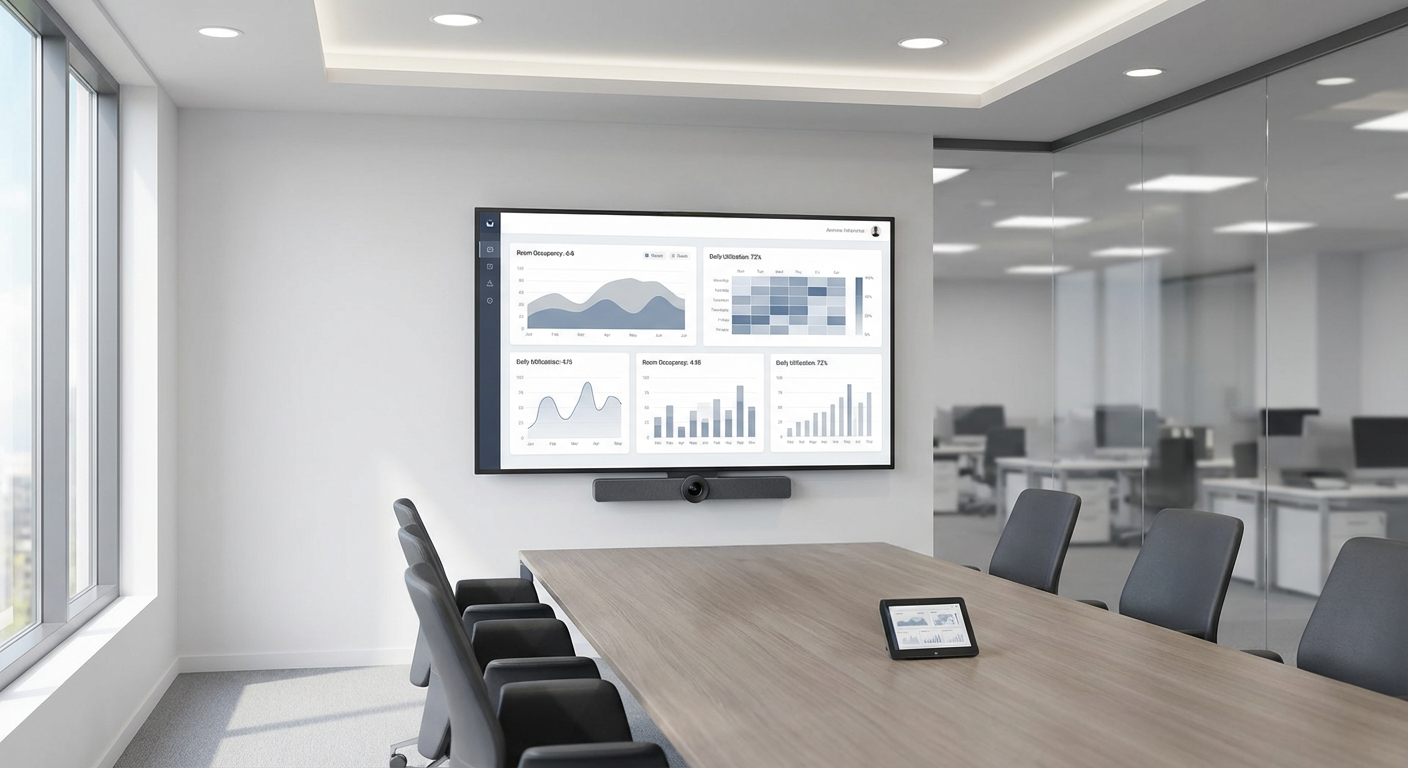
Too many workplace decisions still start with the same sentence: “Everyone says we need more rooms.”
Sometimes that is true. Often it is incomplete.
A room may look impossible to book, but still sit empty for a meaningful share of reserved time. A large conference room may be occupied all day by two-person meetings. A site may complain about poor meeting experience when the real issue is not quantity, but a bad mix of room sizes, stale hardware, or weak booking discipline.
That is why meeting room analytics matter more in 2026 than they did even a year ago. Buyers are under pressure to justify office footprint, technology refreshes, and AI-related workplace spending with evidence. At the same time, platforms like Microsoft Places, Zoom Spaces, and newer device-level data layers from room vendors are making workplace signals easier to collect.
The key is using those signals well.
The Metrics That Actually Matter
The phrase “room analytics” covers several different measurements, and treating them as one thing leads to bad decisions.
Here are the main categories buyers should separate:
- **Booking data**: what was reserved on the calendar
- **Utilization**: how often rooms are used over time
- **Occupancy**: how many people are actually in the room
- **No-show rate**: how often rooms are booked but never used
- **In-room activity**: evidence that the room was actually active, not just reserved
Those metrics answer different questions. Booking data can show demand on paper. Occupancy can reveal whether the room size matches actual use. No-show trends expose ghost meetings. Device and room health data help explain why some rooms are avoided even when they are available.
If you collapse all of that into one dashboard number, you will miss the story.
Where Real Estate Waste Hides
Real estate waste is not always a lease issue. Often it is a room-planning issue.
Ghost meetings are one example. A room looks unavailable, teams work around it, and leadership assumes demand exceeds supply. In reality, the room may be booked and empty for a meaningful share of the day.
Wrong-size room inventory is another. If six- to ten-person rooms are mostly used by one or two people, the organization may be allocating premium space inefficiently. Meanwhile, the smaller spaces teams actually need are overbooked.
Then there is the refresh problem. Capital requests often focus on the rooms that complain the loudest. Without usage data, those requests can miss where the business actually needs better technology, different standards, or a different room mix.
What the New Platform Layer Adds
Microsoft Places is an important signal that workplace analytics are moving closer to the mainstream collaboration stack. Microsoft describes Places as a workplace app that helps optimize space management with occupancy and utilization data, while embedding workplace experience features into Teams and Outlook.
Zoom is making a similar move with Zoom Spaces. Its recent intelligent office messaging emphasizes room and desk recommendations, reservation workflows, and a more proactive workplace layer around in-office coordination.
At the device side, vendors such as Logitech are increasingly talking about occupancy and room health as part of the room portfolio itself, not as a separate facilities tool.
That convergence matters because room planning works better when booking, room experience, and operational data are not isolated from each other.
Privacy and Trust Cannot Be an Afterthought
This is where many analytics conversations go wrong.
Employees are often comfortable with room-planning improvements. They are much less comfortable if the analytics layer feels like personal surveillance.
That means leaders should be explicit about what the system is measuring and why. For most organizations, the right goal is not to identify individuals. It is to understand patterns of space use, room mismatch, no-show behavior, and device performance.
A good governance model should define:
- what signals are collected
- whether data is aggregated or individualized
- who can access the reporting
- how long data is retained
- what decisions the data will and will not be used for
The more clearly those boundaries are set, the easier it is to use analytics without damaging employee trust.
A Practical Rollout Path
Most organizations do not need to instrument every room at once.
A better path is to start with a pilot across a representative mix of spaces. Include a few large conference rooms, a few medium collaboration rooms, and a few smaller focus or huddle spaces. Then define the specific questions the pilot should answer.
For example:
- Are large rooms being used for small meetings?
- Which sites have the highest no-show rates?
- Which room types produce the most complaints relative to actual usage?
- Where do refresh dollars have the clearest connection to real demand?
Once those patterns are visible, analytics become useful for standards decisions. You can choose where premium room experiences are justified, where simpler rooms are enough, and where policy or booking cleanup will do more than hardware spend.
Why This Matters for Virginia Enterprises
For Virginia organizations with multiple offices, campuses, healthcare environments, or state-adjacent facilities, room planning is rarely just a technology issue. It touches real estate, employee experience, capital planning, and support operations at the same time.
That is why the most valuable analytics projects are cross-functional. IT, facilities, workplace teams, and finance need the same view of what space is doing and what it is costing.
Why VIcom Is a Strong Partner Here
VIcom’s advantage is that this problem sits at the intersection of workplace design, AV systems, UC platforms, room devices, and lifecycle support. Room analytics become more useful when the same partner can help interpret the data, align it with room standards, and connect planning decisions to actual meeting experience.
A dashboard alone does not cut waste. A well-governed workplace strategy does.
If you want help turning room data into a real workplace and AV standards plan, connect with VIcom by filling out the form below.