
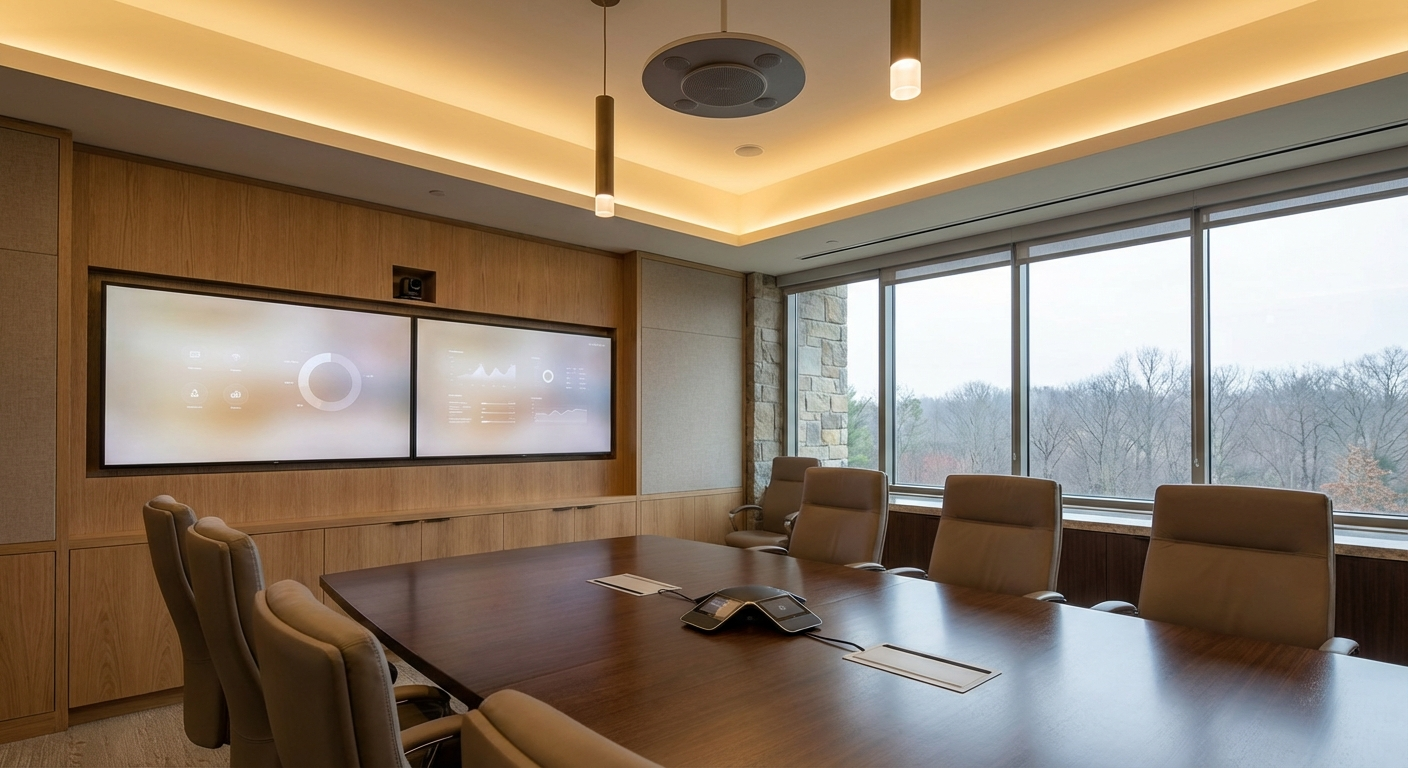
A premium boardroom rarely fails on installation day.
It fails two days later.
The integrator has already left. The room passed its acceptance check. The displays looked perfect. Audio was clean. The executive team signed off because everything worked in a controlled environment, with the right people in the room and the right settings in place.
Then a firmware update lands. A user changes a camera setting. A network policy shifts. A peripheral drops offline. Suddenly the CEO’s board presentation freezes, the audio cuts out during an investor call, or a public meeting starts without a working recording path.
That is the real risk in enterprise AV.
Not whether you bought the wrong box. Whether you have a plan for Day 2.
For Virginia enterprises, health systems, and government agencies, this is the difference between a beautiful installation and a dependable business asset. Managed AV services are what protect the investment after the ribbon-cutting is over.
Installation Day Is a Controlled Event. Day 2 Is Operations.
Most six-figure AV environments are designed carefully and commissioned professionally. That is not the problem.
The problem is that real-world rooms do not stay frozen at the moment they were installed.
After go-live, systems start interacting with the messy realities of production environments:
- Collaboration platforms update on their own schedules
- Firmware versions drift across room devices and peripherals
- End users change settings without realizing downstream effects
- Network and security teams make policy changes that affect room connectivity
- Usage patterns reveal weak points that were not obvious during commissioning
This is why so many organizations experience the same frustrating pattern: the room worked yesterday, so nobody budgeted for what it would take to keep it working tomorrow.
That mindset turns a strategic AV investment into a recurring emergency.
Break-Fix Support Is Not the Same as Managed AV Services
Many organizations think they have support because they can call someone when something breaks.
That is break-fix support.
Break-fix support is reactive. It starts after the disruption has already happened. It is useful, but it is not a protection strategy.
Managed AV services are different. A true managed-services program is designed to reduce the chance of disruption in the first place and shorten the blast radius when something does go wrong.
A proactive managed AV program typically includes:
- Remote monitoring of room systems and peripherals
- Automated alerts when devices go offline or fall out of compliance
- Firmware and software tracking across the environment
- Incident triage and remote remediation
- SLA-backed response and escalation paths
- Reporting on uptime, usage, recurring issues, and lifecycle risks
- Planned maintenance and refresh recommendations
In plain terms, break-fix waits for the phone to ring. Managed service is built to keep the phone from ringing as often.
What Proactive AV Monitoring Actually Looks Like
“Remote monitoring” can sound vague until you define it.
In a well-run managed AV environment, support teams are not waiting for an executive assistant to report that the boardroom is down. They are watching the health of the room ecosystem before the next critical meeting starts.
That can include:
Device health dashboards
A support team can see whether displays, cameras, microphones, control processors, compute devices, and collaboration endpoints are online and healthy.
Offline device alerts
If a codec, controller, DSP, or room PC drops offline, the system flags it before the next important meeting is underway.
Firmware and version tracking
Mixed device fleets drift over time. Managed monitoring helps identify which rooms are running outdated firmware, which endpoints missed an update, and which version mismatches are creating risk.
Room utilization and anomaly visibility
If a room that is usually busy suddenly shows repeated failed starts, poor peripheral availability, or odd usage behavior, that can signal an issue before a user opens a ticket.
Trend reporting
Patterns matter. If the same room is generating repeat incidents, the issue may not be user error. It may be a failing component, unstable network path, or aging device that should be replaced proactively.
This is where managed AV starts looking less like help desk support and more like operational infrastructure.
Microsoft Has Already Set the Baseline
The market itself is moving in this direction.
Microsoft describes Teams Rooms Pro Management as a cloud-based management service that proactively monitors and updates Microsoft Teams Rooms devices and peripherals. Microsoft also frames the platform around intelligent operations that automate updates, issue detection, and issue resolution. That matters because it signals a shift in buyer expectations: proactive room operations are no longer a luxury feature.
Teams Rooms Pro Management is especially useful because it supports automated maintenance workflows and issue remediation during scheduled maintenance windows. In other words, one of the world’s largest collaboration platforms is explicitly treating preventative room operations as a built-in requirement.
That does not eliminate the need for an integrator. It clarifies what a good integrator should add.
A managed-services partner such as VIcom can extend that baseline in ways the platform alone cannot:
- Support for the full room, not just the Teams application layer
- Visibility across displays, audio, control, networking, and third-party peripherals
- Coordination between AV, UC, IT, and facilities stakeholders
- Local on-site response when remote remediation is not enough
- Lifecycle planning tied to real room usage and business priorities
The platform can tell you a Teams Rooms endpoint needs attention. A strong managed-services partner makes sure the entire meeting environment stays dependable.
The SLA Numbers That Actually Matter
If an integrator says they offer managed support, the next question should be simple: what, exactly, are they committing to?
This is where many buyers need more specificity.
A useful AV service-level agreement should define at least five things:
1. Response time
How quickly does the support team acknowledge a critical incident? For a boardroom, public meeting space, or executive collaboration environment, hours can matter. So can minutes.
2. Resolution path
Is the expectation remote triage only, or is there a defined process for escalation, vendor coordination, and field dispatch when the issue cannot be solved remotely?
3. Uptime target
The difference between 99.5% uptime and 99.9% uptime sounds small until you do the math.
- 99.5% uptime allows roughly 43.8 hours of downtime per year
- 99.9% uptime allows roughly 8.8 hours of downtime per year
That is a difference of about 35 hours annually.
If those hours hit during quarterly board meetings, investor calls, telehealth sessions, or public hearings, the business impact is not theoretical.
4. On-site dispatch window
When remote support fails, how quickly can a qualified technician get on-site? This is where local footprint matters.
5. Escalation ownership
Who owns the problem if the root cause touches multiple domains such as networking, platform licensing, room hardware, and user workflow? The best managed partners do not point fingers between vendors. They quarterback the outcome.
For Virginia organizations, local response is not a minor detail. It is often the difference between same-day recovery and an extended outage that affects leadership, staff, and public stakeholders.
Lifecycle Management Is Where the ROI Shows Up
Many AV buying decisions still focus too heavily on procurement and too lightly on the five years that follow.
That is backward.
The installation is a moment in time. Lifecycle management is where the true return on investment is protected.
A mature lifecycle plan typically includes:
- Expected hardware refresh windows, often in the five-to-seven-year range
- Annual reviews of firmware, software, and platform changes
- Proactive replacement of components showing failure patterns
- Roadmap planning tied to room standards and workplace strategy
- Budgeting guidance that avoids surprise replacement projects
Without lifecycle management, organizations drift into expensive reactive behavior. They replace equipment late, after failures. They patch rooms inconsistently. They let standards erode from one site to the next. Over time, support becomes slower, training gets harder, and user confidence drops.
With lifecycle management, the environment stays predictable. Standards hold. Upgrades become planned events instead of budget shocks.
That is why the “real investment” is not just the room build. It is the operating model that keeps the room reliable over time.
Why AV-as-a-Service Is Resonating With CFOs
The rise of AV-as-a-Service is not just a technical trend. It is a financial one.
Commercial Integrator recently highlighted AVaaS, including remote monitoring, maintenance, and operations, as a major growth opportunity for 2026. That tracks with what financial leaders want: predictable costs, bundled accountability, and less risk tied to surprise failures.
Instead of treating AV as a one-time capital purchase followed by a vague support plan, AVaaS packages hardware, deployment, and managed support into a more predictable operating model.
For CFOs, that can create several advantages:
- Smoother shift from CapEx spikes to planned OpEx
- Clearer total cost of ownership over a multi-year term
- Fewer emergency service events and unplanned replacement costs
- Bundled accountability instead of fragmented vendors
- Easier refresh planning because support and lifecycle are already built in
Not every organization will choose a subscription model. But the reason AVaaS keeps gaining traction is clear: it better reflects how modern collaboration environments behave. They are living systems, not static installations.
Why This Matters Even More for Virginia Enterprises and Agencies
In some settings, an AV failure is embarrassing.
In others, it is operationally and politically expensive.
A failed room during a board meeting can delay decisions and erode executive trust. A failed telehealth environment can disrupt patient-facing workflows. A failed public-meeting system can create compliance, transparency, and reputational problems.
That is why managed AV support is increasingly a governance issue, not just a convenience line item.
Virginia organizations also need to think about geography. If your rooms span Richmond, Hampton Roads, and Northern Virginia, support quality depends on whether your partner can respond locally when remote recovery is not enough.
This is where VIcom’s model matters. The company’s local Virginia technician footprint gives clients a path to rapid on-site response, while its broader AV, UC, IT, and networking experience supports more accurate root-cause resolution. VIcom’s ESOP ownership structure also reinforces a service mindset that is tied to long-term client retention, not just the initial sale.
That alignment matters when the real buying question is not “Who can install this room?” but “Who will still own the outcome after go-live?”
The Smarter Way to Evaluate an AV Partner
If you are planning a new boardroom, command center, collaboration rollout, or room refresh, do not stop at design and equipment.
Ask the Day 2 questions early:
- How will this environment be monitored after deployment?
- What issues can be identified before users notice them?
- What SLA commitments back the service model?
- How fast can qualified support respond remotely and on-site?
- What is the lifecycle plan for updates, replacement, and standardization?
- Is there an AVaaS option that aligns better with budget and risk tolerance?
Those questions do more than improve support. They protect the investment itself.
A six-figure boardroom should not become a fragile asset the moment the install team leaves. It should become dependable business infrastructure with a clear operating model behind it.
That is what managed AV services deliver.
And in 2026, that is the real investment.
If you are planning how to protect boardroom uptime, reduce support risk, or build a more predictable lifecycle strategy for your AV environment, connect with VIcom by filling out the form below.