
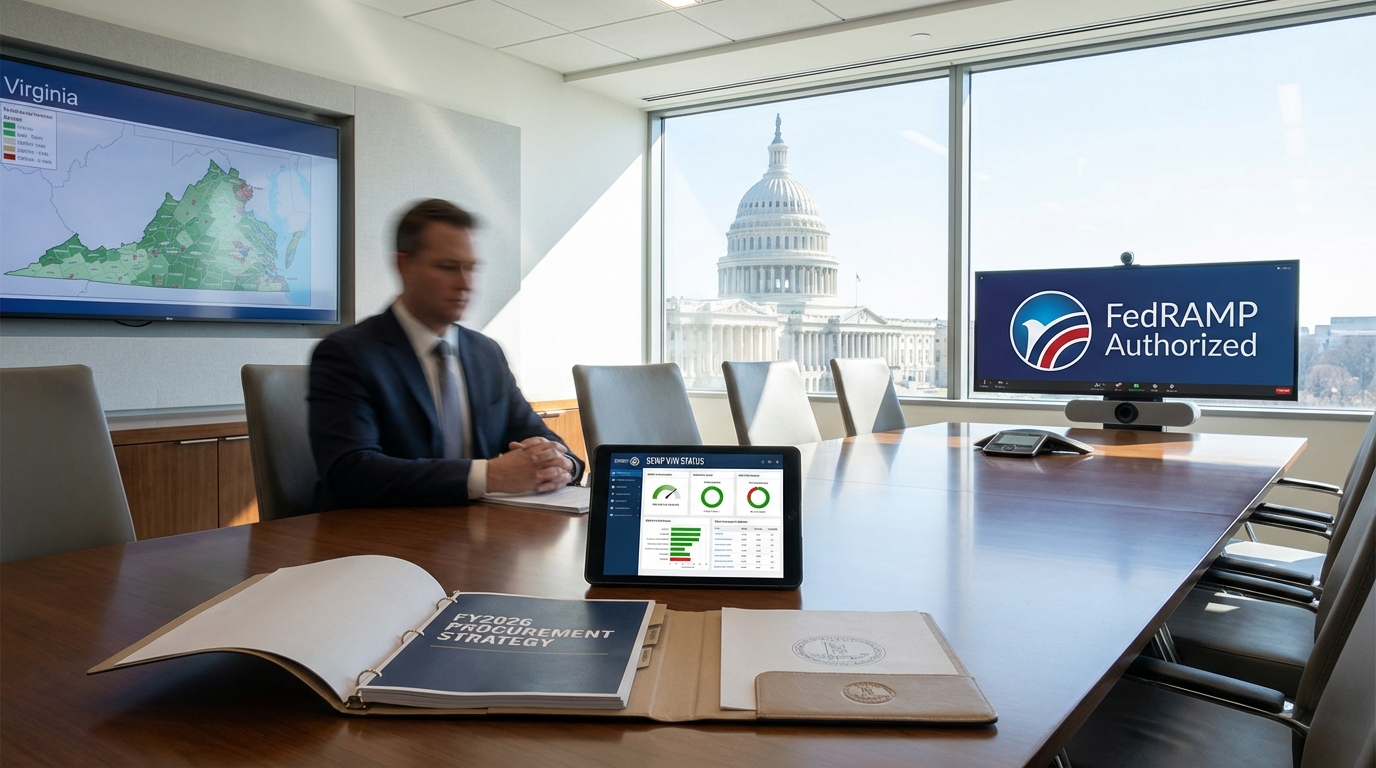
Federal AV procurement moved into a period of genuine uncertainty in early 2026 — NASA’s SEWP V contract was extended through April 30, 2026 while SEWP VI remained under review, and budget scrutiny across federal agencies created pressure on technology spending that many Virginia-area federal facilities are navigating in real time. For Virginia state and local government buyers, knowing which procurement vehicles are active, which certifications matter, and which local vendors hold the right qualifications isn’t a minor administrative detail — it determines whether a project gets funded, approved, and completed on time.
The Federal Procurement Landscape Right Now
SEWP V — NASA’s Solutions for Enterprise-Wide Procurement contract — covers IT products and services including AV systems. The contract was extended through April 30, 2026 while SEWP VI procurement proceeds. Organizations with active SEWP V task orders should monitor the transition timeline carefully; procurement scheduled for late 2026 should factor in whether SEWP VI will be the vehicle.
SEWP VI remains in development, with the procurement process expected to modernize the contract structure and potentially expand eligible vendors. For Virginia-area organizations planning major AV investments for delivery after mid-2026, SEWP VI timeline tracking is a planning responsibility, not an IT afterthought.
GSA Schedule (Multiple Award Schedule) remains the most stable federal procurement vehicle for AV integration services. The relevant Special Item Numbers cover IT products and professional services. GSA Schedule procurement is active and well-understood by contracting officers — for organizations uncomfortable with the SEWP V/VI transition uncertainty, GSA Schedule provides a reliable alternative.
FY2026 NDAA authorized $900.6 billion including $145.7 billion for R&D, confirming that defense spending in the Hampton Roads area — home to one of the largest concentrations of military and federal facilities in the country — remains substantial. Budget pressure exists, but it’s primarily expressed as scrutiny of spending justification, not as across-the-board cuts to mission-critical technology.
Why SWAM Certification Matters for Virginia State and Local Projects
Virginia’s SWAM (Small, Women-owned, and Minority-owned Business) certification creates preference in state and local government procurement. For state agencies, institutions of higher education, and local government entities conducting competitive procurements, SWAM-certified vendors receive evaluation preference that can be decisive in a close competition.
VIcom holds SWAM certification. Combined with DCJS license #11-6695 (required for security system installation in Virginia), VIcom is positioned to bid on integrated AV and security projects for Virginia government clients as a prime contractor — not a subcontractor to a larger national integrator.
This distinction matters more than it might appear. National integrators frequently win Virginia government contracts and then subcontract the local delivery work to regional firms. The result is that the organization with the government relationship and the SWAM certification benefit is not necessarily the organization that shows up to do the work. Specifying a SWAM-certified prime contractor for AV integration projects ensures the procurement benefit and the delivery accountability sit in the same organization.
VIcom’s documented government project history reinforces the delivery capability: City of Norfolk, Newport News Police Department Mobile Command Post, HRSD, Virginia Beach. These aren’t portfolio references — they’re systems that have to work reliably in public-facing and operational contexts.
FedRAMP-Authorized Collaboration Platforms: What Government Buyers Must Specify
Platform selection for government meeting rooms is not a preference decision — it is a compliance requirement. Video collaboration platforms handling government meetings must be FedRAMP-authorized. Using a non-FedRAMP platform for government collaboration is not a minor policy gap; it’s a security control failure.
Microsoft Teams GCC (Government Community Cloud): FedRAMP Authorized, appropriate for most state and local government needs. The GCC environment is physically separated from commercial Microsoft infrastructure and meets the security requirements for most state government information.
Microsoft Teams GCC-High: FedRAMP High Authorized, required for federal agencies handling Controlled Unclassified Information. Hampton Roads area organizations supporting DoD clients or handling export-controlled information should be using GCC-High, not standard Teams or GCC.
Zoom for Government: FedRAMP Authorized, strong choice for government agencies whose users are already familiar with Zoom. Separate infrastructure from commercial Zoom ensures data handling meets government requirements.
Cisco Webex for Government: FedRAMP High Authorized — the highest authorization level available. For federal agencies with the most stringent security requirements, Webex for Government is often the required choice. Cisco’s deep presence in DoD network infrastructure also creates natural integration advantages for defense facility deployments.
Security-Certified AV Hardware: Specify Correctly or Risk Non-Compliance
Government AV hardware carries certification requirements that commercial AV hardware does not. Specifying non-certified hardware for DoD network installations creates a compliance failure that surfaces at inspection or accreditation — not at the design review where it could have been addressed.
Crestron produces NIAP-certified (National Information Assurance Partnership) and FIPS 140-2 validated products for classified and sensitive government environments. Crestron DM NVX encoders and decoders for specific government configurations meet classified network requirements. For unclassified DoD networks, Crestron products appear on the DoDIN Approved Products List.
Extron maintains DoDIN APL listings and JITC (Joint Interoperability Test Command) certification for their government-targeted products, including the Extron NAV AVoIP platform. JITC certification is the hardware compliance standard for DoD network connections — AV equipment connected to DoD networks that isn’t JITC-certified is non-compliant regardless of its technical capabilities.
Logitech produces TAA (Trade Agreements Act) and NDAA Section 889-compliant devices for federal procurement. TAA compliance confirms that the product is manufactured or substantially transformed in a TAA-designated country — a federal procurement requirement. NDAA Section 889 compliance confirms the product contains no prohibited telecommunications equipment components, which is a separate but equally important requirement.
Understanding the difference between TAA and NDAA compliance, and between DoDIN APL and JITC certification, is part of the specialized knowledge that separates government AV integrators from general commercial AV integrators. Procurement officers who specify “government-compliant AV hardware” without specifying which compliance regime are leaving the compliance verification work to the integrator — and to the accreditation inspector.
Council Chambers and Command Centers: The Transparency Imperative
Virginia’s FOIA requirements and broader public sector transparency expectations have created a specific AV requirement for government facilities: public meetings must be recorded and made accessible. Modern council chamber AV technology addresses this directly.
City council chambers, board of supervisors rooms, planning commission spaces, and school board meeting rooms all require integrated recording, livestreaming to public-facing platforms, and searchable archives of meeting recordings. This is not a technology capability add-on — it is a transparency infrastructure requirement. The technology exists (cloud recording platforms, automated livestream integration, searchable video archives) and is routinely deployed by VIcom for local government clients including the City of Norfolk.
Command center and emergency operations center deployments carry different requirements: multi-display video walls with flexible input routing for situational awareness, redundant display paths for mission-critical monitoring, and physical security requirements for the spaces themselves. Newport News Police Department’s Mobile Command Post deployment is an example of VIcom delivering mission-critical AV in a specialized government context — the requirements bear no resemblance to a corporate conference room project, and the integrator’s experience in that context matters.
Budget Justification Strategies in a Scrutiny Environment
Federal and state budget scrutiny in 2026 requires technology spending to be justified more rigorously than in previous cycles. Two strategies consistently produce approval for government AV projects.
Total cost of ownership over 10 years typically makes a stronger financial case than first-cost comparison. Quality AV infrastructure designed for government environments — with certified hardware, proper network integration, and managed services support — has a demonstrably lower total cost over a decade than lower-cost installations that require more frequent replacement and generate higher support costs. Procurement offices increasingly accept TCO arguments when supported with documented operational cost comparisons.
Technology-as-a-Service financing converts capital expenditure to operating budget — often a more flexible funding source for government agencies operating under capital budget constraints. VIcom’s TaaS offering allows government clients to deploy current technology on an operating expenditure basis, aligning AV technology refresh cycles with the agency’s budget cycles rather than requiring a capital appropriation for each refresh.
VIcom’s government project history, SWAM certification, DCJS license, and familiarity with Virginia procurement vehicles make us a straightforward choice for state and local government AV projects. We’d love to get started working with you today!