
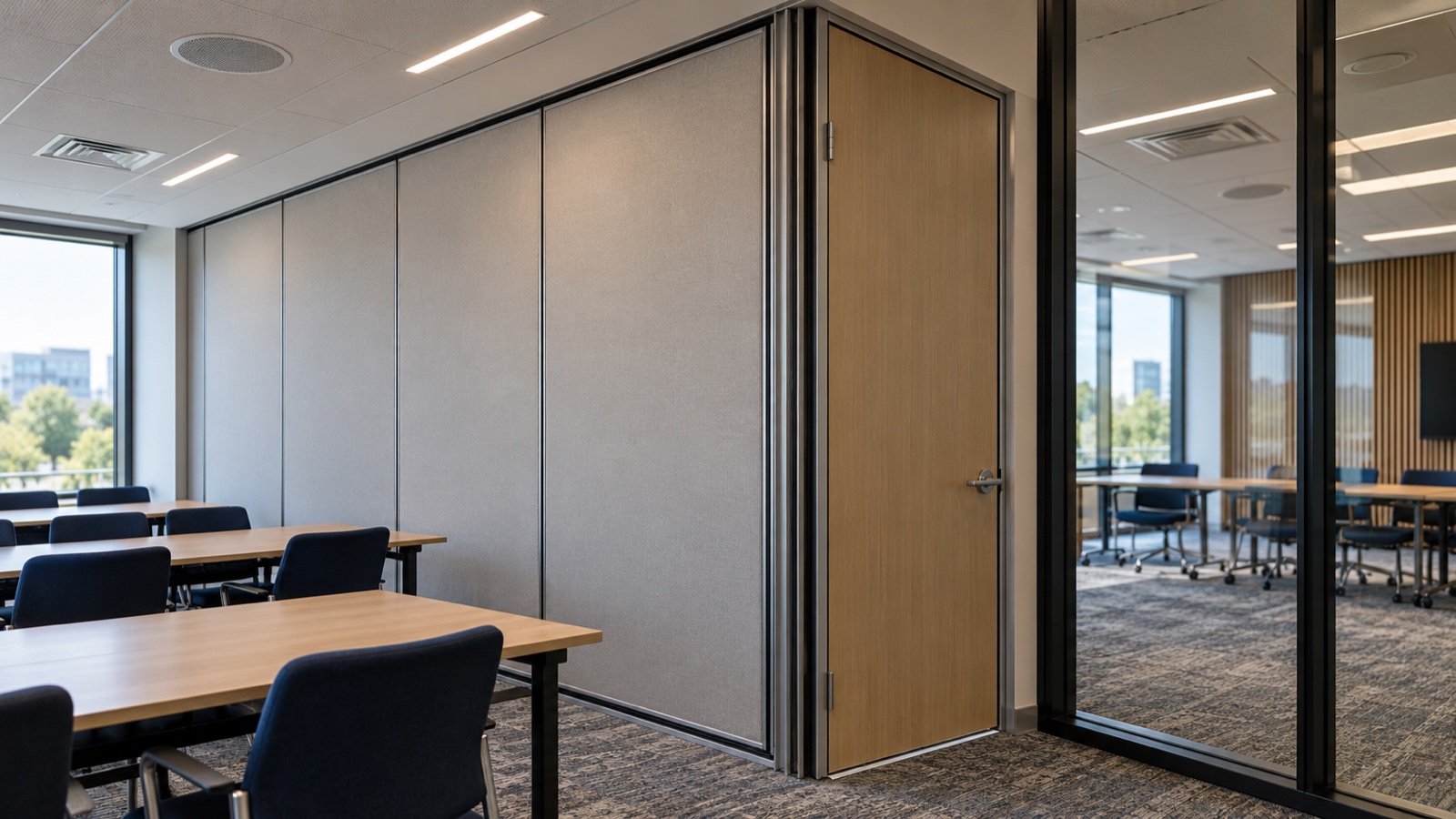
Two meetings start on opposite sides of a closed partition. A few minutes later, someone asks why they can hear the other presenter. Facilities suspects the microphones. IT suspects the partition. Each team can spend time adjusting its own system while the complaint continues.
Sound leaking between divisible meeting rooms needs a shared investigation. First establish whether the neighboring room’s speakers are reproducing unwanted audio, whether speech travels directly through the building, or whether both paths are present. That finding determines who should investigate next and what a proposed remedy needs to accomplish.
Start with a controlled, ordinary conversation
Arrange an approved walkthrough with AV and facilities staff. Reserve both rooms, tell the occupants what will happen and use a neutral script. Keep confidential discussions out of the exercise. Choose a speaking level representative of the meetings people hold there, and record the positions of the talker and listener.
Confirm that the partition is fully deployed according to its normal operating instructions. Record the room mode shown on the controls, door positions, HVAC operation and any existing masking. Have authorized staff operate the systems. Avoid changing several settings at once, since that makes the result harder to interpret.
The earlier VIcom divisible-room changeover guide covers operational room modes. For this investigation, concentrate on the path by which the listener receives the unwanted speech. A correct divided-room control state can coexist with a physical transmission problem.
Follow the electronic path first
Have the AV team check whether sound emerges from the receiving room’s loudspeakers. Under the approved test plan, compare the result with that room’s relevant reproduced audio muted. Preserve required announcements and other protected functions. Do not disconnect unfamiliar circuits or disable systems whose purpose is unclear.
If the unwanted speech disappears with the relevant speaker output muted, the team has evidence to investigate electronic routing. Review divided and combined presets, conferencing connections, source assignments and any automation that changes the mode. A single routing error can affect several outputs, so test the expected behavior in both rooms.
If speech remains audible directly in the space, add a building-path investigation. Some installations have both problems. Correcting an electronic route can expose a quieter physical leak that was difficult to distinguish earlier.
- Speech reproduced by receiving-room speakers: assign the electronic route to the AV team and retest after correction.
- Speech audible directly with the relevant reproduced audio muted: assign a facilities investigation, with an acoustical specialist where needed.
- Both paths observed, or the result remains uncertain: keep both investigations open and record the uncertainty.
Mark where the listener hears it
Use a simple floor plan to record observations at occupied seats, near the door, along the partition edges and in the corridor. Keep the talker’s position and script consistent while the listener moves. Note whether the listener hears indistinct sound, recognizes occasional words or can follow connected speech. Those are different observations.
Ask facilities to inspect the partition’s condition and operation, including seals and interfaces, using the manufacturer’s approved procedures. Ask about possible flanking routes through adjacent construction, shared ceiling spaces or HVAC paths. A clear observation near a grille can guide an investigation, but it does not establish the complete route by itself.
Leave ceiling access, ductwork changes and work on rated assemblies to the appropriate specialists. A casual repair can affect ventilation, fire protection or the partition’s operation. The walkthrough should produce an evidence record and work assignments before anyone alters construction.
Separate absorption, isolation and masking
Absorptive finishes can reduce reflected sound inside a room. Isolation measures address sound passing between spaces. Masking adds a designed background sound in an appropriate receiving area to reduce the intelligibility of other speech. These approaches have different jobs, and a project may need more than one.
Biamp’s Sound Masking 101 explains the absorb, block and cover framework. It is vendor guidance for understanding the options. It does not establish a privacy outcome for your divided rooms.
A microphone or DSP adjustment changes the electronic system. It cannot seal a gap in the building. Likewise, a new wall panel may change reverberation without addressing the path through which speech reaches the next room. Ask the person proposing a remedy to connect it to the observed path and define how its effect will be checked.
Masking requires its own design review. Biamp’s Qt X design considerations treat conference and training rooms carefully because their normal purpose is clear communication. Avoid assuming that adding background sound inside both rooms will solve the complaint. Review receiving areas, room uses and interactions with conferencing audio before choosing a design.
Use a joint facilities and AV evidence sheet
| Field | Record during the walkthrough |
|---|---|
| Operating condition | Partition and door positions, selected room mode, HVAC, occupancy and existing masking state. |
| Talker and material | Location, representative voice level and neutral script or approved test source. |
| Listener location | Mark each seat, partition edge, door or corridor observation on the plan. |
| Electronic check | Relevant output state, authorized change, what disappeared and what remained audible. |
| Finding | Electronic route, suspected building path, both, or unresolved; describe intelligibility. |
| Next action | Responsible AV, facilities or specialist owner; approved work scope and due date. |
| Verification | Agreed criteria, repeat conditions, observed result, limitations and approver. |
For a hypothetical example, listeners might hear speech from a ceiling speaker until AV corrects the divided-room preset, then still understand words near the connecting door. The work record should retain the door investigation. Marking the entire complaint resolved after the routing correction would miss the remaining path.
Retest the rooms as people use them
Repeat the agreed checks after corrective work. Include realistic speaking locations, normal HVAC conditions and representative adjacent occupancy. Test relevant divided and combined modes, and confirm that changes preserve intended presentation and conferencing behavior.
If the intended use requires a defined acoustic or speech-privacy performance, engage the appropriate specialist to establish criteria and measurements. An assembly rating alone cannot describe every installed condition. Keep any remaining limitations in the room’s operating guidance, especially where meeting sensitivity exceeds what the current space supports.
Bring the evidence sheet to a discussion of VIcom sound-masking and AV options, with facilities involved. Confirm the scope of any acoustical or building investigation separately. Identifying the transmission path gives each team a specific problem to evaluate and a result to verify.
Connect with VIcom by filling out the form below.